

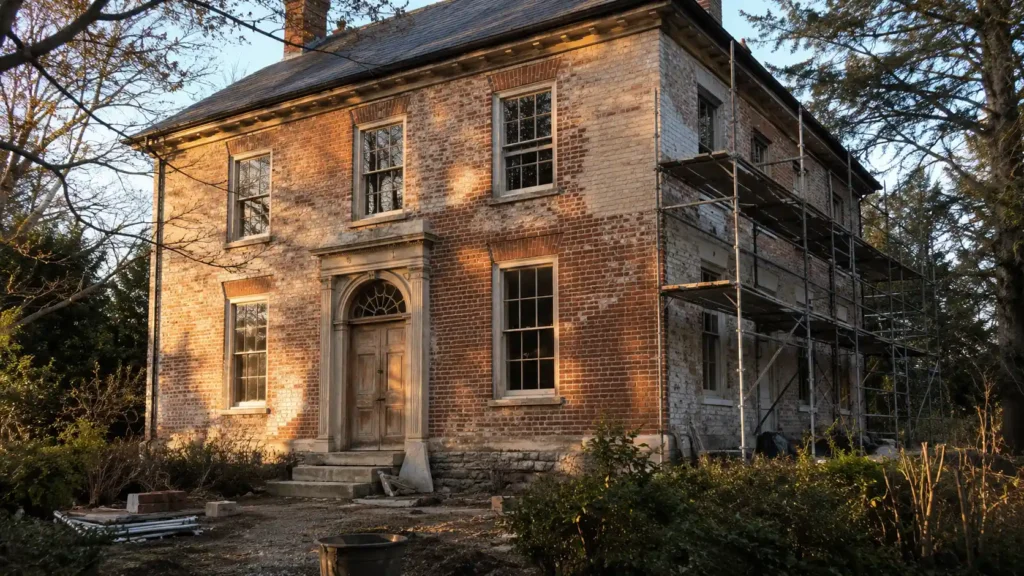
The first time I walked through a house that had been “restored” by the previous owner, I stood in the kitchen for a full minute just staring at the ceiling. Fresh paint, new cabinet hardware, a gleaming faucet. Everything looked touched. Nothing looked fixed. The floor joists underneath were soft enough to press a finger into. The knob-and-tube wiring was still live behind the drywall. The foundation crack in the northeast corner had been caulked over not repaired, caulked and painted the same cream as the rest of the basement. That house had been dressed up, not brought back. There’s a difference, and it costs people tens of thousands of dollars to learn it.
Home restoration is the process of returning a building to a documented earlier state repairing what’s broken, replacing what’s missing, preserving what remains. It is not renovation. It is not remodeling. Renovation updates. Restoration recovers. The distinction sounds academic until you’re standing in front of a Historic Preservation Board trying to explain why you replaced original sash windows with vinyl.
The Structural Work Nobody Wants to Talk About First
Every honest restoration professional will tell you the same thing: start outside, work in, and don’t touch the finishes until the bones are right. It sounds obvious. It rarely happens.
Structural restoration covers the parts of a house that hold everything else up foundation, framing, roof structure, sill plates, load-bearing walls, floor joists. These don’t photograph well. They don’t show up in the before-and-after post. But skip them and you will spend money twice, sometimes three times, on work that gets undone when the structural instability finally forces its way to the surface.
Foundation repair is where residential restoration budgets first encounter reality. Minor crack sealing and drainage improvement on a stable slab sits at the accessible end a few thousand dollars, a week of work. Foundation underpinning using helical piers or steel piers, which stabilize and potentially lift a settling foundation, runs $10,000 to $15,000. Severely bowing basement walls needing anchoring systems run $4,000 to $12,000. Total foundation replacement the option nobody wants to hear about costs $20,000 to $100,000 or more depending on home size and foundation type. These are not estimates to argue with. They reflect what structural stabilization actually costs when the damage has been left long enough to compound.
Framing restoration and roof structure assessment come next. A floor that feels slightly springy might have floor joists with three inches of rot at the bearing point. The roof sheathing looks intact from the attic until you find the corner where water has been wicking in through failed flashing for six winters. Timber frame homes carry their own category of complications mortise and tenon joints that have shifted, tie beams that have split along the grain, peg connections that need skilled hands to assess. Get these inspected separately, documented, and addressed before a single piece of interior finish work begins. The building envelope roofing, siding, windows, doors must be watertight before money spent inside means anything.
Mechanical Systems: The Part That Makes a Period Home Livable
Old houses were not built for modern electrical loads, modern plumbing pressure, or modern expectations of thermal comfort. The mechanical systems inside them reflect the era they were installed, not the era you’re living in. Upgrading them is not optional in any restoration project that expects the house to be occupied safely.
Electrical wiring upgrade is almost always a full replacement in period home restoration. Knob-and-tube wiring the cloth-insulated, ungrounded system common in homes built before the 1940s poses a genuine fire risk and cannot be insulated over without creating a heat-trap hazard. Upgrading to a 200-amp service panel is the baseline. Ungrounded outlets throughout need addressing. The work is expensive and invasive, but concealed wiring routed through existing wall cavities by electricians who understand how to work in old structures without gutting them preserves the historic fabric while bringing the system up to code.
Plumbing upgrade and re-piping follows the same logic. Galvanized plumbing pipes corrode from the inside out; the water pressure drops, the water discolors, and eventually the pipe fails. Plumbing rough ins during a restoration ideally happens while walls are already open for other mechanical work it’s a sequencing decision that saves significant labor cost. The same applies to the HVAC system. Mini-split systems have become the preferred solution in historic home restoration because they require no ductwork, meaning they can be installed without cutting into plaster ceilings or removing original millwork. MEP engineers mechanical, electrical, and plumbing are worth bringing in on any project of significant scope. They coordinate what individual trade contractors plan in isolation.
Energy-efficient systems and insulation upgrades need careful handling in period home restoration. Double-glazed windows that replicate original profiles exist and perform well. Insulation installed in wall cavities must allow moisture to move breathable masonry paint and lime-based stucco on exterior masonry walls exist for exactly this reason. Trap moisture behind an impermeable coating on a brick wall built before 1920 and the thermal upgrade period you paid for becomes a damp-proofing old house crisis within a decade.
Materials, Authenticity, and the Sourcing Problem Most Guides Skip
Period correct materials are not always available off a shelf. This is where restoration projects slow down, where budgets stretch, and where shortcuts start to look tempting. They shouldn’t.
Lime plaster restoration requires plasterers who still work in the traditional method scratch coat, brown coat, finish coat, each allowed to cure before the next is applied. The craft is uncommon enough that finding a plaster specialist in most markets takes time. Millwork replication matching original crown molding profiles, door casings, window surrounds requires a millwork fabricator who can run custom profiles, not a lumberyard pulling stock trim. Salvaged timber restoration for structural repair uses wood with grain density that modern-growth lumber cannot match. These are not aesthetic preferences. In many cases, building codes and heritage compliance require materials that match the original in composition, not just appearance.
Matching brickwork for masonry restoration is a sourcing exercise before it is a craft exercise. Antique brick from the right period and region has a specific color variation, texture, and size that modern brick does not replicate convincingly. Stone restoration, chimney restoration, stained glass panel repair, and pocket door restoration all sit in the same category work that requires specialists, not generalists, and materials that require lead time.
Hardwood floors, wood paneling, cabinetry restoration interior finishes belong at the end of the sequence. Plaster repair, ceiling restoration, molding restoration, and replica fixture replacement after the structural and mechanical work is complete, not before. Putting new flooring over a floor that hasn’t had its structural problems addressed is one of the most expensive sequencing mistakes in residential restoration. The floor comes back out. The repair gets done anyway. And you pay twice.
What a Restoration Actually Costs — Unfiltered
Full house restoration runs $50,000 to $200,000 for most projects. Historic home restoration with specialized labor and period-correct materials pushes the upper range further. Renovating an old house on a per-square-foot basis costs $15 to $60 for moderate scope work, more when structural damage, lead paint removal, asbestos removal, or full systems replacements are involved.
Budget management on a restoration project requires a contingency fund of 10 to 20 percent of total project cost. Not as a suggestion. As a rule. Restoration projects find surprises hidden damage behind plaster, galvanized plumbing pipes that look intact until disturbed, floor joists with rot at the ends that only reveals itself once the floor covering is removed. The experts’ rule of thumb: work out what you’ll need and add 20 percent. Phased project cost management sequencing work so that critical structural and systems work is funded first, cosmetic restoration funded in later phases is how most homeowners get large-scale historic home rehabilitation done without stopping halfway through.
Labor costs account for approximately 65 percent of a typical restoration budget. Material costs make up the remaining 35 percent. Skilled labor rates for a preservation architect, restoration carpenter, masonry expert, and plaster specialist are higher than general contracting rates. This is not negotiable on a project where the workmanship is the point.
Financing options worth knowing: the FHA 203(k) loan bundles purchase price and renovation loan into a single mortgage. State preservation programs and local preservation programs offer low-interest financing for qualifying properties. Historic preservation grant funding through state and local bodies, and renovation-related tax breaks for properties on the historic register listing, reduce net project cost significantly for those who qualify. The National Park Service criteria determine what qualifies as a historic property. Engage a preservation consulting professional early before project scope is set so that financing and grant funding can inform the restoration plan, not chase it.
The Professionals Who Make or Break a Restoration
A general contractor who builds new construction is not a restoration contractor. The skill sets overlap in project management and trade coordination. They diverge in almost everything else. A heritage contractor who understands historic fabric, building sequencing in old structures, and the tolerance required when working around original features that cannot be replaced is a different professional. So is a preservation architect, who navigates landmark preservation committee submissions, Historic Preservation Board reviews, and heritage compliance requirements that most general contractors have never encountered.
The building inspection phase deserves its own team. A structural engineer assessing the foundation, roof structure, and load-bearing elements. A licensed electrician familiar with historic rewiring. A licensed plumber experienced with re-piping in occupied period structures. A separate condition assessment for the building envelope roofing, flashing, window restoration, door restoration, facade restoration. The damage inspection report that comes from this process becomes the restoration plan. Skip it and the project scope is a guess.
Curb Appeal, Property Value, and the Case for Doing It Right
Property restoration done properly produces outcomes that cosmetic renovation cannot. Structural integrity, authentic original character, period-appropriate finishes, functional mechanical systems these translate into resale value that outlasts market cycles. Property value for a properly restored historic home reflects not just square footage and location but the irreplaceable features inside it.
Curb appeal on a restored period home is not manufactured. It is recovered. Facade restoration, siding restoration, brick repointing, exterior paint in period-correct colors, window restoration that preserves original profiles these produce a first impression buyers cannot assign a number to, and then do anyway. Landscaping improvement, lawn care, shrubs and trees placed with proportion to the architecture, garage door replacement where appropriate the exterior is the argument the house makes before anyone walks through the door.
ROI home improvement logic applies differently to restoration than to renovation. Return on investment on a garage door replacement runs around 194 percent by some measures. Landscaping improvement returns 10 to 12 percent in property value. But a full historic home restoration, done with the right sequencing, the right materials, and the right professionals, produces a livable historic property that the market consistently values above comparable unremarkable houses. The building becomes an asset that compounds, not just appreciates.
The people who get that outcome right are almost always the ones who started with the structural work, sequenced the mechanical systems before the finishes, sourced the materials before they needed them, and hired professionals who had done this specific kind of work before. None of that is glamorous. All of it is the job.
Frequently Asked Questions (FAQ’s)
Home restoration focuses on repairing and preserving a property so it closely reflects its original condition, materials, and character. Renovation is broader and may update or modernize a home without preserving its historic details.
Structural problems should come before finishes or cosmetic work. Foundations, framing, roof structure, drainage, windows, and the building envelope need to be stable and watertight before money is spent on flooring, plaster, cabinetry, or paint.
A full home restoration can commonly range from about $50,000 to $200,000, with historic properties often costing more because they require specialist labor and period-correct materials. Keeping an additional 10% to 20% contingency is sensible because hidden structural, plumbing, or electrical problems are common in older houses.
Yes, but the work should be planned to protect as much original building fabric as possible. Experienced electricians, plumbers, and HVAC professionals can often route new systems through existing cavities or use solutions such as mini-splits to reduce unnecessary demolition.
It can be worthwhile when the property has sound potential, valuable original features, and the restoration is properly planned and executed. Structural repairs, reliable mechanical systems, authentic materials, and careful exterior restoration can improve livability, protect the building, and support long-term property value.

8 thoughts on “What Home Restoration Actually Demands And Why Most People Find Out the Hard Way”