

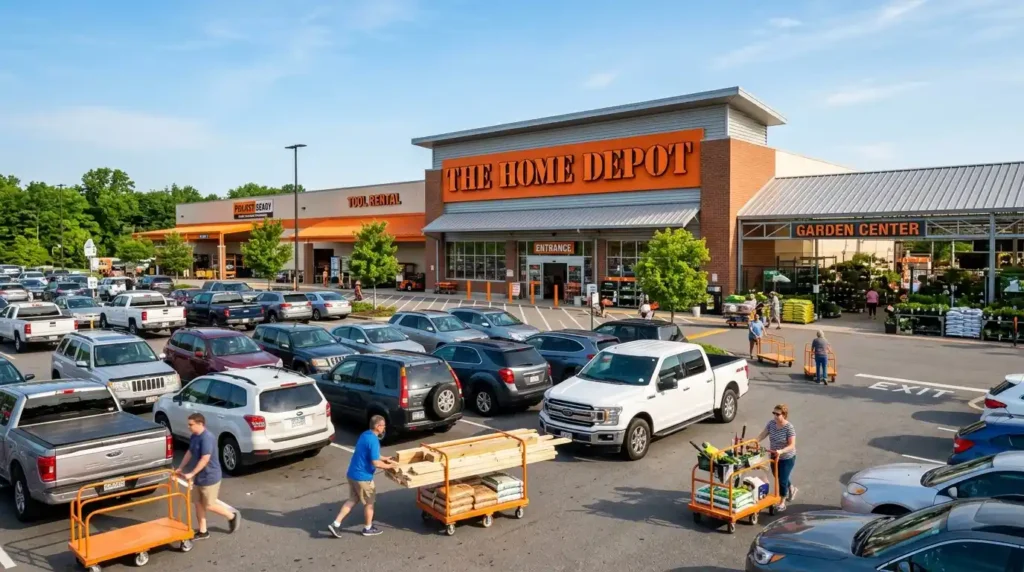
There’s a particular kind of confidence that comes from walking into a Home Depot store on a Saturday morning with a specific project in mind and leaving two hours later with everything you need, a clearer plan than you arrived with, and if you timed it right a workshop under your belt. I’ve been that person more times than I can count. And what’s changed in 2026 isn’t the fundamental utility of the world’s largest home improvement retailer. What’s changed is the depth of what the Home Depot is becoming which is something meaningfully different from the big box hardware store that opened its first location in Atlanta, Georgia more than 40 years ago.
The home improvement store is in active transformation. Three consecutive quarters of sales below expectations, 800 Home Depot jobs eliminated in early 2026, a push away from remote work, and distribution center optimization that reflects a company making hard structural decisions rather than comfortable ones. At the same time, 12 new Home Depot stores are opening across 8 states with 1.6 million square feet of new retail space an expansion move that signals genuine confidence in the physical retail model at a moment when many retailers are reducing their brick-and-mortar footprint rather than extending it.
Magic Apron, Hubspace 2.0 and the AI-Powered Home Improvement Future
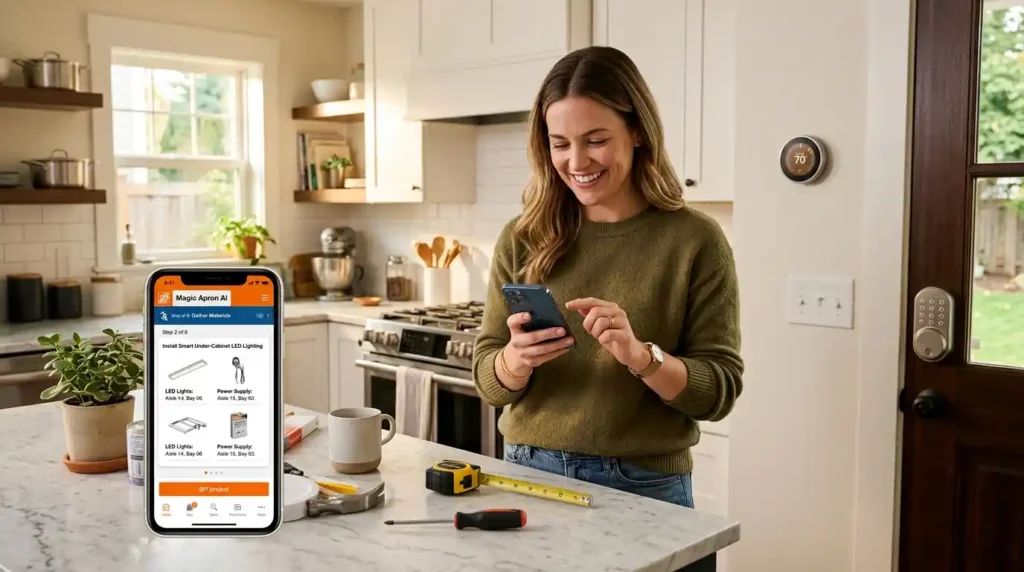
The most consequential shift at the Home Depot in 2026 is not a new product category or a store layout redesign. It is the AI powered home improvement infrastructure being built into both the customer and Pro contractor experience simultaneously. Magic Apron the Home Depot’s AI shopping assistant is the most visible piece of this.
Available through the Home Depot website and app, Magic Apron gives homeowners step by step guidance on completing specific DIY projects, identifies which supplies are needed, and tells you exactly where those products are in your local store. The next version, currently in development, will allow customers to upload pictures of their specific project context and receive tailored guidance which closes the gap between generic DIY project ideas and genuinely personalized home improvement project guidance.
AI-Powered Tool
For professional contractors, the AI-powered tool that deserves serious attention is the blueprint takeoffs system. This tool uses advanced AI and proprietary algorithms to analyze construction plans and generate material estimates with speed and accuracy that traditional manual estimation simply cannot match.
A contractor who previously spent a full day generating a detailed material estimate for a mid scale renovation project can now compress that process significantly which means faster quotes, tighter bids, and a competitive advantage that compounds across dozens of jobs per year. The home improvement ecosystem that the Home Depot is building around its Pro customer is not just a loyalty program or a trade discount. It is an operational infrastructure that makes the professional contractor more efficient.
Hubspace 2.0
Hubspace 2.0 is the smart home platform anchoring the consumer technology side of this transformation. Originally focused on smart lighting, Hubspace has expanded to cover smart home devices across outlets, door locks, security systems, fans, thermostats, and outdoor hosting products all controllable through app controlled and voice controlled interfaces.
Following a partnership announcement with Texas Instruments and Kwikset at the 2026 Consumer Electronics Show, Hubspace is now integrating deeper smart lock and smart thermostat functionality into a coherent smart home ecosystem rather than a collection of standalone smart home devices. For homeowners building out a connected home alongside a renovation project, the Home Depot is increasingly the single-source answer for both the building materials and the smart home integration layer above them.
The Pro Segment Strategy That’s Reshaping the Entire Business Model
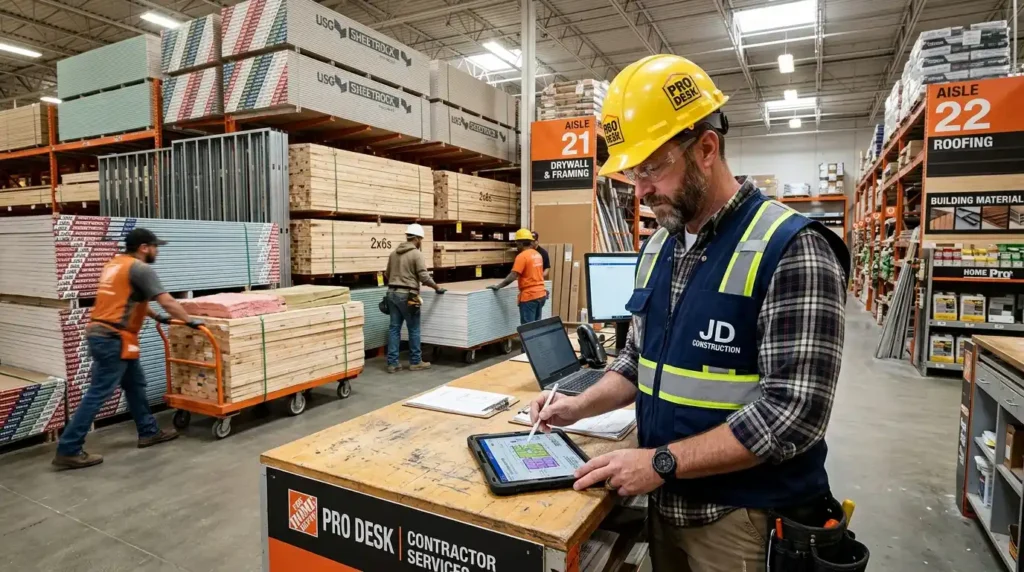
The Home Depot’s relationship with professional contractors the Pro customer cohort is the most important commercial story in home improvement retail in 2026. Pro customers now account for 55% of Home Depot sales versus 45% from the DIY customer cohort. That split is not accidental. It reflects a deliberate, multi-year strategic shift that accelerated dramatically with the $18.3 billion SRS Distribution acquisition completed in June 2024.
SRS Distribution serves roofing contractor supplies, landscaping contractor supplies, and pool contractor supplies through more than 1,250 locations giving the Home Depot a specialty distribution network that reaches professional contractors where they actually source materials, not just where they walk into a retail store.
GMS Acquisition
The $4.3 billion GMS acquisition completed in September 2025 deepens this further. GMS broadens access to drywall supplies, ceiling materials, and framing products the structural elements of construction that professional contractors need in volume and on schedule. Together, SRS and GMS give the Home Depot cross sell pathways between retail and wholesale channels that no purely retail competitor can replicate.
The contractor supply and Pro contractor supply ecosystem is now operating as a parallel business to the consumer facing home improvement store one that carries higher order values, better spending predictability, and more reliable recurring revenue than discretionary DIY purchases.
Mingledorff’s HVAC Supplier Acquisition
The Mingledorff’s HVAC supplier acquisition completed just weeks before this writing adds HVAC supplies and specialist contractor services to this portfolio. The pattern is deliberate: each acquisition targets a specialty trade vertical where professional contractor spending is concentrated, recurring, and volume driven.
Roofing contractor supplies through SRS. Specialty building materials through GMS. HVAC supplies through Mingledorff’s. The Pro Xtra loyalty program, Pro Referral system, and contractor-specific credit services sit above all of this as the commercial relationship layer that turns individual transactions into contractor market capture at scale.
Pro Segment Revenue Strategy
This Pro segment revenue strategy is also what differentiates the Home Depot most sharply from Lowe’s in 2026. Lowe’s generates approximately 30% of its revenue from Pro customers versus Home Depot’s 55% a gap that reflects years of different strategic priorities, though Lowe’s is actively closing it through the $8.8 billion Foundation Building Materials acquisition and the $1.31 billion Artisan Design Group acquisition.
The home improvement competitive landscape in 2026 is not a story of one giant dominating and one struggling. It is two large operators pursuing the same Pro contractor market through different acquisition and integration sequences, against a backdrop of housing market recovery that will benefit both when it arrives.
Store Expansion, Consumer Shifts and What the Numbers Actually Mean
The 12 new Home Depot stores opening in 2026 across the Southern California coast to the Florida peninsula represent the company’s answer to a specific strategic question: where is housing demand concentrated, and how do we shorten the distance between a project’s start and its completion? Moving inventory and expert support closer to the nation’s fastest growing regions is not a defensive move it is an offensive one, timed to the housing starts recovery.
Housing starts improved to 1,487 thousand annualized units in January 2026 from October’s low, and the median age of a US home continues to rise, which drives repair and maintenance spending and renovation spending recovery regardless of transaction volume.
Home Improvement Store Expansion
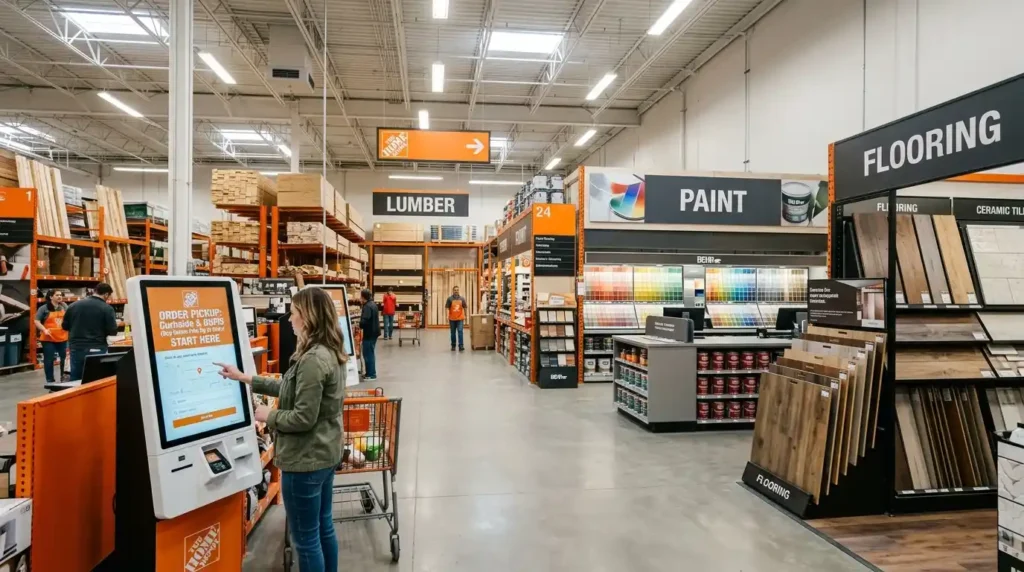
The home improvement store expansion is happening as Home Depot’s omnichannel retail strategy matures. Buy online pick up in store BOPIS curbside pickup, same-day delivery, next-day delivery, and the Home Depot app experience are all components of an omnichannel customer journey that serves both DIY customers doing weekend projects and Pro contractors sourcing materials for active job sites.
The Home Depot online shopping guide, project calculator guide, paint calculator, and square footage calculator are functional tools that drive traffic before the purchase decision, not after. That pre-purchase utility is part of what makes the Home Depot website and app a category destination rather than just a transaction platform.
Wahlburgers Partnership
The Wahlburgers partnership with food trucks from the Wahlberg family restaurant chain positioned outside Home Depot stores starting in Stuart, Vero Beach, and Rockledge, Florida reads as a customer experience innovation rather than a revenue driver. Three food truck locations don’t move the revenue needle at a $165 billion annual revenue company.
What they represent is a willingness to experiment with in-store food service as a customer dwell time and satisfaction lever at a moment when the Home Depot’s customer satisfaction scores increased every quarter in 2025 and associate tenure is the highest it has been since 2017.
Financial Picture Of 2026
The financial picture for 2026 reflects a company in disciplined transition. Home Depot revenue guidance for fiscal 2026 sits at 2.5% to 4.5% growth. Adjusted operating margin guidance is 12.8% to 13%. The current debt ratio sits at 2.6x, with a target of 2.0x before restarting share repurchases a deleveraging strategy that reflects the capital deployment required by the SRS and GMS acquisitions.
The SRS acquisition contributed 3.2% to total sales growth in fiscal 2025, though acquisition amortization is compressing margins in the near term. Free cash flow generation remains the balance sheet strength that analysts consistently cite as a dividend leadership advantage over Lowe’s, which faces margin pressure and a negative shareholders’ equity position from its own aggressive acquisition strategy.
Home Depot’s Corporate Responsibility
Home Depot’s corporate responsibility through the Home Depot Foundation, Eco Actions sustainability program, government customers program, and supplier program round out the institutional footprint of a company that is simultaneously a home improvement retailer, a specialty building materials distributor, a professional contractor ecosystem, and an AI-powered home services platform.
The Home Depot military discount, Home Depot protection plan, Home Depot rebate center, and Home Depot special financing reflect the breadth of a consumer relationship that extends well beyond the transaction at the register. The home improvement giant that opened in Atlanta more than four decades ago has become something considerably more complex and in 2026, that complexity is the point.
Conclusion
The Home Depot in 2026 is not a single thing. It is a DIY store, a Pro contractor ecosystem, a smart home platform, an AI-powered project planning tool, and a specialty building materials distributor operating simultaneously across more than 2,300 locations with 12 more opening this year. For homeowners, it remains the most reliable single destination for home improvement products, project guidance, and installation services.
For professional contractors, the SRS and GMS acquisitions and the blueprint takeoffs AI tool represent a fundamentally more capable partner than any big box retailer has historically been. Whether the housing market recovery arrives in late 2026 or stretches into 2027, the home improvement leader is positioning itself to capture the renovation spending recovery from both ends of the market at once.
Frequently Asked Questions (FAQ’s)
Home Depot is expanding beyond traditional home improvement retail by investing in AI tools, smart home technology, Pro contractor services, and specialty distribution. Its 2026 strategy combines physical store growth with stronger digital and professional contractor support.
Homeowners can use Magic Apron for project guidance, product recommendations, and in-store product location help. Professional contractors can benefit from AI-powered blueprint takeoff tools that speed up material estimating and help produce more accurate project quotes.
Home Depot currently has a stronger Pro-focused business model, with professional customers representing a larger share of sales according to the article. Lowe’s is also expanding in this market, but Home Depot has built a broader contractor supply network through acquisitions such as SRS Distribution and GMS.
Homeowners can combine in-store shopping with online ordering, curbside pickup, delivery, project calculators, smart home products, and DIY guidance. This makes Home Depot useful for planning, purchasing, and completing both small upgrades and larger renovation projects.
The new stores are intended to place inventory, services, and expert support closer to growing housing markets. The expansion also shows that Home Depot still sees physical retail as an important part of its wider omnichannel home improvement strategy.

2 thoughts on “The Home Depot: What’s Actually Changing in 2026 and Why It Matters for Homeowners and Contractors”