

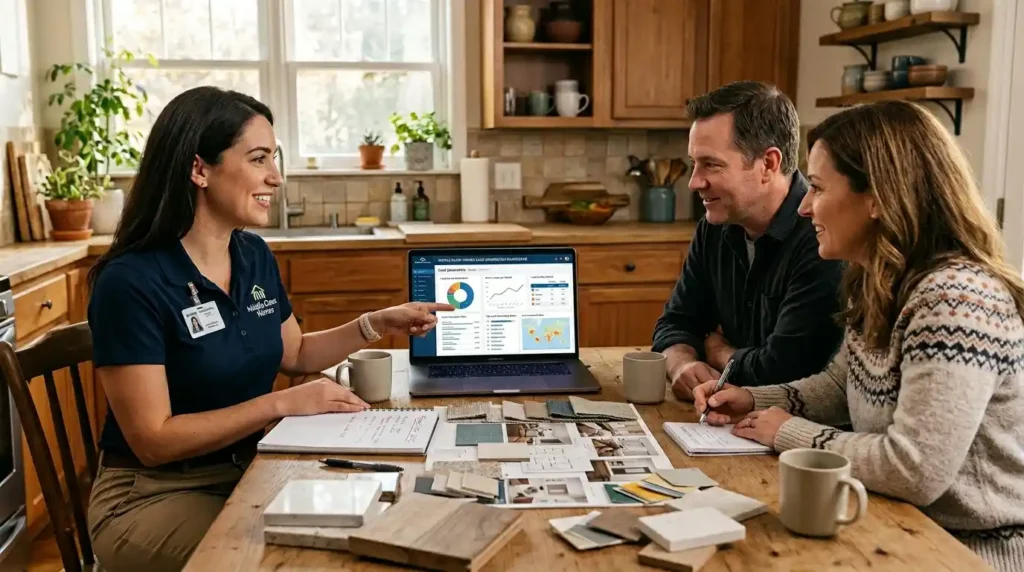
The first time I watched a remodeling business owner spend $1,000 on 30 shared home improvement leads. And close exactly one job. I understood something that most lead generation advice doesn’t say plainly enough. Buying home improvement leads without a system to convert them is not a marketing strategy. It’s a recurring expense that erodes margin and builds dependency on platforms. That have no interest in your long term success. Home improvement spending in the United States exceeds $500 billion annually. The demand exists. The question every contractor, remodeler, builder, and specialty trade operator needs to answer honestly is whether the homeowners. Who need their services can actually find them. And whether the home improvement lead generation strategy they’re using is building. Something they own or something they’re renting month to month.
The home services lead generation landscape in 2026 is less forgiving than it was three years ago. More home improvement lead generation companies are competing for the same homeowner attention, digital ad costs are projected to rise 8% to 12% in top states, and platforms like Angi and Thumbtack are selling the same lead to 3 to 5 contractors simultaneously while charging every one of them for the privilege. The average home services platform lead cost has reached $91 in 2026. For a contractor running 5 to 10 leads per day, that’s $450 to $900 in daily lead acquisition cost $13,500 to $27,000 per month before a single project is booked. That math works only when close rates are strong, average job value is high, and the follow-up system is fast enough to reach homeowners before the three other contractors who received the same shared lead.
Exclusive Leads vs Shared Leads: The Decision That Changes Everything About Your Pipeline
The distinction between exclusive home improvement leads and shared home improvement leads is the most consequential decision in any contractor lead generation strategy, and it’s where most home improvement lead generation advice glosses over the real operational implications. A shared lead costs $20 to $75 from a lead marketplace, gets delivered to multiple contractors simultaneously, and typically results in a phone call from a homeowner who has already heard from two or three other businesses.
Seventy percent of Angi leads don’t answer or aren’t qualified, according to contractor reviews on Trustpilot. At $25 to $120 per lead from Angi and $10 to $75 per lead from Thumbtack, the math of shared lead generation deteriorates quickly when close rates are factored in rather than raw lead volume.
Exclusive Home Improvement Leads
Exclusive home improvement leads cost $100 to $300 per submission your team is the only one contacting that homeowner. In major metropolitan markets including California, New York, Florida, and Texas, exclusive roofing and remodeling leads can exceed $200, with lead costs running 20% to 50% above national norms due to urban density and high labor and material costs. The return, however, is fundamentally different. Exclusive leads deliver better lead quality, reduce wasted calls, eliminate price competition pressure, and consistently produce stronger buyer intent than anonymous shared leads from a lead aggregator.
The contractor example that makes this clearest: a kitchen remodeler spending $1,000 per month on 30 shared leads closes one job. The same operator, switching to a premium agency at $3,000 per month for 10 qualified exclusive leads, closes three high-margin custom kitchen projects with signed contracts without heavy discounting. The cost per lead went up. The cost per booked job and the gross profit both went down in the right direction.

Live Transfer Home Improvement Leads
The Live transfer home improvement leads and phone verified home improvement leads represent the highest intent tier of purchased lead products. Live transfer calls connect a qualified homeowner directly to your business in real time, eliminating the response window problem that kills close rates on standard form based leads.
Phone verified leads have been confirmed as genuine before delivery. Both cost more than standard pay per lead products and both consistently outperform them on cost per booked job the metric that actually matters, not cost per lead in isolation.
Building Owned Home Improvement Lead Generation That Doesn’t Disappear When You Stop Paying
The most effective long term home improvement lead generation strategy focuses on owned channels assets your business controls, builds equity in, and doesn’t pay per-inquiry fees on indefinitely. Local SEO for contractors and a well optimized Google Business Profile are the foundation. Together they generate exclusive high-intent home improvement leads from homeowners actively searching for services in your area, without ongoing per-lead fees.
Content marketing and SEO drive inbound leads with a 3 to 6 month ramp-up time but deliver the lowest long-term cost per lead often under $30 once the system is producing consistently.
Google Local Services Ads
Google Local Services Ads are the strongest short term owned-channel investment for most home improvement lead generation for contractors. LSA went from 28% contractor adoption in 2021 to approximately 70% in 2026. The Google Guaranteed badge carries social proof that third party lead platforms cannot replicate, and LSA charges per lead rather than per click, making contractor marketing budget management significantly more predictable.
Google Ads cost per lead for home improvement keywords runs $25 to $110 depending on trade and market. For kitchen and bath terms specifically, expect $8 to $18 CPC and $150 to $400 CPL in competitive markets, with 70% of all home-service search impressions now coming from mobile.

Facebook Ads And Meta Ads
Facebook Ads and Meta Ads deliver CPLs of $30 to $60 for local campaigns and work best for awareness and warm home improvement leads homeowners in the inspiration phase browsing Instagram and Pinterest for design ideas and price ranges before they move into active contractor research.
YouTube project content, before and after photos, project gallery pages, and case study posts serve the same function: they build homeowner intent before the search happens, which means that when the homeowner searches “kitchen remodeling contractor near me” on Google Maps and checks Local Services Ads and top organic results, your business already has credibility in their mind from content they’ve already consumed.
Microsoft Ads
Microsoft Ads serve as a cost-efficient secondary channel in competitive metropolitan markets where Google Ads CPC is highest. Television advertising for contractors shows measurable impact within 2 to 4 weeks and works particularly well for filling calendar gaps in seasonal trades roofing, deck building, landscaping where lead flow has natural Q1 and Q2 peaks and troughs that digital-only strategies don’t smooth effectively.
Lead Response, CRM and the System That Converts Pipeline Into Revenue
The quality of your home improvement lead generation strategy is ultimately limited by the speed and consistency of your follow up system. Lead response time is where most home improvement leads for contractors are lost not at the platform level, not at the cost per lead level, but in the minutes between a form submission and the first contact attempt.
Contacting a lead within minutes rather than waiting hours is one of the strongest indicators of whether a qualified homeowner will schedule an appointment. The homeowner who fills out a contact form at 7:30pm on a Tuesday and hears nothing until 10am Wednesday has already shortlisted a competitor.
Contractor CRM
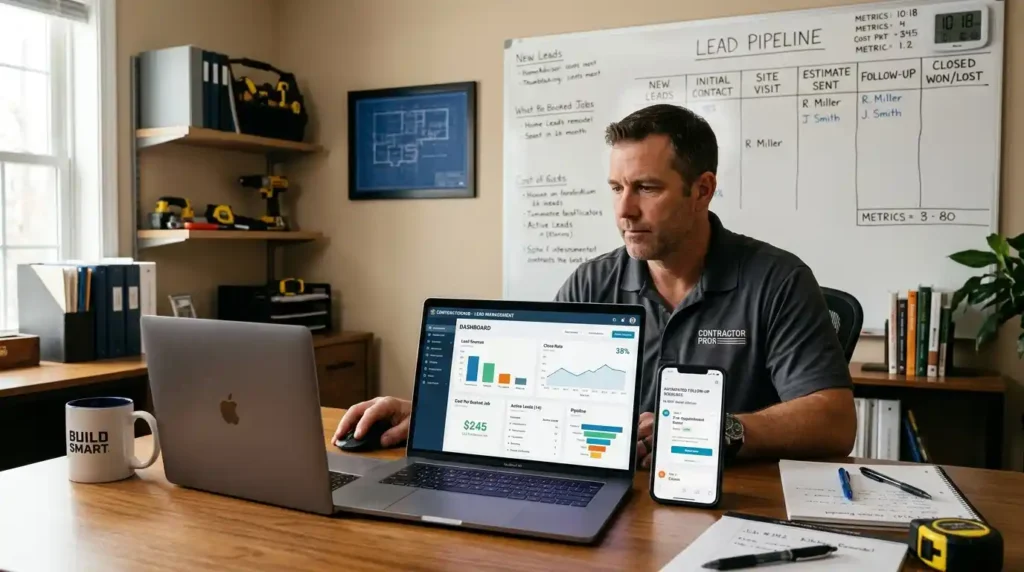
A contractor CRM is the infrastructure that makes fast follow-up systematic rather than dependent on individual memory or goodwill. CRM software for contractors tracks every inbound inquiry, automates initial follow up sequences, schedules appointment reminders, logs call outcomes, and captures the lead source data that revenue attribution depends on.
Without CRM level lead tracking, it becomes difficult to determine which home improvement lead generation channels are resulting in booked projects and which are only generating unproductive phone inquiries. Call tracking, appointment scheduling integration, and online booking systems complete the conversion infrastructure that separates contractors who scale predictably from those whose pipeline fluctuates with the season and the platform.
Practical Contractor Marketing
The practical contractor marketing budget recommendation for established home improvement businesses sits between 5% and 15% of annual revenue, with 7% to 10% being the practical planning range for most. That range covers Google Local Services Ads management, Google Business Profile optimization, local SEO, a pay-per-lead support channel for schedule gap filling, CRM software, call tracking, landing page optimization, and lead follow up automation.
The mistake is spreading that budget too thin across too many home improvement lead generation channels simultaneously. A better approach: one primary lead channel typically Google LSA or exclusive leads and one support channel typically SEO or a lead marketplace for seasonal gap filling with disciplined tracking of close rate, cost per lead, cost per acquisition, cost per booked job, average job value, and gross profit margin at every source level.
High Ticket Home Improvement Verticals
Modernize focuses specifically on high-ticket home improvement verticals including roofing, solar leads, HVAC leads, window leads, and bathroom remodeling leads attracting homeowners through educational content during the research and planning phase before delivering qualified leads in real time. Networx operates on a flexible pay per lead basis with options for shared leads, exclusive leads, and direct call products, making it an accessible lead marketplace for home improvement businesses of all sizes without long term subscription lock in.
Inquir connects contractors with homeowners through a performance based acquisition model that prioritizes homeowner intent and transparent, trackable lead delivery a model that addresses the core failure of legacy lead platforms, which sell activity rather than outcomes.
Remodeling Lead Generation Playbook
The remodeling lead generation playbook for 2026 combines local SEO, Google LSA, a referral lead generation system, and a diversified lead strategy that doesn’t put more than 40% of lead volume on any single channel. Referrals close at higher rates than any purchased lead source because the trust transfer from a neighbor referral, real estate agent referral, or contractor referral removes the credibility gap that every cold lead requires you to bridge from scratch.
A formal referral program with a structured ask, a small incentive, and a systematic follow-up process for past clients is the most underinvested home improvement lead generation asset in most remodeling businesses, and it costs a fraction of what any lead platform charges per inquiry.
Conclusion
Lead generation for home improvements is not a marketing issue, but a systems one. Contractors able to create quality pipelines consistently in 2026 are not those that spent most money on their platform. Such contractors are those who have created systems that compound over time, spent more on a contractor’s CRM that facilitates quick and efficient follow up, opted for exclusivity instead of shared leads where budget permits, and calculated ROI per booking rather than per each lead. Build your systems first and spend will not matter much.
Frequently Asked Questions (FAQ’s)
Home improvement lead generation is the process of attracting homeowners who need remodeling, renovation, or specialty trade services and turning them into potential customers. A strong system helps contractors create a predictable pipeline instead of depending only on paid lead platforms.
Exclusive home improvement leads usually provide better opportunities because only one contractor contacts the homeowner, reducing direct price competition. Shared leads may cost less upfront, but multiple contractors often receive the same inquiry, making conversions more challenging.
Contractors can build owned lead sources through local SEO, Google Business Profile optimization, content marketing, and other channels they control. These methods take time to develop but can reduce long-term dependence on paid lead marketplaces.
Fast follow-up, proper tracking, and a contractor CRM are key factors in improving conversions. A CRM helps manage inquiries, automate follow-ups, schedule appointments, and identify which marketing channels produce actual revenue.
Most established home improvement businesses can plan to invest around 5% to 15% of annual revenue into marketing activities such as Local Services Ads, SEO, CRM tools, tracking, and conversion improvements. The right budget depends on close rates, project value, and the performance of each channel.

7 thoughts on “Home Improvement Leads: What Every Contractor Needs to Know Before Spending Another Dollar”