

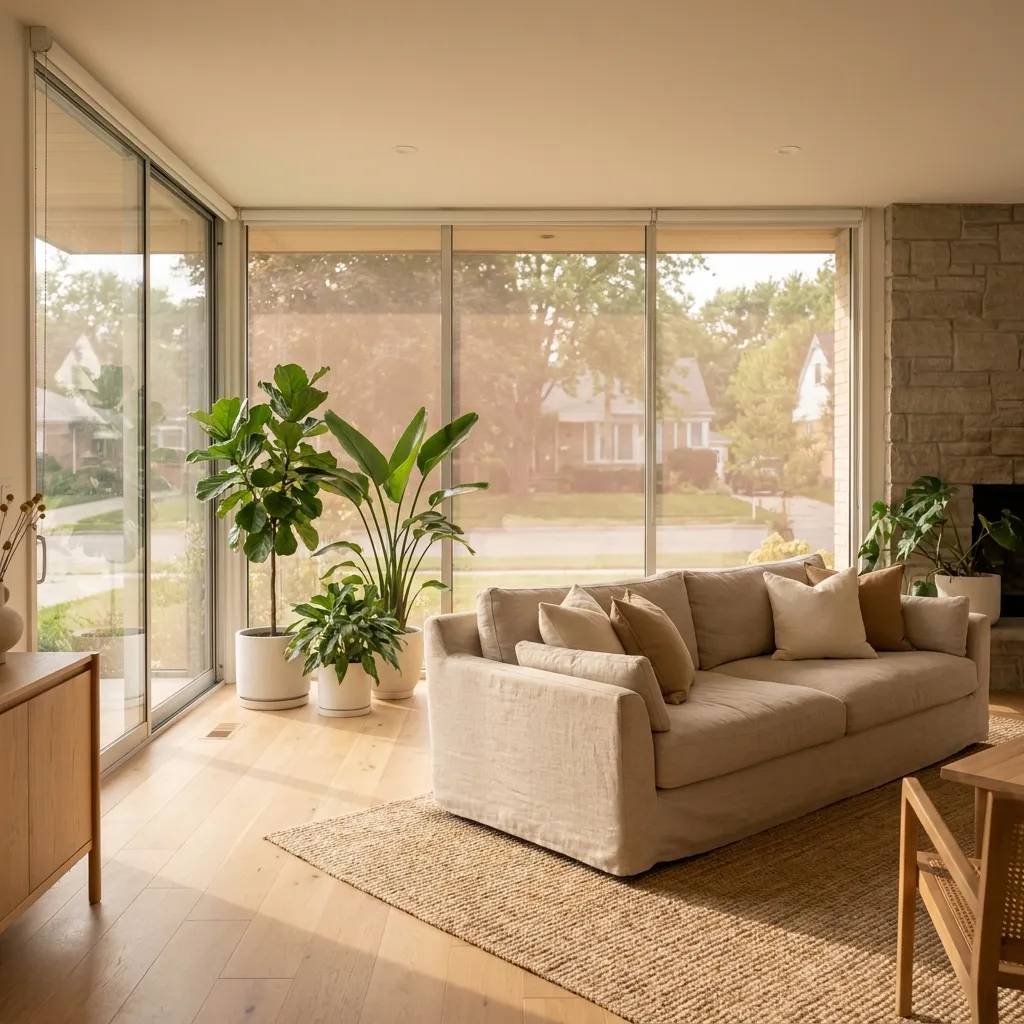
The summer I moved into a west-facing terraced house in a busy suburb, the living room was practically unusable between 2 and 6 in the afternoon. The sun would pour straight through the large single-pane windows, turn the sofa cushions into a furnace, and bleach the edge of my hardwood floor so badly you could see the tide line. I tried blackout curtains, layered blinds, even repositioning furniture. Nothing fixed the core problem. A neighbour eventually knocked on my door she’d noticed me hanging a bedsheet as a makeshift sun blocker and said, quietly and without judgement, “have you looked into residential window tinting?”
That conversation changed how I think about sun control solutions for the home entirely.
Why South-Facing and West-Facing Windows Are Quietly Destroying Your Interiors:
Most people don’t realise the damage is cumulative. It doesn’t happen in one hot afternoon it happens over three summers of infrared ray exposure landing on the same patch of flooring, the same armchair fabric, the same framed print above the sideboard. UV protection is the headline benefit that window tinting companies lead with, and for good reason: heat blocking film for south-facing windows and west-facing glass can block up to 99% UV blockage, which is the primary cause of furniture fading, flooring protection failure, upholstery protection breakdown, and artwork protection loss.
Solar heat gain the technical term for what your living room experiences at 3pm in July isn’t just uncomfortable. It forces your air conditioning or cooling system to work harder to compensate, which means your energy bills climb quietly month after month. A properly installed solar control film creates a layer of passive solar control between the glass and the room, cutting indoor temperature regulation costs without changing how the window looks from inside. You keep the natural light. You lose the heat. That’s the trade most homeowners don’t realise they can make.
Furniture fading is the visible consequence of ignoring this long enough. By the time you see the tide line, the damage is already done. Fade protection film for a home studio, a reading room, or a south-facing lounge isn’t a luxury it’s what stops you replacing a £900 sofa in four years.
The Film Types That Actually Matter And What Each One Is For:
Walk into any conversation with a local window tinting service and you’ll hear a dozen product names thrown at you. Here’s what cuts through the noise.
Ceramic window film and nano ceramic film are currently the benchmark for residential performance. They reject heat without the metallic sheen, they don’t interfere with Wi-Fi or mobile signals, they hold their colour over time, and they sit well on both single pane window film and double pane window compatibility requirements. The visible light transmission VLT, the percentage of light that passes through stays high, which means rooms stay bright. Shades run from 5% VLT at the darkest end up to 75% VLT for a film that’s nearly invisible. For most living spaces, a 35% to 50% VLT ceramic film hits the right balance of glare reduction, heat rejection film performance, and retained light.
Reflective window film and dual-reflective film create the one-way mirror film effect you’ve seen on office buildings high exterior reflectivity, clear interior view during daylight. These work well as a street-facing window tint or front window privacy film, especially in terraced houses or ground-floor flats where daytime privacy is the real concern. The limitation: at night, when interior light is stronger than exterior light, the effect reverses. You’ll need blinds or curtains for nighttime privacy. That’s not a flaw in the product; it’s physics.
Frosted window film and decorative window film handle a different brief entirely. Bathroom window film, bathroom privacy, glass door tinting, sliding glass door film these are contexts where you want opacity over solar performance. Frosted film transmits light without transmitting a clear image, making it ideal for window tinting for flats, apartments, and any room where the view in matters more than the view out. Patterned window film and white opaque film take this further, functioning more as a design element than a sun control solution.
Safety and security film is the category most homeowners skip until something happens. This film bonds the glass so that if it shatters impact, accident, attempted break-in the fragments hold together rather than scattering. Glass strengthening and shatter resistance aren’t marketing language; they’re the practical outcome of a thicker, multi-layered film adhesion process. For bay window tinting on a ground floor, or tint film for a glass extension roof, this is worth serious consideration.
Blackout window film does exactly what it sounds like complete light control, maximum privacy, no view in or out. Bedroom window tinting is the most common application, particularly in urban settings where street lighting creates sleep disruption.
What “Near Me” Actually Means Finding a Certified Installer Worth Trusting:
Searching for house window tinting near me returns a mix of certified window film installers, general glaziers who offer film as an add-on, and DIY kit retailers who rank locally. The difference matters more than most people expect.
Professional window tinting specifically from a window tinting specialist who works with residential projects daily delivers a bubble-free installation with clean edges, no film overhang, and correct adhesion to your specific glass type. A mobile window tinting service will come to your home, assess your windows in situ, and recommend VLT levels based on room orientation and use something no online calculator or kit replicates. The seamless application you get from an experienced local window tinting company also affects how long the film lasts. Poorly applied film peels at the corners within a year. Properly applied film on interior glass holds for ten to fifteen years.
For window tinting for terraced houses, window tinting for new build homes, and particularly solar film for Victorian sash windows where the glass profile is irregular and fragile a certified window film installer with experience on period properties is non-negotiable. Window tint for period property and window film for double glazing exterior both sit in a specialist bracket. Ask whether the installer has experience with your window type before you book.
One thing worth checking before committing: window film building regulations UK and window film HOA approved status in the US both affect what you can legally install, particularly on listed buildings, conservation area properties, and managed apartment complexes. A good local window tinting contractor will know your local rules. A less experienced one won’t raise it until after installation.
What It Actually Costs Honest Numbers for the UK and US:
The cost to tint home windows varies considerably based on film type, glass area, installer experience, and your location.
In the UK: the average sits around £300 per window, with a per square-metre range of £60–£90 for solar film and £120 per square metre as a general residential average. A full home project with eleven windows tinted runs toward £750 and up, depending on film grade. DIY kit options start at £30–£80 but the quality gap in terms of durability, appearance, and bubble-free installation is significant enough that most homeowners who try DIY once go professional the second time.
In the US: the national average cost for residential window tinting sits at $550, with individual windows averaging $75 per window and professional installation quoted at $6–$8 per square foot for materials and installation combined. A 110-square-foot window tinting project runs approximately $750 for the full job.
The window tinting cost calculation also needs to factor in what you avoid paying. Reduced HVAC use, lower utility bills, and the cost of not replacing sun-damaged furniture and flooring over a five-year period all sit on the other side of the ledger. Many homeowners who request a free tinting estimate and compare it against a residential tinting quote for solar control film find the payback period is shorter than expected.
For a window film quote that reflects your actual home room orientation, glass type, single vs double pane, film preference get at least three quotes from local window film companies. The variation between a window tinting installer near me search result and an established local window tinting specialist can be hundreds of pounds or dollars on the same job.
The Rooms Where Window Film Makes the Biggest Difference:
Home office window film is underrated. Glare on screens particularly in rooms with east or west-facing glass is the kind of daily irritation that feels minor until you remove it and realise how much cognitive energy it was draining. Reduce sun glare on TV screens and monitors by pairing a 35% VLT ceramic film with your existing layout, and the room transforms without any furniture moving.
Living room window tint serves a dual purpose: heat control during the day and privacy from the street in the evening. A dual-reflective film handles both when chosen at the right VLT level. Conservatory window film and tint film for glass extension roof are high-demand applications conservatories without film are essentially greenhouses. A solar window film specified for that glass area, with the right SHGC (solar heat gain coefficient), can drop internal temperature enough to make the space usable year-round.
Skylight film and window tint for bifold doors are the two applications I see homeowners overlook most. Skylights have no shade option. Bifold doors cover an enormous glass area. Both are significant contributors to indoor temperature regulation failure in modern homes, and both respond well to a heat-blocking glass solution that doesn’t obstruct the view or change the external appearance.
Removable window tinting film is worth knowing about for window film for rented flat situations some products are designed to be installed and removed without leaving adhesive residue, which matters when you don’t own the glass. Daytime privacy film without darkening room is the specific product category to ask about if your landlord approves film but you want to keep the room light.
The One Question Most Homeowners Forget to Ask:
After the installation is done, after the 30–45 minute installation time per window has passed and the film is curing, the question most people forget is: what does this look like from outside?
Window tint that doesn’t look dark from outside is a real film category spectrally selective film and lightly tinted ceramic films are engineered to control heat and UV without the darkened exterior appearance that older metallic films had. This matters for window tinting for new build homes with HOA restrictions, for energy rated window film UK applications on properties in conservation areas, and for any homeowner who cares about kerb appeal as much as indoor comfort.
It also matters because the window is a two-way object. It’s filtering what comes in. It’s also shaping how your home reads from the street, from the garden, from the neighbour passing at 7am. The right residential window tinting decision accounts for both directions not just what the film does to your interior, but what it says about your home’s exterior.
That’s the part Rubin at my local installer’s shop spent forty minutes explaining to me before he touched a single roll of film. The spec sheet tells you the VLT. The conversation tells you whether it’s the right call for your specific house.
Frequently Asked Questions (FAQ’s)
Residential window tinting adds a thin film to household glass to reduce solar heat, glare, and UV exposure while keeping useful natural light. Depending on the film type, it can also improve daytime privacy and help protect furniture, flooring, and artwork from fading.
Ceramic window film is usually better when you want strong heat rejection without a mirrored appearance or interference with wireless signals. Reflective or dual-reflective film is more suitable when daytime privacy is a priority, especially for street-facing windows.
Look for a specialist who regularly handles residential glass and can recommend the correct film for your window type, orientation, and required VLT level. Ask about experience with single-pane, double-glazed, sash, skylight, or other specialist windows before accepting a quote.
UK prices can vary from roughly £60–£120 per square metre depending on the film and installation, while US professional projects are often priced by the window or square foot. The final cost depends on the amount of glass, film quality, accessibility, and whether specialist installation is required.
Yes, these windows usually receive some of the strongest direct solar exposure, making heat control and fade protection especially useful. A suitable solar or ceramic film can reduce glare and heat gain while helping protect interiors without relying entirely on heavy curtains or blackout blinds.

7 thoughts on “House Window Tinting Near Me – What Nobody Tells You Before You Book”