

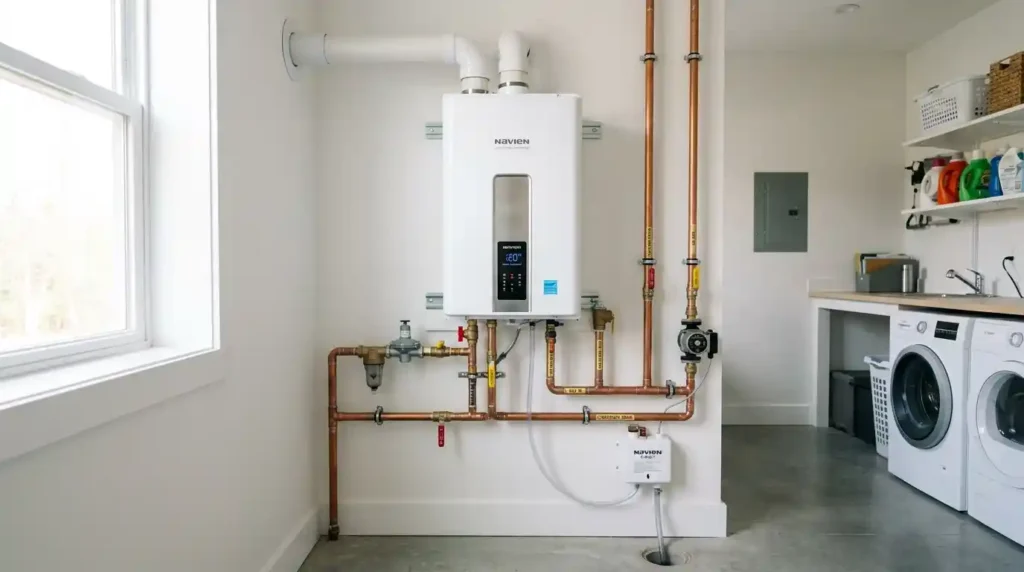
Most homeowners start researching a tankless water heater after one of two moments either their old storage tank water heater just failed on a February morning, or they got hit with a utility bill that made them sit down. Both situations make people rush the decision. And rushing this particular decision costs real money, sometimes $800 to $1,500 in avoidable upgrades that nobody mentioned during the sales pitch.
I’ve watched this play out enough times including in my own house, where switching from a conventional water heater to a condensing tankless water heater meant three separate contractor visits because the original gas supply line diameter wasn’t wide enough to handle the BTU demand. That oversight added six days and roughly $600 to a project that was supposed to take one afternoon. The unit itself was fine. The preparation wasn’t. That’s what this is actually about.
Why the On-Demand Water Heating Model Changes Your Entire Energy Picture
A traditional tank water heater stores anywhere from 40 to 80 gallons of water and keeps it hot continuously whether anyone in the house is awake, home, or using it. That constant reheating is called standby heat loss, and it’s the reason conventional tank models bleed energy around the clock. A tankless water heater eliminates that entirely. Cold water travels through a pipe into the unit, a gas burner or electric heating element fires, and hot water on demand comes out the other side only when a faucet or appliance asks for it.
The Department of Energy puts the energy savings at 24% to 34% for households using up to 41 gallons of hot water daily. For heavier usage homes, that figure drops somewhat, but the savings don’t disappear. Most households realistically see $100 to $200 knocked off their annual utility bills after switching not a dramatic figure in isolation, but compounded over the 15 to 20 year lifespan of a quality unit, the math starts to look very different compared to replacing a storage tank every 8 to 12 years.
The payback period is a genuine consideration and not one you should paper over with optimistic projections. An electric on-demand water heater installed runs $1,400 to $3,000 total. A gas tankless water heater costs $2,100 to $5,600 fully installed depending on what the existing infrastructure requires. That’s a real upfront cost vs long-term savings calculation every household needs to run honestly before committing.
Electric vs Gas Tankless — The Decision That Drives Everything Else
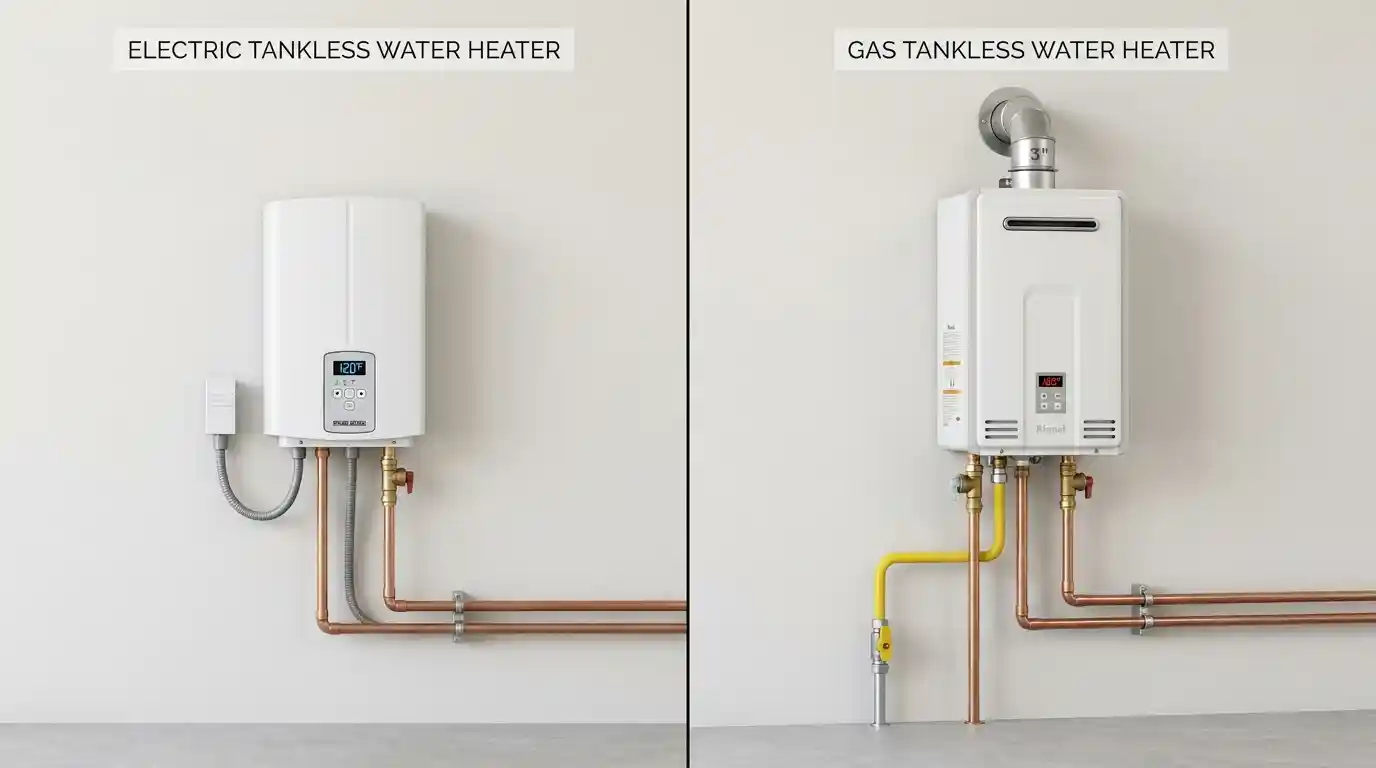
Fuel source isn’t just a preference. It drives permit requirements, installation complexity, flow rate capacity, and whether the system can actually handle your household’s simultaneous hot water usage without temperature fluctuation.
Electric tankless water heaters are cheaper upfront and considerably easier to install there’s no venting requirement, no gas line specification to worry about. But electric units have flow rate constraints that matter in larger homes. Running two showers, a dishwasher, and a bathroom faucet at the same time pushes past what most single electric units can deliver at consistent temperature, particularly in cold climates where groundwater temperature pulls the temperature rise demand higher. For apartments, condos, and smaller homes with moderate hot water demand, electric makes solid sense. For a two-story home with multiple bathrooms, it usually doesn’t.
Gas models running on either natural gas or propane deliver higher maximum flow rates and handle simultaneous hot water usage far more comfortably. A properly sized whole-home gas tankless unit running at 199,000 BTU can push 9.5 to 11 GPM depending on the temperature rise needed, which covers most residential demand scenarios. The trade-off is installation complexity. Gas tankless water heaters require venting direct vent or power vent depending on placement and often need gas line upgrades to supply the volume the unit demands. Natural gas line installation costs $350 to $2,000 depending on whether you’re upgrading an existing line or running a new one. That cost doesn’t appear in most unit price comparisons, which is where homeowners get caught off guard.
Propane tankless water heater installations follow the same logic as natural gas but with the added variable of tank refills a 20-pound propane tank runs $20 to $30 and delivers roughly 8 to 10 hours of burn time, which matters more in rural settings without natural gas access.
Tankless Water Heater Sizing Guide: Flow Rate and Temperature Rise Are the Only Numbers That Matter
Getting the sizing wrong produces one of two problems: either the unit can’t keep up with demand or you get that sharp cold water sandwich effect mid-shower when someone turns on a faucet elsewhere, or you overbuy capacity you’ll never need and paid $800 extra for it.
Flow rate is measured in gallons per minute. Add up the GPM demand of everything that might run simultaneously in your household a standard shower head pulls about 1.8 GPM, a bathroom faucet around 1.2 GPM, a dishwasher roughly 1.5 GPM. A household running two showers and a sink simultaneously needs a unit capable of at least 4.8 GPM at the required temperature rise, and sensible sizing adds a buffer above that figure.
Temperature rise is the difference between your incoming groundwater temperature and the desired hot water output temperature. In northern states and Canada, ground water temperature in winter can sit at 40°F, meaning a unit needs to produce a 60°F rise to deliver 100°F water. In warmer climates like Texas or the UK’s southern counties, the required rise is considerably less, which means the same unit delivers meaningfully higher effective GPM. This is why a tankless water heater for two bathrooms that works perfectly in Houston will underperform in Minnesota using identical settings.
What Condensing vs Non-Condensing Actually Means for Your Wallet
Most buyers skip past this and regret it. Non-condensing tankless units are simpler and cheaper they vent hot exhaust gases directly out through a stainless steel flue. Condensing tankless water heater models extract additional heat from those exhaust gases using a secondary heat exchanger before venting, which is how they achieve UEF ratings of 0.95 and above. The Uniform Energy Factor rating is what the federal tax credit qualification hinges on gas tankless units need a 0.95 UEF or higher to qualify under current IRS guidelines.
Condensing models cost more upfront but the efficiency gap is real. A non-condensing unit might run at 80% to 85% efficiency. A condensing unit hits 96% to 98%. Navien’s condensing technology pushes their top NPE series units to a 0.96 UEF. A.O. Smith’s ADAPT condensing series runs at 0.95 UEF with dual heat exchangers and X3 scale prevention technology built in. That built-in scale prevention matters most condensing units without it require annual descaling with a vinegar flush to clear mineral buildup from the heat exchanger, particularly in hard water areas. Skipping that maintenance shortens the unit’s effective lifespan considerably.
Brands, Real-World Performance, and What the Warranties Actually Cover
Rinnai, Navien, Rheem, Bosch, A.O. Smith, Noritz, EcoSmart, and Takagi are the names that come up repeatedly in professional installation circles, and they’re not interchangeable.
Rinnai is the flow rate leader. Their RX199iN runs 199,000 BTU, delivers reliable GPM at high temperature rise, and with proper annual descaling lasts 18 to 20 years. It’s the unit most plumbers recommend for larger households with demanding simultaneous hot water usage. The heat exchanger warranty runs 15 years on most Rinnai models longer than Rheem’s 12-year coverage on comparable units, which matters when the heat exchanger is the single most expensive component to replace.
Navien pioneered condensing technology in the residential tankless market and their ComfortFlow recirculation system a built-in recirculation pump that pre-circulates hot water through a dedicated loop genuinely cuts the wait time for hot water at fixtures, which is one of the genuine practical complaints about tankless systems. Navien’s top efficiency models reach 0.96 UEF. For homeowners who want the highest efficiency and longest warranty in one package, Navien is the honest recommendation.
Rheem sits at the more accessible price point their Prestige series includes a built-in recirculation pump similar to Navien’s approach, Wi-Fi connectivity for remote monitoring, and smart features including error alerts and digital control panels. Rheem won’t match Rinnai’s flow rates at the top end but costs less and is easier to find certified service technicians for in most markets.
Bosch’s Greentherm 9000 series brings Wi-Fi connectivity, built-in scale prevention technology, and a compact footprint that suits utility room and crawl space installation. Bosch’s support network in North America is thinner than Rinnai or Rheem fewer certified technicians familiar with their units though that’s improved as their residential market presence has grown.
The Federal Tax Credit, IRA Rebates, and the Money Most Homeowners Leave Behind
This is the section that pays for the time it takes to read it. The Inflation Reduction Act made federal income tax credits available for ENERGY STAR certified tankless water heaters — up to $600 under the Energy Efficient Home Improvement Credit, covering 30% of total installation cost. The credit runs through 2032. Gas tankless units need a 0.95 UEF or higher to qualify. Starting in 2026, a Product Identification Number is mandatory when filing, alongside the Qualified Manufacturer code on IRS form 5695. Navien’s QM code is M6G5. A.O. Smith’s is A5X5.
State rebates layer on top of the federal credit many programs offer $200 to $500 for qualifying high-efficiency systems, and utility company rebates push available savings further. Austin Energy runs an $800 rebate for qualifying ENERGY STAR certified installations. Texas Gas Service offers rebates on high-efficiency natural gas tankless models. PG&E runs periodic programs for qualifying units in California.
The honest advice here: ask your plumber to help navigate the rebate paperwork before the installation date, not after. They know which programs are currently funded and which have run dry. That local utility rebate programs operate on limited budgets and close without notice is something many homeowners learn by missing the window.
What the Installation Actually Involves and Where Costs Expand
Total installation cost to install a tankless water heater runs $1,200 to $3,800 for most homes, averaging around $2,632 for a complete installation including labor and parts. Licensed plumbers charge $75 to $150 per hour, and installation typically runs 4 to 8 hours. First-time installations cost more than water heater replacement projects because they involve new plumbing or venting work rather than a direct swap.
If the existing electrical panel can’t support a new electric tankless unit, panel upgrade costs run $850 to $1,700. Installing a dedicated electrical circuit adds $250 to $900. Gas exhaust vent replacement costs $100 to $600. Old tank disposal adds $50 to $200 depending on local requirements. General contractor overhead adds 13% to 22% on top if a GC is coordinating the project rather than a direct plumber hire. Building permits are required in most jurisdictions and should be factored from the outset, not discovered after the job is done.
The question of whether a tankless water heater is worth it resolves differently for different households. For long-term homeowners staying in place for a decade or more, the ROI from energy savings, avoided tank replacements, and space-saving design is real. For someone planning to sell in three years, the upfront cost recovery is less certain, though quality outdoor tankless water heater installations and well-documented indoor units do contribute to property value in current market conditions. The honest answer is: run your numbers, get your rebates, size it correctly, and don’t skip the gas line assessment before the installation day.
Conclusion
The decision to switch to a tankless water heater doesn’t come down to one factor it never does. It comes down to your household’s actual hot water demand, your existing gas or electrical infrastructure, how long you plan to stay in the house, and whether you’re willing to do the upfront work that makes the long-term savings real. Get the sizing right, pull the permits, claim the rebates, and hire someone who’s done this installation enough times to spot the gas line problem before it becomes your problem. A tankless water heater bought and installed correctly is genuinely one of the better long-term investments a homeowner makes. Bought in a hurry with the wrong unit for the wrong house it’s just an expensive lesson with a 20-year warranty on it.
Frequently Asked Questions (FAQ’s)
A tankless water heater heats water only when a faucet, shower, or appliance needs it instead of keeping a storage tank hot all day. This reduces standby energy loss and can provide continuous hot water when the unit is sized correctly.
Electric models usually work well in smaller homes with moderate hot water demand because they cost less to install and do not need gas venting. Gas tankless water heaters are generally better for larger households that regularly use several showers, faucets, or appliances at the same time.
Add the gallons-per-minute demand of the fixtures you expect to use simultaneously, then compare that number with the unit’s output at your required temperature rise. Colder incoming water requires more heating power, so climate and groundwater temperature matter just as much as the number of bathrooms.
Condensing models recover additional heat from exhaust gases, making them more efficient than standard non-condensing units. They normally cost more upfront, but the higher efficiency can reduce long-term energy use and may help certain qualifying models meet efficiency requirements for available incentives.
It can be a strong long-term investment for homeowners who plan to stay in their property for many years and have the correct gas, electrical, and venting infrastructure. Before buying, compare installation upgrades, expected energy savings, maintenance needs, and any available rebates so the decision is based on total ownership cost rather than the unit price alone.

3 thoughts on “Is a Tankless Water Heater Worth It? Honest Answers for Homeowners in 2026”