

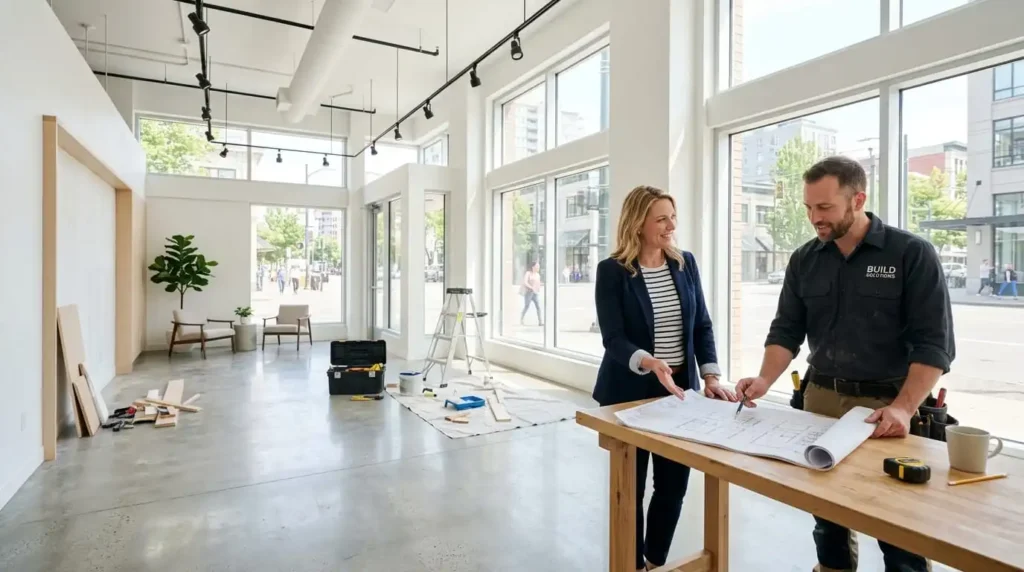
Commercial remodeling is something I did not know much about until I got into it myself. Through the years, spending time with construction contractors, architects, and building owners, I have figured out what makes a successful commercial remodeling project. It is not all about aesthetics; there is much more to it than that.
Making the Most of What You Already Have
Every commercial space has untapped potential sitting right beneath its surface Remodeling is the best way to get the most out of your existing structure. I have seen owners turn old, cramped offices into wide-open and highly functional spaces. The difference is truly astounding.
Replacing old office cubicles with open-floor plans is one of the best things a company can do. Eliminating physical boundaries enables staff to interact and cooperate naturally on a daily basis. It’s not just about layout; it’s about maximizing efficiency and fostering quality interaction.
Repurposing underused areas is another strategy I always recommend to commercial property owners. A neglected storage room can become a bright, functional space that suits your business needs perfectly. Decluttering cramped corners and giving them new purpose is always a cost-effective procedure worth exploring early.
Renovations That Refresh Your Brand Identity
Commercial remodeling does something powerful for a business it gives it a brand-new look. When done right, a refreshed space helps attract the right customers and boosting brand recognition simultaneously. I have witnessed how retail stores can make a complete change in their personality solely by altering the layout.
Colors, lighting, sounds, displays, and layout itself contribute to shaping consumer behavior. Proper placement of items in the best possible locations within the store aids consumers in their purchasing activities. It does not cost any extra money on marketing because it is an indirect factor in boosting sales.
Those retail stores that alter their layout to highlight their products always achieve success. Consumers like places that look designed. Clean and refresh the store, and business will flow naturally into it.
Why Renovation Is Smarter Than Starting Over
One thing I tell every client without hesitation remodeling beats purchasing another property almost every time. It requires less spending on financial and other resources compared to building a new facility from scratch. For companies running on a tight budget, this distinction matters enormously in the planning phase.
Renovation eliminates the need for creating an entirely new design plan from the ground up. It builds on the original building structure, which significantly shortens reconstruction time overall. The setup shortens the timeline compared to new construction, saving both money and unnecessary stress for everyone involved.
A cost-efficient way of making decisions is what makes each and every one of the commercial remodel projects that I have seen become successful. The fact that the decision has been made to renovate the business area instead of moving the business saves it from having to relocate.
Efficiency Upgrades That Actually Pay Off
Outdated commercial buildings struggle to operate at peak conditions without serious intervention. Efficient design ensures that buildings function at their optimum and that energy usage is minimized. Personally, I have witnessed efficient heating and cooling systems significantly improve indoor air quality in renovated buildings.
Adhering to green building codes is now necessary for any commercial establishment that wants to be ahead of the competition. By adhering to green building codes and showing dedication towards green initiatives, organizations can gain a definite edge over others in terms of competitive advantage. To be environment friendly is becoming more important to customers.
Efficiency-improving modifications constitute some of the most profitable investments for any business premises. Energy-efficient devices, solar panels, and central heating systems all help decrease the building’s carbon emissions significantly in the long term. Sustainable remodeling involves minimizing electricity usage by harnessing natural sunlight.
Safety Is Never an Afterthought in Commercial Renovations
Promoting building safety through remodeling is something I feel strongly about from personal experience. Outdated structures carry hidden risks that only become visible during a thorough professional inspection process. Modifying and updating a layout in line with regulatory safety standards helps avoid accidents effectively.
The preservation of customers and employees from getting hurt should always be the main reason why a renovation needs to happen. The old buildings with their outdated architecture require renovations to keep operating and comply with the building codes of that area. Getting permits and conducting inspections are compulsory.
Building codes from local, state, and national levels dictate how to go about inspecting a building and obtaining permits. I always advise property owners to research their local authority’s requirements before a single tool is lifted. Compliance from the start prevents costly legal complications from emerging later in the construction process.
Planning and Preconstruction: Where Success Begins
Every successful commercial remodeling project I have been part of started with thorough preconstruction initiation. Vested parties must clearly define goals before any contractor touches the building or reviews documents. Without this step, even the most experienced construction team will struggle to deliver consistent results.
Change of use scenarios require verifying building occupancy and confirming parking requirements to comply with current codes. Future requirements should also be incorporated into the design plan from the very beginning of planning. For example, timing roofing membrane replacement with roof top HVAC equipment changes makes practical and financial sense.
Redoing certain areas just months after completing remodel construction is one of the most avoidable and costly mistakes. I have seen it happen when owners rush preconstruction without consulting experienced Houston contractors for proper guidance. The occupation standards between a café and a store are different; thus, these need to be considered right from the start.
It would be best to get the necessary paperwork done, such as the cost analysis, as early as possible. Before contacting the contractors for pricing purposes, make sure that everything is set in stone regarding your plans and budget.
. Exploring options from a vetted group of general contractors before committing is always the wiser approach professionally.
Understanding Construction Delivery Methods
There are two widely accepted construction delivery methods used in commercial remodeling projects across the industry. The traditional method is called build to bid, where an independent design firm prepares all construction documents first. Those documents are then shared with a vetted group of general contractors who submit formal proposals accordingly.
The second method is design to build, where a single commercial contractor manages both design and construction delivery. The general contractor facilitates the design process within a targeted construction budget aligned with the owner’s specifications. After the designs have been finalized and the cost of construction established, permits are obtained and implementation commences right away.
Each approach has its strengths based on the nature and requirements of your individual project. In my opinion, the design to build approach is more suitable for small commercial building renovations owing to better communication. There is no scope for misunderstanding when there is one point person responsible for both design and construction.
Permits, Compliance, and Hazardous Material Surveys
Obtaining permits prior to commencing the remodeling is mandatory because of laws and regulations. Different areas have different requirements regarding renovations and therefore your commercial contractor should do this efficiently. As part of the regulations, environmental impact assessment and hazardous substances check might be necessary based on the extent and nature of the remodeling.
Asbestos Certification is another important aspect that is essential in cities such as Houston in remodeling commercial buildings. Remodeling in the city of Houston involves a requirement where property owners are required to prove that the contract of remodeling does not involve asbestos at all.
Long lead time building components require special attention during material and labor procurement planning stages. Items like casework, stair systems, and steel fabrication requiring shop drawing or engineering must be ordered well ahead. Purchase orders should confirm materials and products meet project specifications and remain within the estimated cost budget.
The Demolition Phase and Going Green
Demolition is one of the most labor-intensive phases of any major commercial remodeling construction project. Some parts of the building may require interrupting utility services like power, water, and gas during demolition. It might be necessary for the general contractor to close the supply lines in the building in order to accomplish this stage safely.
Dust particles and other debris that might result from demolition have the potential to affect air quality within and surrounding the premises. Both the employees working on-site and any other person involved in the construction project should be well-protected during this disruptive stage. This would involve assessing the structural integrity of the building, securing utility facilities nearby, having evacuation plans in place, and always being ready with first aid kits.
Using masks to protect oneself from inhaling dust particles is an essential safety measure during the demolition stage. Post-demolition would then come my most favorite stage, which involves going green and constructing sustainably.
Inspections, Compliance, and Occupancy Certificates
After completion of each construction phase, a formal inspection by building code officials is absolutely required. This includes such processes as laying the groundwork, installing electrical wiring, plumbing installation, roof construction, and floor installation, all of which need to be inspected individually. If an inspector finds anything that is not up to code, it must be remedied before proceeding to the next stage.
It is only after all the construction work on the renovation project has been thoroughly inspected and approved that you will be able to get your new occupancy permit. This permit is the legal document that grants you permission to run your business from your newly renovated commercial property.
Light Commercial Construction and What Sets It Apart
Light commercial construction is best described as small-scale construction projects covering about 25,000 square feet or less. Offices, restaurants, small medical facilities, banks, free-standing retail centers, warehouses, and small manufacturing centers all qualify. These buildings are typically less than four stories, making them distinct from heavy construction projects structurally.
Some light commercial constructions are complete build-outs, while others are renovations and modifications to update the building’s look. Retrofits and renovations in light commercial structures are becoming increasingly popular across the United States right now. The clients should know what they want and ensure that they follow the procedures required to ascertain whether the project will be successful.
Heavy construction is characterized by massive and complicated projects which are constructed from scratch, such as roads, stadiums, tunnels, and telecommunications infrastructure. The tall structures like high-rise buildings and skyscrapers fall under heavy construction.
Extensive remodeling, expansion, and restructuring of commercial buildings typically falls into medium-scale construction classification instead.
Light and heavy constructions differ significantly across several vital areas worth understanding before beginning any project. These may consist of usage, design, required support facilities, type of machinery used, time schedule for operations, and general supervision. Knowing the place of your project on this scale will assist you in choosing the appropriate contractor.
Zoning, Standards, and the Rules That Govern Light Construction
Light commercial zoning means regulating where light commercial buildings can be constructed on allocated portions of land. Cities and towns regulate the location of shops and services to maintain convenience for nearby residents. The purpose is to ensure commercial buildings remain close to residents without interfering negatively in their daily lives.
Potential investors and builders must respect height regulations, yard regulations, intensity of use regulations, and additional local regulations. These are not suggestions — they are enforceable rules that can halt your project if ignored during planning. I always advise clients to consult zoning requirements before even beginning to sketch out a preliminary project plan.
Light commercial construction standards involve building codes, professional associations, and industry publications that establish acceptable quality benchmarks. These standards resolve disputes, avoid litigation, train personnel on correct installation procedures, and answer critical client questions. Every builder and property owner embarking on light commercial construction must comply with these established standards completely.
Communication, Planning, and Delivering a Successful Project
The problem of lack of proper communication between the clients and the contractors is very common in the failure of the remodeling project. Projects such as those of light commercial building construction, where there is need for remodeling or modification, are likely to suffer from problems of poor communication, and hence lead to expensive mistakes.
Hiring a reputable general contractor from the moment project viability is decided makes everything significantly easier. With the right construction company performing the work, it becomes more difficult for things to go seriously wrong. A good contractor brings accountability, expertise, and clear communication that keeps the entire project on a steady track.
Conclusion
It is hard to find another investment that can be as practical as the commercial renovations. You could be trying to clear out cluttered spaces, update your aging building system or even incorporate eco-friendly equipment into your property. Whatever it is, it can definitely boost the value of your commercial property. I have personally witnessed many business properties become thriving and functional after commercial renovations.
This whole process might seem easy, but it cannot be if you do not know what needs to be done. Preconstruction initiation, permit procurement, asbestos certification, and inspection of compliance cannot be overlooked. These are just some of the processes that go into a commercial renovation project. Skipping these will only cause more headaches for you in the future.
In every renovation project, client-contractor communication is still the most crucial element. The contractor can help you understand everything about commercial renovation and make it easier for you to execute it. Hiring an experienced general contractor will ensure accountability, transparency, and professionalism during your renovation process.
There is a purpose behind light commercial construction codes, zoning laws, and building codes. Adherence to the stipulations of structure height, intensity of usage, and yards will ensure compliance with laws from the very beginning. Everything depends on planning in advance, making sure that all the required documentation has been prepared, and performing all the tests beforehand.
In essence, the entire point of commercial renovations lies not only in improving appearance or increasing size but also in creating a functional place for work where everyone involved can feel more comfortable. When done properly, commercial renovations will enable you to get an advantage over your competitors, increase productivity, create a powerful corporate image, and guarantee safety at work.
Frequently Asked Questions (FAQ’s)
Commercial remodeling involves improving an existing business property to make it more functional, efficient, safe, or visually aligned with the company’s needs. It can include layout changes, system upgrades, energy improvements, and updates that strengthen the customer or employee experience.
Remodeling can be more practical when the existing structure is sound because it may reduce construction time, relocation needs, and overall project costs. New construction may offer greater flexibility, but renovation makes better use of a building the business already owns or occupies.
In bid-build, a separate design team prepares the plans before contractors compete to perform the construction work. Design-build places design and construction under one contractor, which the article presents as especially useful for smaller commercial projects where simpler communication can improve coordination.
Begin by defining the project goals, budget, intended use, occupancy requirements, and future building needs before requesting contractor pricing. Permits, zoning rules, hazardous-material requirements, long-lead materials, and inspection stages should also be considered during preconstruction rather than after work begins.
A qualified general contractor should be involved early when the project includes permits, code compliance, demolition, structural work, utility changes, or multiple construction trades. Early involvement can improve budgeting, scheduling, communication, procurement, and compliance throughout the project.

3 thoughts on “The Complete Guide to Small Commercial Renovations”