

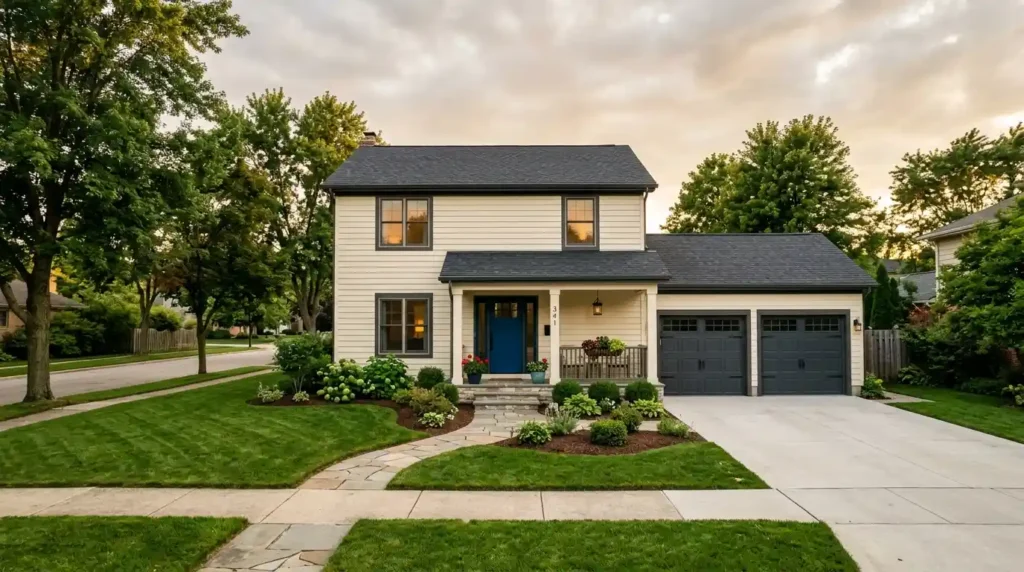
There’s a version of the middle class home that gets shown in renovation roundups constantly freshly painted cabinets, a neat backyard, a kitchen that somehow looks like it cost $80,000 but the caption says $4,200. I’ve been in enough of these homes to tell you that version exists but it’s not the starting point. The starting point is a detached home or semi-detached, three bedrooms, maybe a covered patio that’s seen better days, a garage that stores everything except a car, and a household income somewhere between $51,813 and $155,438 which is, officially, the middle class income bracket in America. That’s a huge range. And the homes that bracket contains are just as varied.
What doesn’t vary is the pressure. Cost of living climbs, the national median home price sits at $402,300, and 76.4 million households in the US currently cannot afford a $300,000 home. The middle class homeowner isn’t operating from financial comfort by default they’re making deliberate decisions about where every renovation dollar goes and whether the property value payoff justifies the spend. That’s the honest version of middle class homeownership.
What the Middle Class Housing Market Looks Like Right Now and Why Affordability Is Getting Harder to Ignore
The middle class affordability gap is real and it’s widening in specific cities faster than the national picture suggests. In 100 cities tracked across the US, people earning a lower middle class income cannot afford a home at the median price. Upper middle class earners — household income pushing past $100,000 can purchase a median-priced home in 85 of those same cities. In 15 cities, Los Angeles, Miami, New York, Scottsdale, the middle class is effectively priced out entirely regardless of income position within the bracket.
The homeownership rate sits at 78.1% for house holds at or above the median income. That number has barely moved in thirty years, which tells you something important: getting into a middle class home and staying in a middle class home are two separate challenges, and the second one gets less attention than the first. Property taxes, school district quality, neighborhood quality, community amenities these factors don’t stop costing money after the mortgage closes. A suburban family in a livable middle class neighborhood is managing ongoing costs that don’t show up in the initial home buying process conversation.
Canada and Australia are running parallel versions of this problem. The Ontario housing market and British Columbia housing affordability figures mirror the American affordability gap almost exactly when adjusted for local cost of living. In the UK, the semi-detached home in a Manchester suburb or an Edinburgh family home sits at a price point that requires a household to be in the upper bounds of the middle class income range to manage comfortably. Middle class home ownership in top-tier countries has stopped being the automatic outcome of middle class earning that it was for the previous generation.
The Rooms That Actually Drive Middle Class Home Value — and the Ones That Don’t
Here’s something the Remodeling 2025 Cost vs Value Report makes very clear, and something I’ve watched play out in real homes repeatedly: the kitchen sells a middle class house. A minor kitchen remodel averaging $28,000 returns 112% of investment at resale. That same logic does not apply to a $75,000 gut renovation you’ll recover roughly 51% of that spend, and you’ll have over-improved for your neighborhood in the process. The 30% of home value renovation ceiling exists for a reason. Spend more than that and you’re building equity for a buyer, not yourself.
The rooms that genuinely move resale value in a middle class property: kitchen cosmetics, bathroom vanity update, front door replacement, garage door replacement. That last one surprises people every time. A garage door replacement costing $5,126 returns 267% at resale $13,600 back when the home sells. A fiber glass front door replacement outperforms a major bathroom remodel in most markets. First impressions in a suburban neighborhood carry weight that interior finishes don’t replicate from the street.
Bathroom remodel costs in the US and Canada range from a few thousand dollars to over $10,000 depending on scope. Minor updates vanity mirror, fixtures, tile-specific paint on existing tiles, a budget-friendly vanity with built-in storage consistently return 80 to 90% of spend. Full-scale plumbing relocations and layout changes are where bathroom renovations stop making financial sense in a middle class home context. The move-in ready, clean, updated presentation is what buyers in this market segment respond to. Not the showpiece renovation that photographs well but adds nothing to daily function.
How Middle Class Homeowners Actually Improve Their Homes Without Blowing the Budget
The renovation budget conversation in a middle class household starts with scope creep that quiet process where a kitchen refresh becomes a kitchen remodel becomes a three-month project that costs four times the original figure. Set a firm number first. Add a 10 to 15 percent buffer for what you don’t see coming. Then work backwards from that number to decide what actually gets done.
Cabinet refinishing is the upgrade I point people toward first, almost every time. A DIY cabinet refinishing job costs $200 to $500. You sand the existing finish, prime, paint in whatever finish suits the kitchen white remains the safest resale choice, though greige and sage green are tracking well in 2025. An accent wall in the living room or master bedroom using the same updated palette costs almost nothing and changes how the entire space reads .The result looks like a $10,000 renovation and the kitchen immediately reads as updated to any buyer walking through. Premium paint makes a genuine difference here Sherwin-Williams or Benjamin Moore at $50 to $70 per gallon covers better and lasts longer than budget alternatives. Cabinet painting kits run $70 to $120 and are worth every dollar over mixing your own approach for the first time.
Countertop upgrade doesn’t require replacement. Countertop coating kits mimic granite or marble at a fraction of the cost and hold up reasonably well in a kitchen that sees normal daily use. Peel and stick backsplash tile transforms the most visually dated part of most middle class kitchens in a weekend and costs a fraction of traditional tile and grout installation. Under cabinet lighting motion sensor versions specifically adds perceived value that costs almost nothing to install and makes the kitchen feel finished in a way that buyers notice without being able to name exactly why.
Flooring follows a similar logic. Waterproof vinyl plank flooring is durable, genuinely easy to install, and sits at a price point that a middle class homeowner can manage without financing. Hardwood flooring holds resale value better over a longer timeline but costs more upfront and requires more maintenance. In a home being prepared for eventual sale, vinyl plank in the main living areas is the smarter spend. In a home being improved for the family currently living in it, the equation shifts toward what holds up under real daily use and vinyl plank holds up well.
Energy Efficient Upgrades That Actually Pay Back in a Middle Class Home
This is where middle class homeowners leave the most money on the table not on aesthetics but on energy efficient upgrades that reduce monthly costs and improve comfort at the same time. Attic insulation and weatherstripping around windows and doors saves an average of $58 per month on energy costs. Double pane windows with low-E coating save $68 monthly. A high efficiency HVAC system delivers $71 in monthly savings. Solar panels with battery storage save $117 per month. An EnergyStar washing machine, if a middle class homeowner can afford to upgrade only one appliance, delivers the most consistent return on investment of any single appliance swap.
The barrier 73% of homeowners cite: high upfront costs. That’s real in a middle class household managing property taxes, school district fees, and a mortgage together. The answer is phasing. Air sealing and attic insulation first lowest cost, fastest payback. Double pane windows with insulated frames and low emissivity coating next. HVAC and solar panels with battery storage as longer-term equity investments. LED lighting is the immediate swap motion sensor under cabinet lighting in the kitchen, dimmer switches in the living room and master bedroom, LED replacements throughout. Under $300 total in most homes. The difference in how the space feels is disproportionate to what it costs.
The Middle Class Home Exterior: Where Curb Appeal and Real Value Actually Meet
The suburban family home exterior is where middle class homeowners most consistently under-invest while over-investing elsewhere. Curb appeal improvements consistently rank among the highest ROI projects in the Cost vs Value data, because they affect how every potential buyer perceives the entire home before they step through the door.
Vinyl siding replacement returns 97% of initial cost at resale and adds energy efficiency alongside the visual facelift. Front door replacement a higher-quality version in fiberglass or solid wood returns significant value and is the first thing neighbors and potential buyers register. Garage door replacement at $5,126 returning $13,600 at resale is the single best ROI renovation available to a middle class homeowner by a significant margin and it still gets skipped in favour of kitchen projects that deliver half the return.
Landscaping and DIY landscape design for the front yard requires almost no spend to make a meaningful impact. A step-by-step landscape design approach clean edges, defined beds, maintained lawn, a couple of seasonal plants near the entry costs an afternoon and $150 in materials and changes the street presence of a middle class home completely. The covered patio or deck at the back gets used every single day by the family living there. Those spaces justify improvement budgets in a way that a guest bedroom renovation rarely does. Outdoor living space is not a luxury add-on in a middle class home it’s where the household actually lives from spring through autumn, and treating it that way in the renovation priority list reflects how the space gets used in reality.
Conclusion
A middleclasshome isn’t a compromise. It’s a resource one that rewards the homeowners who treat it like one. The families who come out ahead aren’t the ones who spend the most on renovations or chase every design trend that surfaces on a mood board. They’re the ones who understand where the real returns sit, who phase their energy efficient upgrades rather than skipping them entirely, who put $5,000 into a garage door and a front entry instead of $30,000 into a kitchen that already functions fine. The middle class homeownership challenge in 2025 is real — affordability gaps, rising median home prices, cost of living pressure that doesn’t ease after the mortgage closes. None of that changes by ignoring it. It changes by spending deliberately, improving strategically, and treating every square foot of a middle class home as something worth getting right.
Frequently Asked Questions (FAQ’s)
A middle class home is typically a practical, family-focused property that fits within a household’s realistic income and ongoing ownership costs. It may be detached or semi-detached, but affordability, functionality, maintenance, and long-term value matter more than luxury finishes.
A minor kitchen remodel usually gives a stronger return because it improves appearance and function without overcapitalising on the property. Cabinet refinishing, new lighting, hardware, backsplash updates, and countertop improvements can often deliver more value per dollar than a complete gut renovation.
Start with cabinet refinishing, fresh paint, improved lighting, vinyl plank flooring, simple bathroom updates, and low-cost landscaping. These projects can noticeably improve daily living and resale appeal without requiring a large renovation budget.
Air sealing, weatherstripping, attic insulation, and LED lighting are sensible first steps because they have relatively low upfront costs and can reduce ongoing energy use. Larger investments such as efficient HVAC systems, upgraded windows, or solar can then be phased in as the household budget allows.
Exterior projects such as garage door replacement, front door upgrades, siding improvements, and basic landscaping can deliver strong value because buyers notice them immediately. Inside the home, modest kitchen and bathroom updates generally make more financial sense than expensive luxury renovations that exceed neighbourhood standards.
