

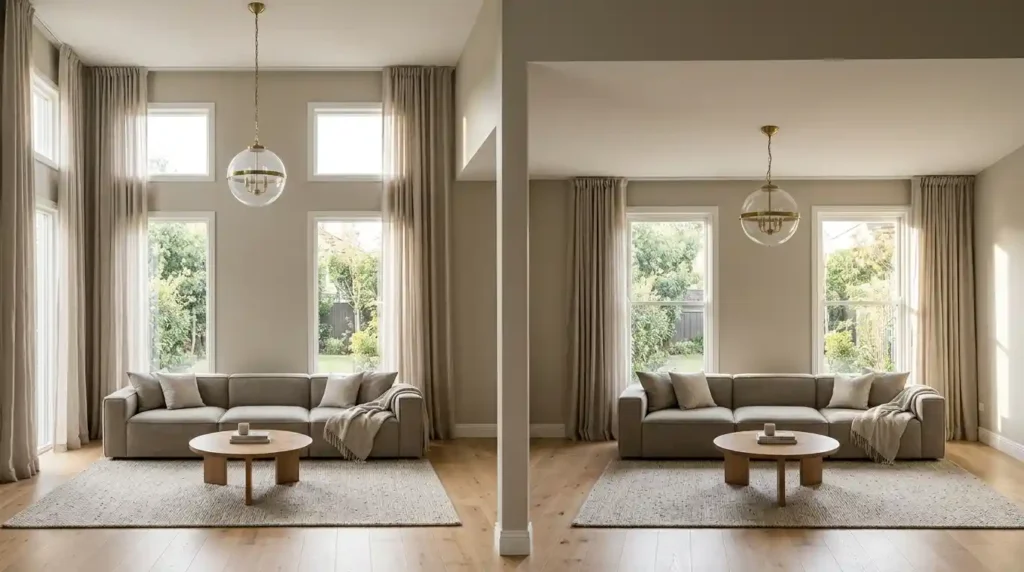
There is a version of this conversation that starts with building codes and ends with millimetres. That version is useful but incomplete. The more honest starting point is the physical experience of walking into a room where the vertical space is wrong too low and the walls close in before you’ve put down your bag, too high and the furniture floats in a volume that refuses to feel domestic. Std ceiling height is the dimension that governs this experience before anything else in the room gets a chance to.
I’ve measured ceiling heights in enough properties post-war semis in Birmingham running at 2.3m, a Victorian terrace in Leeds with original 3.1m ceilings, a Queensland new build sitting at 2.7m, a Minneapolis basement conversion squeezed to 6 feet 5 inches to know that the number on the drawing and the experience of the finished room are related but not identical. Understanding what the standards actually say, why they landed where they did, and how room type changes the calculation is the difference between a ceiling height decision that serves the building and one that the occupants quietly resent for years.
Why the Same Number Means Different Things in Different Countries
The std ceiling height for habitable rooms converges on roughly 2.4 metres or 8 feet across the US, UK, and Australia but the reasoning behind that number, and the regulatory framework surrounding it, differs in ways that matter practically.
In the US, IRC Section R305.1 sets the minimum habitable room ceiling height at 7 feet 2,134mm measured from finished floor to the lowest projection from the ceiling. That 7-foot minimum is the floor, not the target. The standard ceiling height US new builds have operated at for decades is 8 feet, driven almost entirely by construction efficiency: standard 4×8 drywall sheets fit an 8-foot wall without cutting. When 4×10 and 4×12 drywall panels became widely available, 9 feet became the new build preference for main floor living areas, and custom builds regularly push to 10 feet. The bathroom ceiling height minimum under IRC sits at 6 feet 8 inches at the centre of the front clearance area for water closets and sinks —the shower ceiling height specifically requires 6 feet 8 inches above a minimum 30×30 inch area at the showerhead.
The standard ceiling height UK sits at 2.4 metres as a practical consensus rather than a hard legislative requirement. The DLUHC national space standard requires a minimum of 2.3m over at least 75% of the gross internal area — the 75% floor area rule that accommodates service zones and kitchen or bathroom ceiling services running below the structural ceiling. The Mayor of London’s Policy D6 raised that bar specifically for new London housing: 2.5m minimum over 75% of the gross internal area, a requirement that reflects liveability concerns in high-density urban development rather than a general national shift. The NHBC standards and RIBA guidance both reference 2.4m as the accepted standard ceiling height UK new builds should target, with the English Housing Survey 2020 data confirming 2.4m as the most common height across the existing housing stock. The Future Homes Standard introduced significant changes to Part L Building Regulations on insulation and thermal performance, which intersects with ceiling height decisions on energy efficiency grounds without directly legislating the vertical dimension.
The standard ceiling height Australia is set by the National Construction Code at 2.4m for habitable rooms and 2.1m for non-habitable areas service rooms, bathrooms, laundries, corridors, walk-in robes, and pantries. The NCC definition matters here: a habitable room includes living rooms, dining rooms, bedrooms, home offices, and home theatres. Non-habitable spaces operate under the 2.1m minimum, which is why kitchens in older Australian builds can feel compressed compared to contemporary equivalents that have pushed upward. The NSW Residential Flat Design Code recommends 2.7m to boost living quality in urban apartment buildings. Victoria’s Apartment Design Guidelines echo that 2.7m recommendation. Queensland’s Development Code takes a climate-specific position in tropical zone 1 north of Mackay, higher ceilings serve a direct functional purpose: heat rises, floor-level temperatures stay cooler, and natural ventilation improves measurably. The market reality in Australia has moved ahead of the NCC minimum: buyers in 2025 and 2026 express a preference for at least 2.6m, with 2.7m now the contemporary Australian standard for main living areas and 3m appearing in upscale market builds.
Room-by-Room: Where Std Ceiling Height Gets Specific
The single-number answer to standard ceiling height breaks down the moment you move from one room to the next. Room function, proportion, and the relationship between floor area and vertical space all pull the ideal measurement in different directions.
Living room ceiling height benefits most from the generous end of the standard range. A living room at 2.7m or 9 feet reads as proportional and open where the same room at 2.3m reads as usable but constrained the furniture scale, the pendant light drop, and the sense of headroom all benefit from the additional vertical space. Open plan ceilings in contemporary builds often push to double height in the living zone specifically because the floor area demands a vertical counterpart to feel right. The 5% to 15% property value premium that 9-foot first-floor ceilings generate over 8-foot equivalents reflects genuine buyer preference, not marketing language.
Bedroom ceiling height sits in different territory. The intimate ambiance of a lower ceiling 2.4m, 8 feet works in a bedroom in a way it doesn’t in a living room. Sleep environments benefit from a sense of enclosure. The overhead boundary in a bedroom is closer to you than in any other room you occupy, and the cosy ceiling that feels like a compression in the hallway reads as comfort above a bed. Master bedroom ceiling height frequently gets pushed higher in custom builds because buyers conflate bedroom quality with ceiling height, but the acoustic and thermal performance of a 2.4m bedroom is genuinely superior to the same room at 3m in most climates.
Kitchen ceiling height operates against practical constraints more than aesthetic ones. The recommendation of 2.75m or 9 feet 6 inches for kitchen ceiling height is driven by range hood clearance, cabinet height, pendant light positioning, and ventilation extraction all of which scale to the vertical space available. A kitchen ceiling at 2.1m, technically permissible in non-habitable classification under Australian NCC rules, creates a compression that makes every practical ceiling element feel like a compromise. The kitchen is a continuously used space and the ceiling height consequence is felt daily.
Bathroom ceiling height carries the IRC minimum of 6 feet 8 inches 2,032mm at the fixture clearance area. In practice, any bathroom running below 2.3m reads as compressed, and the shower ceiling height in particular affects comfort in ways that a low ceiling in a storage room never would. The toilet room and laundry room ceiling height minimum under IRC matches the bathroom at 6 feet 8 inches, though the building regulations UK and Australian NCC both permit 2.1m for these non-habitable spaces.
Basement ceiling height applies a specific regulatory framework in the US. Habitable basement space requires the same 7-foot minimum as above-grade rooms under IRC Section R305.1. Non-habitable basement areas drop to 6 feet 8 inches 2,032mm. Beams, girders, ducts, and other obstructions in non-habitable basement zones may project to 6 feet 4 inches from the finished floor. Alterations to existing basements under IRC Section R305.2 require a minimum ceiling height of 6 feet 4 inches including beams and obstructions 1,931mm. The practical benchmark for a basement conversion that functions as additional living space rather than a room that announces itself as a basement is 8 to 9 feet finished ceiling height.
Loft Conversions, Extensions, and Where the Minimums Get Harder to Meet
Loft conversion ceiling height is where the std ceiling height question becomes most practically urgent for existing homeowners in the UK. Building regulations for a loft conversion require a minimum headroom of 2.2m 7.2 feet to comply with health and safety standards as habitable space. The general design guidance from architects and loft conversion specialists puts 2.1m as the workable minimum for a study, children’s room, or ensuite bathroom within a loft, while recommending 2.4m or above for living areas and master bedrooms within the conversion. Part K of the Building Regulations requires a minimum head height of 2m for staircase and landing headroom the staircase ceiling height in a loft conversion is frequently where headroom is tightest and where the building regulation requirement bites hardest.
The hip to gable loft conversion significantly increases usable ceiling height by extending the roof structure to create a gable end it is the standard recommendation when the existing loft falls below the 2.2m habitable minimum at the ridge beam. Dormer loft conversions extend the roof plane outward to create full-height wall sections within the loft space, giving both additional floor area and the vertical headroom that a standard raked ceiling loft cannot provide. Roof light loft conversions the simplest conversion type, requiring no structural roof changes only work where the existing loft ceiling height already meets or exceeds the 2.2m threshold without modification.
For home extensions, most local planning authorities in the UK require a minimum of 2m ceiling height where building regulations don’t specify a habitable room minimum precisely. This 2m threshold is the floor anything below it will face significant resistance from building inspectors regardless of local authority variation.
The Energy and Design Trade-Offs Nobody Puts in the Sales Brochure
Every 10cm increase in ceiling height produces approximately a 1% rise in energy consumption a figure from Australian building research that holds broadly across temperate and cold climate zones. The standard ceiling height UK new build preference for 2.4m reflects this directly: energy-efficient homes under Part L Building Regulations and the Future Homes Standard favour 2.4m because the smaller air volume requires less energy to heat and maintain, the insulation ceiling performs better in a tighter vertical space, and the heat pump ceiling height interaction is more favourable at 2.4m than at 2.7m in cold climate conditions. Lower ceilings reduce the volume of air needing conditioning. Higher ceilings create the airy interiors, light distribution, and sense of openness that buyers demonstrably pay a premium for the 5% to 25% property value increase data point that real estate agents reference without necessarily explaining the energy cost trade-off that accompanies it.
The low ceiling design tips that make a 2.3m or 8-foot room read as taller than it is come down to a short list of consistent techniques. Floor to ceiling curtains hung above the window frame and falling to the floor extend the apparent wall height. Light ceiling colour and pale walls reflect natural light upward and reduce the visual weight of the overhead plane. Vertical lines wall panelling with tall narrow proportions, vertically oriented artwork, tall narrow bookcases draw the eye upward. Recessed lighting eliminates the downward projection of pendant lights and ceiling fans that reduce the perceived clearance between the fixture and the floor. Crown molding ceiling detail paradoxically makes a ceiling read higher by creating a clean visual boundary between wall and ceiling plane. Mirror placement opposite windows doubles natural light and removes the visual closure that a low ceiling imposes on a room’s depth.
The psychology behind ceiling height preference has been measured rather than assumed. Joan Meyers-Levy’s research found consistent cognitive differences between people thinking in high-ceiling versus low-ceiling rooms abstract thinking and broader cognitive processing in taller spaces, concrete detail-focused processing in lower ones. That research gives the wellbeing interior design case for ceiling height investment a measurable basis rather than just an aesthetic one. The emotional wellbeing ceiling connection, the sense of freedom ceiling height delivers in living spaces, the creativity ceiling height supports in home offices these aren’t marketing claims. They’re documented responses to vertical space that the std ceiling height decision either accommodates or forecloses before the first piece of furniture arrives.
Conclusion
Std ceiling height is the measurement most homeowners inherit rather than choose — and the ones who choose it deliberately almost always wish they had done it earlier in the process. Once the structure is up, changing the vertical dimension costs between $4,800 and $40,000 depending on what needs to move to make it happen. That arithmetic makes the ceiling height decision one of the most consequential calls in any new build or major renovation, and one of the least discussed until the room is already finished and something about it feels persistently wrong.
The codes set the floor. The IRC puts habitable rooms at 7 feet minimum. The DLUHC national space standard puts UK homes at 2.3m over 75% of the floor area. The Australian NCC sits at 2.4m for habitable rooms. None of those minimums are recommendations they are the point below which a space stops being legally classifiable as habitable. The actual decision lives in the range above them, shaped by room function, climate, energy efficiency targets, and what the ceiling height does to the long-term liveability and resale value of the property.
The 5% to 15% buyer premium that 9-foot ceilings command over 8-foot equivalents, the 1% energy cost increase per 10cm of additional height, the cognitive and emotional wellbeing research connecting vertical space to how people think and feel inside a room — these are the variables that make std ceiling height a design decision with consequences, not just a building code compliance exercise.
Get it right at the planning stage and the room takes care of itself. Get it wrong and no amount of floor to ceiling curtains, pale paint, or recessed lighting fully corrects what the overhead boundary is doing to the space below it.
Frequently Asked Questions (FAQ’s)
A common std ceiling height is around 8 feet or 2.4 metres, although legal minimums vary by country and room type. In newer homes, 9-foot or 2.7-metre ceilings are increasingly common in main living areas because they create a more open feel.
A minimum ceiling height is the lowest dimension permitted by the relevant building rules, while a recommended height focuses more on comfort, proportion, and everyday use. Meeting the legal minimum does not necessarily mean a room will feel spacious or well designed.
An 8-foot ceiling is practical, easier to heat, and works well in smaller rooms, while a 9-foot ceiling generally gives living areas more openness and better visual proportion. The better choice depends on room size, climate, energy costs, and the overall design of the house.
A conversion must first satisfy the applicable local headroom and building regulations, particularly around stairs, beams, and habitable areas. Where the structure allows it, a finished height closer to 8 feet or above usually makes a converted loft or basement feel more like normal living space.
Use floor-to-ceiling curtains, light wall and ceiling colours, vertical design elements, recessed lighting, and carefully positioned mirrors. These techniques cannot physically increase ceiling height, but they reduce visual compression and draw the eye upward.
