

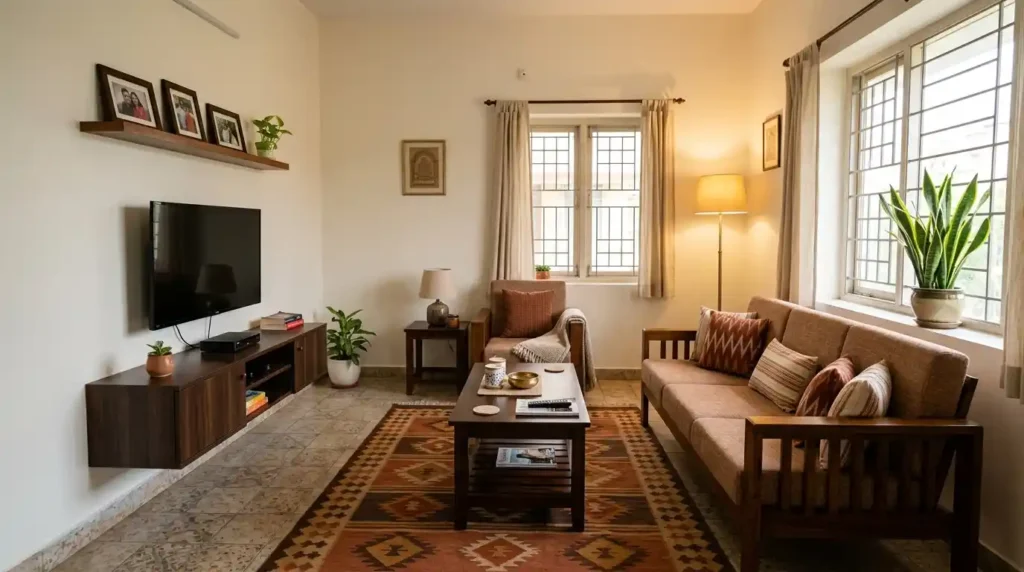
Walk through most design content online and you’ll find either bare minimalism that photographs well but ignores real storage needs, or full-blown luxury renovations nobody’s actually budgeting for. What life looks like for middle class inside middle class homes rarely matches either extreme. It’s furniture that earns its keep, storage that hides daily clutter, and a handful of well-chosen pieces instead of everything at once. Here’s the specific furniture choices, storage strategies, lighting decisions, and realistic budget ranges that actually work for a compact Indian flat or a modest family home no pretending you’re renovating a showroom.
What Middle Class Inside Middle Class Homes Actually Prioritizes
The usual assumption behind budget interior advice is wrong. It’s not about buying cheaper versions of expensive things, it’s about spending selectively so the money that does go out works harder. A living room built around one genuinely well-made anchor piece usually the sofa, or a solid wooden TV console tends to hold up far better over time than five mediocre pieces bought all at once. That single investment piece becomes the room’s visual and functional center, and everything else can stay more modest without the space reading as cheap.
Multifunctional furniture matters more here than in almost any other budget bracket, mostly because space is genuinely tight in most 2BHK and 3BHK apartments. A sofa-cum-bed handles guest sleeping without a dedicated guest room. A storage ottoman doubles as seating and a home for blankets or toys. Nesting tables collapse when you need floor space and expand back out for a gathering. None of this is compromise for its own sake it’s furniture doing two jobs instead of one, which matters a lot more when square footage is the actual constraint.
Buying too many small decorative accessories instead of one or two quality anchor pieces is probably the single most common misstep people make on a budget. A room filled with inexpensive knickknacks reads as cluttered and cheap, while the same money spent on a single solid console or a well-made rug creates a much stronger impression.
Storage-First Layouts for Small Middle-Class Homes
Storage is where the real difference between a chaotic small home and a calm one actually lives, and it’s rarely about buying more furniture it’s choosing furniture that does storage work invisibly. A hydraulic storage bed eliminates the need for a separate wardrobe drawer for extra linens. A floor-to-ceiling wardrobe with sliding doors uses vertical space a standard hinged wardrobe wastes entirely. In the kitchen, vertical storage and overhead cabinets matter more than counter space in most compact layouts, since counter space gets consumed by daily use anyway while overhead storage stays available for things you don’t need constantly.
I’ve noticed the households that actually stay organized long-term solved storage before buying decor, not after. A slim vertical shoe cabinet by the entryway, under-stair storage if the layout allows it, a wall-mounted study desk that folds away when it’s not in use all of it reduces visible clutter without needing a bigger home. That’s really the whole point: solving the storage problem structurally instead of fighting an endless daily battle against mess.
Modular and off-the-shelf storage furniture works fine for most rooms, and typically costs 20 to 30% less than fully custom carpentry the gap comes down to laminate carcass construction versus solid custom veneer work. Custom carpentry still makes sense for awkward spaces, like under-stair storage or a corner wardrobe needing exact measurements, where off-the-shelf sizing just won’t fit right.
Lighting, Color, and Making a Small Room Feel Bigger
Paint and lighting deliver more visual impact per rupee than almost anything else in this category, and they’re consistently the most underfunded part of a budget makeover. Light, high-LRV wall colors reflect more natural light around a room, which matters a lot in small Indian flats where windows are often limited. A single accent wall in a bolder tone adds personality without the cost or commitment of painting an entire room dark, and it draws the eye in a way that makes the room feel deliberately designed rather than accidentally plain.
Layered lighting beats a single overhead fixture every time, and it doesn’t need to cost much to get right. A warm-toned setup around 3000K, paired with two or three lighting layers ambient overhead, a task lamp near seating, maybe LED strip lighting behind a TV unit creates depth a single bulb just can’t manage. Mirrors help too, particularly one placed opposite a window, since it bounces existing natural light back into the room instead of requiring more artificial light to compensate for what’s missing.
Realistic Budgets for a Middle-Class Living Room
Actual numbers help more than vague encouragement here. A simple paint, lighting, and rug refresh for an existing living room commonly runs somewhere between ₹25,000 and ₹60,000, covering most of the visual transformation without touching furniture at all. A more complete room redo new sofa, TV console, rug, lighting, paint typically lands in the ₹1,00,000 to ₹2,00,000 range for a traditional living room setup, though costs shift depending on city, material choices, and whether you’re going custom or modular.
Modular wall-hung TV consoles commonly run ₹12,000 to ₹25,000, while modular shelving tends to land between ₹8,000 and ₹15,000 a rough sense of where mid-range furniture spending actually sits. Treat these as planning benchmarks rather than fixed quotes, since labor costs, city, and brand choice shift the final number meaningfully either direction.
Conclusion
Good design for middle class inside middle class homes isn’t about doing less than you’d like it’s spending deliberately on furniture and storage that earn their place, then layering in lighting, color, and one or two meaningful decor pieces around that foundation. Prioritize storage before decoration, choose one quality anchor piece per room over several cheaper ones, and budget in phases if the full room isn’t affordable at once. Done that way, a modest budget still produces a home that feels genuinely put together.
FAQs
How much does a basic middle-class living room makeover cost in India?
A paint, lighting, and rug refresh typically runs ₹25,000 to ₹60,000, while a more complete redo including new furniture usually falls between ₹1,00,000 and ₹2,00,000. Actual costs vary by city, material quality, and whether you choose modular or custom furniture.
What furniture should I prioritize first on a tight budget?
Start with the sofa or main seating piece and task lighting, since both get used daily and carry the biggest visual impact. A good rug is the third priority most designers point to, since it anchors the furniture layout and adds warmth without a major structural investment.
Is modular furniture good enough, or should I go custom for a budget home?
Modular furniture works well for most standard rooms and typically costs 20 to 30% less than custom carpentry. Custom work really only makes sense for awkward or irregular spaces, like under-stair storage or a tight corner wardrobe, where standard sizing won’t fit.
How can I make a small middle-class living room look bigger without renovating?
Light, high-reflectance wall colors and a mirror placed opposite a window both help bounce natural light around the space, making it feel more open. Layered lighting with two or three sources instead of one overhead fixture adds visual depth too, which makes a small room read as larger than it actually is.
