

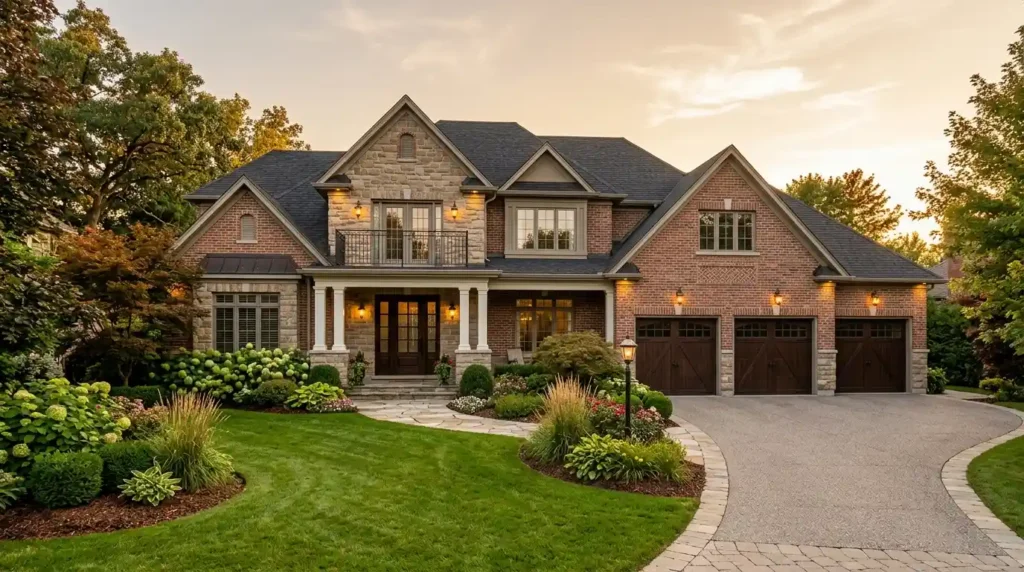
Had someone ask me last month whether their new-build with a three-car garage automatically counted as upper middle class. Not really. Not on its own. Upper middle class homes get defined first by household income, roughly seventy-five to a hundred ten thousand dollars a year by several economic analyses, sometimes climbing past one seventeen to one fifty depending on which source you check. Garage and granite come after that number, not before. Going through what the bracket actually means below, real income figures, and which features genuinely separate this tier from standard middle class housing.
What Income Actually Puts You in This Bracket
Numbers shift depending on the source, worth saying upfront rather than pretending there’s one clean figure everyone agrees on. Pew Research and similar analyses generally place middle class somewhere between fifty-six thousand and roughly a hundred seventy thousand for a household. Wide range, swallows a lot of different lifestyles inside it. Upper middle class sits narrower, I’ve found, usually landing between seventy-five and a hundred ten thousand by some measures, climbing to a hundred fifty by others depending on region and household size.
I quoted a client the AEI figure once, family of four, somewhere between a hundred fifty-four thousand and four hundred sixty-two thousand, and watched her face go blank at how wide that band actually is. Fair reaction. Cost of living swallows that range whole, rural Ohio versus coastal California, a hundred ten thousand stretching completely differently depending on where you’re standing.
So what actually counts, then? Household income somewhere in the seventy-five to one-fifty range generally qualifies in most areas, location shifting that ceiling meaningfully either direction. Same hundred ten thousand, two totally different lives, one in a lower cost-of-living state, one in a major coastal city. Both technically upper middle class on paper. Doesn’t feel that way in practice.
Why Housing Costs Are Eating More of That Income
This part’s genuinely shifted, and it matters more than any feature list ever could. A family earning the nation’s median income now needs something like thirty-four percent of it just to cover a median-priced home’s mortgage payment, per recent NAHB and Wells Fargo Cost of Housing Index data. Bigger bite than it used to take, by a wide margin.
Median home prices have pushed past four hundred thousand nationally as of recent figures, some measures putting it closer to four hundred forty depending on the month. Back in 1975, inflation-adjusted, median home price sat closer to two hundred thirty thousand. Gap’s obvious once you put the two numbers side by side. Homeownership’s shifted too, sixty-one percent of adults owned back in 1971, closer to fifty percent today by some estimates. That’s a real drop.
Can upper middle class households still comfortably afford a home right now? Not as easily as a decade ago, honestly, even sitting on a solid six-figure income. Recent Redfin analysis puts the number needed around a hundred ten thousand annually just to afford a median-priced home without housing eating past thirty percent of income. Plenty of upper middle class earners sit right at that edge now, not comfortably clear of it.
The Features That Actually Show Up in This Tier
Move past the income number and real patterns start showing up. Custom or semi-custom construction, more than in standard middle class housing. Dedicated home offices. Walk-in pantries. Three-car garages built for genuine storage, not just parking two cars and a bike. I’ve walked through enough of these listings to notice the same handful of upgrades repeating, smart home automation, zoned HVAC, heated bathroom floors, comfort fixes more than flash.
Outdoor living tends to run more developed too, built-in grills, covered patios, sometimes a pool depending on climate and lot size. None of it’s universal, worth saying clearly. But it shows up often enough across listings and design coverage that it’s become a recognizable pattern rather than random luxury bolted on.
What’s the actual biggest difference between middle class and upper middle class homes? Space and finish quality, mostly, not one dramatic feature everyone points to. A dedicated home office instead of a shared corner of the living room. A walk-in closet instead of a standard reach-in. Professional-grade kitchen appliances instead of builder-grade. Gap shows up in dozens of small upgrades, honestly, rarely one obvious signal you can point at.
Where These Neighborhoods Tend to Land
Location plays a bigger role than people expect walking in. Top-rated school districts drive a lot of the premium here, buyers in this bracket frequently paying noticeably more for strong public schools rather than covering private tuition separately. I’ve watched families choose a smaller house purely for the district line. Planned communities and HOA neighborhoods show up constantly too, clubhouses, walking trails, community pools, amenities individual homeowners couldn’t easily replicate on their own even with money to spend.
Move-up market pricing generally sits three hundred to five hundred thousand nationally, though that shifts a lot region to region. Genuine step up from entry-level without crossing into true luxury, and it’s where I see a lot of upper middle class buyers actually land once they’re moving out of a starter home.
Conclusion
Upper middle class homes get defined by income first, roughly seventy-five to a hundred fifty thousand depending on source and location, with features like custom finishes, dedicated offices, and planned-community amenities following from there rather than defining the bracket on their own. Housing costs have eaten a growing share of that income over the last decade, and the line between comfortable and stretched has moved even for households sitting well above the national median. Understanding the actual numbers matters more than chasing any single feature or finish.
FAQs
What income is considered upper middle class for a family?
Most estimates place upper middle class household income somewhere between seventy-five thousand and a hundred fifty thousand dollars annually, though broader analyses covering a family of four push that range even wider depending on region. Cost of living plays a significant role in how far that income actually stretches.
Do upper middle class homes always have a pool or three-car garage?
No, these features show up commonly but aren’t universal requirements for the bracket. Climate, lot size, and regional building norms all affect which amenities actually appear, and plenty of homes in this income tier skip a pool entirely while still qualifying based on income and other features.
Is a household earning a hundred thousand dollars still considered upper middle class today?
In many regions, yes, though rising housing costs mean that income doesn’t stretch as far as it did a decade ago. Recent affordability data suggests households now need closer to a hundred ten thousand dollars just to comfortably afford a median-priced home without exceeding thirty percent of income on housing costs.
How is upper middle class different from truly wealthy or upper class?
Upper middle class households typically rely primarily on salaried professional income rather than significant investment or inherited wealth, which caps both their assets and their financial flexibility compared to genuinely wealthy households. The distinction usually comes down to income source and asset accumulation rather than lifestyle alone.
