

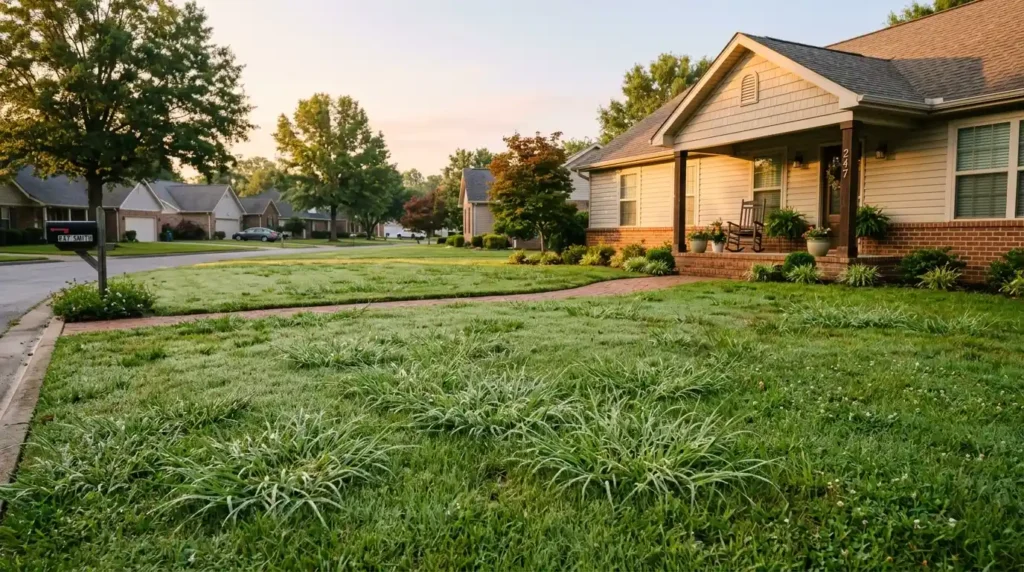
This is one of the most stubborn invasive weeds that can be found in any lawn. First, I have personally suffered with crabgrass for years and years and, again, early action is the key. It is a warm season annual weed from the Poaceae family that grows aggressively in lawns, gardens, and landscapes across the globe. It is important for all homeowners to understand the biological characteristics of this weed .management.
What Exactly Is Crabgrass and Why Does It Matter?
Crabgrass belongs to the genus Digitaria spp. It is an aggressive, warm-season annual grass. The two species that are highly problematic are large crabgrass (Digitaria sanguinalis) and smooth crabgrass (Digitaria ischaemum).Both species are summer annuals that grow from seed each single season. They are classified and grouped in taxonomy quite well in the family Poaceae that is the family of grasses throughout the world.
The common names are fingergrass, summergrass and crab-finger grass, due to its spreading growth habit. It is frequently confused with other perennial grasses with similar appearance such as goosegrass, dallisgrass and bermudagrass. Correct scientific name and identification markers are very helpful in saving time and effort during the management process.
How to Identify Crabgrass in Your Lawn
Identification plays a critical role in crabgrass management. Crabgrass is a bunch grass with jointed, finger-shaped or leg-like branches resembling those of crabs. This is how it got the name, and it will come in handy during identification. The plant develops shallow, fibrous roots and creeping stems that root at their joints as they grow. The hairy crabgrass species has both sides of its leaf sheaths and blades covered with hairs.
On the other hand, smooth crabgrass is characterized by non-hairy branches and blades lying flat against the ground surface. Unlike annual bluegrass (Poa annua), whose leaves fold inside the bud, crabgrass’ leaves unroll from the bud stage. One individual plant can give rise to branched seed heads yielding 150,000 seeds each growing season. While plants wither away following the first hard frost in fall, their seeds remain dormant until the next spring.
Smooth Crabgrass: A Closer Look
This perennial plant spreads mainly via seeds, as well as through root formation from stems. If not cut, the plant can grow up to 6 inches tall, yet, when cut down to only half an inch, it can continue growing seeds. This weed prefers forming patches in lawns and usually forms thick clumps since there are several individual plants growing together. Seedling leaves have light green color and are rather smooth. Thus, pale leaves are easily distinguishable on already grown lawns. Fully grown leaves are dark green but remain smoother and paler than most turfgrasses surrounding it.
A membranous appendage called a ligule is found at the base of each blade of leaves. The collar area of the blade is not characterized by auricles as seen in some other grasses. The upper side of the leaf blade is glabrous but there may be some pubescence on the lower side of the leaf blade. Reddish coloration can also be seen at the base of the leaf blade which can be used for identification purposes. An inflorescence or flower stalk bears 5 to 7 awnlike spikes emerging from the central stem at intervals of 1/8 inch to 1/4 inch apart.
Large Crabgrass: What Makes It Different?
Large crabgrass behaves similarly in turf but has some notable differences worth understanding clearly. It is also low-growing when found in turf and spreads by seed and by rooting at stem nodes touching soil. Left unmowed, large crabgrass can reach up to 2 feet tall, making it far more visible than smooth crabgrass. It does not tolerate close mowing as well as smooth crabgrass and is less common in maintained turf situations.
Seedling leaves are light green and hairy, while true leaves are slightly darker and about 3 inches long. Hairs cover both the upper and lower surfaces of the leaf blade and sheath completely and densely. Its flower stalk carries 3 to 11 fingerlike branches that are longer, measuring about 2 to 5 inches at the end. Most remarkably, seed production from a single large crabgrass plant can exceed 100,000 seeds per season easily.
Distinguishing Crabgrass from Other Grasses
The flower stalks of both types of crabgrass are quite similar to those of bermudagrass and goosegrass. The finger-shaped branches of the crabgrass flower stalk appear initially at an interval of 1/8 to 1/4 inches, which is located at the tip of the flower stalk. The finger-like branches are usually more elongated compared to those that grow on the flowering stems of bermudagrass and goosegrass. In bermudagrass and goosegrass, the branches on the flowering stems emerge from one single point.
The finger-like branches that grow on dallisgrass flowering stems are widely spaced out from each other. Like in bermudagrass, dallisgrass can also be differentiated from crabgrass by the vegetative means of reproduction it employs to rapidly spread. It is essential to know the time of germination of all weeds since that will help you to plan your activities. In this case, both species of crabgrass will germinate once the soil temperature is consistently 55 degrees Fahrenheit for a couple of days in the presence of soil moisture. Both types will germinate in the Southern coast of California, where the temperatures are relatively low year-round, from mid-January to early April.
Germination Periods: When Does Crabgrass Strike?
It is necessary to know the germination time of all the weeds because that would allow you to plan your operations accordingly. The two crabgrasses would germinate when soil temperature is 55 degrees Fahrenheit continuously for a few days with adequate soil moisture. They would germinate in southern coastal California where there are relatively mild temperatures year round, between mid-January and early April. New seedlings will be appearing during spring and summer months, and the flowering process can take place as late as July or August.
Germination and growth of plants will be happening in Southern California’s inland valleys from mid-February until early April before dying due to the first frost. For the Central Valley and Central Coast areas, crabgrass will germinate from early February until mid-March, continuing to grow during the summer and autumn seasons. The first frost and cold temperatures will kill the plants by late October in Central California. Crabgrass species in Northern California and the North Coast area will germinate during late February to mid-March. Warm surfaces near buildings and pavement trigger early germination, serving as a useful seasonal indicator for the entire area. I always watch for these early patches near my driveway as my personal signal to begin preemergence treatments immediately.
Where Crabgrass Thrives and Why It Loves Your Lawn
The crabgrass flourishes on the turf and landscape where it gets hot and dry soils. It can easily compete with other turfgrasses in lawns because of its ability to flourish in hot and sunny weather conditions. This weed grows based on the period of daylight. It germinates in the spring season when the soil temperatures reach 55 degrees. Its growth continues during the summer months and starts to flower during the fall season.
Crabgrass drops its seed and dies by the first frost, only to return reliably in spring again. Its extraordinary heat tolerance and drought tolerance make it a fierce competitor in any weakened lawn environment .It is most effective on lawns that lack moisture, soil compaction sites, poor quality thinning grass, and bare patches that have no vegetation present. The crabgrass seed requires light for germination, and lower mowing levels result in greater light levels, which give the weed seeds a definite advantage. Mowing at higher levels shades the weed seeds, ensuring a competitive advantage for the lawn grass.
Cultural Control: The Foundation of Crabgrass Management
Based on my personal experience, cultural control is the best approach for controlling crabgrass problems over a prolonged period of time. Cultural controls include techniques used in gardens that will prevent weeds from establishing themselves, reproducing, spreading, surviving, and at the same time ensure the vitality of the turf grass. The surest method of preventing crabgrass invasion of your garden is to maintain a dense and healthy lawn. Raising the cutting height to at least three inches, sunlight will be prevented from reaching the soil, thus preventing the germination of crabgrass seeds. In trimming the grass, do not cut more than one-third of its leaves.
Mowing the lawn should be followed by cleaning the mower to avoid transferring the seeds elsewhere. Select the appropriate grass type depending on the region where you live, considering many variables like shade, drought tolerance, foot traffic, wear resistance, and pest problems. Cool-season grasses include bentgrass, Kentucky bluegrass, tall fescue, and ryegrass, which grow well in northern and coastal California. Warm-season grasses consist of bermudagrass, buffalograss, St. Augustine, zoysiagrass, and kikuyugrass. Consultation can be sought from the local nursery, sod suppliers, and landscape contractors regarding the best grass species for your particular geographical location. Hybrid bermudagrass is highly invasive, yet it needs six hours of full sunlight each day to flourish.
Therefore, fertilizing plays an absolutely crucial role due to the fact that the quickly growing and thick grass does not give any opportunities for the emergence of crabgrass seeds. One must understand that the vast majority of lawns should receive up to 4-6 pounds of nitrogen for each 1000 sq. ft., using a certain amount of fertilizer for four to six treatments each year. Different types of fertilizers with high contents of nitrogen, phosphorous, and potassium should be applied at least once during a year, preferably in spring. Overgrown grass lacking proper fertilizing would give rise to crabgrass and weed. The moment of irrigation is critical since too watered lawns watered daily have shallow roots. Water must be applied deeply up to 6 to 8 inches deep and less often to promote deeper roots development. Thin areas should be resown and filled with plugs.
Cultural Control in the Landscape and Garden
In ornamental landscape beds, crabgrass is easily controlled through hand pulling, hoeing, and mulching before plants set seed. Solarization using clear plastic over a 4 to 6 week process is effective for eradicating crabgrass plants and seeds in soil. This works best when applied during periods of high solar radiation for maximum killing effect on seeds. Covering the soil with wood chips, nuggets, yard waste compost, or synthetic landscape fabric prevents the necessary exposure to sunlight for seed germination and initial growth. The depth requirement for coarse mulch should be 3 to 6 inches, whereas fine mulch only requires depths of 2 to 3 inches.
Replace landscape mulches as often as necessary due to decomposition, displacement, and settling that eventually result in reduced effectiveness in preventing weed growth. Mulches that slowly break down into organic matter and create a suitable growing environment for crabgrass seeds require proper management. Raking or disturbing mulch with a hoe is one method used when crabgrass seeds start to grow within the mulch bed. Using a flamethrower is an effective way to destroy crabgrass, but do not use it around flammable materials.
Chemical Control: Herbicides That Work
Chemical control provides dependable results where cultural practices cannot successfully control crabgrass on their own. Pre-emergent herbicides are used prior to weed seed germination, while post-emergent herbicides are used once weeds emerge. The main aspect of successful pre-emergent herbicide control of crabgrass in home lawns involves timing of application, even distribution of the herbicide, and ensuring that adequate water reaches the soil to activate the chemical. Most pre-emergent herbicides require irrigation with roughly half an inch of water shortly after application in order to penetrate the weed seed germination layer.
In many areas of California, crabgrass germinates and grows for 6 to 8 months, sometimes requiring a second application for extended control. The effective active components used in preemergence herbicides include pendimethalin, prodiamine, benefin, bensulide, dithiopyr, indaziflam, mesotrione, sulfentrazone, napropamide, oryzalin, trifluralin, and isoxaben for site application. Weed and Feed products include both fertilizer and herbicide where the fertilization and herbicidal activity of the preemergence herbicide can be applied in spring at the same time. Please note that planting of seeds should not be performed before the complete degradation of the preemergence herbicide in the soil.
Postemergence herbicides enter the plant system through leaf surface or stem surface into the root system. Applying postemergence herbicides depending on the life cycle of crabgrass will be more effective where young plants need to be targeted. Quinclorac is very common but resistant weeds of crabgrass species are found. Topramezone controls broadleaf and grass weeds including crabgrass and causes chlorophyll loss, growth stops, and weeds die relatively quickly. The combination of quinclorac and topramezone is very effective at controlling crabgrass after it emerges from the ground, although the latter herbicide is not safe for all types of turf grass.
Most postemergent herbicides need to be mixed with surfactants, which help them spread and stick to foliage and stems. Nonselective herbicides such as glyphosate and glufosinate can be applied through selective spot treatments because these substances can harm desirable ornamental plants within your landscape. There are several organic-compatible contact herbicides that can be applied to control crabgrass selectively but are not systemic, meaning that they will require repeat applications. It is best not to apply herbicides in garden plots where you grow vegetables because both the crops themselves and their roots could be harmed by these pesticides.
Benefits, Origins, and Ecological Role of Crabgrass
Despite its reputation as a troublesome weed, large and smooth crabgrass do have some legitimate agricultural value worth acknowledging. Both species have been used in grazing systems and hay production for farm animals across many countries worldwide throughout history. Crabgrass has also been grown as a cereal grain in various countries, demonstrating its nutritional value and agricultural use beyond lawn management.
It falls under the category of alien because it is native to Europe and Asia but not to North America It was introduced to the US as a forage crop in the year 1849, hence it is termed as a naturalized species because of its biogeography. The grasses that resemble crabgrass are the quackgrass, bermudagrass, and tall fescue.
Conclusion
Indeed, crab grass is one weed that a person will never find easy to deal with in their lawns. Crab grass reappears every year in the spring and tries to take over every poorly managed lawn in sight. From my years of experience in dealing with this weed, I have found out that there is no beating crab grass without being consistent, patient and having an effective approach. While cultural practices such as proper mowing, watering deeply and proper fertilization form your best weapon against crab grass on annual basis, use of herbicides is recommended when these measures do not suffice.
Whether using preemergence or post-emergence application techniques of herbicides, ensure that you apply them while the soil temperatures are optimum for controlling the weed. With a dense and actively growing lawn, crab grass will be history in the coming days. Never let crab grass produce any seedlings, since the seeds can remain dormant in the soil for at least three whole years.
Frequently Asked Questions (FAQ’s)
Crabgrass is a warm-season grass in the Digitaria genus that grows from seed and spreads aggressively during warmer months. Large crabgrass (Digitaria sanguinalis) and smooth crabgrass (Digitaria ischaemum) are the two main species discussed in the article.
Smooth crabgrass has flatter, mostly hairless leaves and tolerates close mowing better, while large crabgrass has noticeably hairy leaves and can grow much taller when left unmowed. Large crabgrass also produces long, finger-like seed branches and can generate more than 100,000 seeds in a season.
Maintain a thick lawn by mowing at about three inches, watering deeply rather than frequently, fertilizing appropriately, and repairing thin or bare areas. Taller, healthy turf shades the soil and makes conditions less favorable for crabgrass seeds to germinate.
Pre-emergent herbicides are designed to stop crabgrass before seeds germinate, while post-emergent products target plants that have already appeared. The better option depends on the growth stage, although the article emphasizes that correct timing is essential for either approach.
The article recommends acting around the period when soil temperatures remain near 55°F for several days, because this is when crabgrass seeds begin germinating under suitable moisture conditions. Early treatment is especially important because new seedlings can continue appearing through spring and summer.

1 thought on “Crab Grass: How to Identify, Kill, and Keep It Gone for Good”