

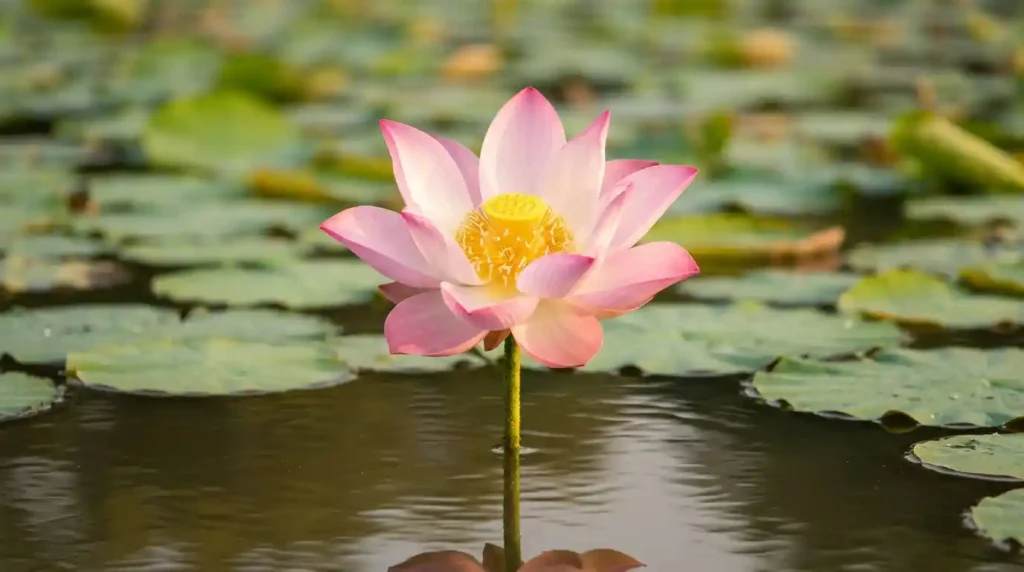
I remember when I really did take some time off to see the lotus flower that had sprung up from the water. This particular lotus flower was lying down peacefully in the dirty water, but at the same time it was so clean. And all of this helped me develop an entirely new perception of flowers and the beauty that lies within them. It’s not just a flower, as it can surprise you every single day.
What Is the Lotus Flower and Where Does It Come From
The botanical name of the Lotus is Nelumbo nucifera. In Sanskrit, its other names are Padma and Kamala, which hold a spiritual significance in Asia. Its exceptional flower is alternatively referred to as the sacred lotus, pink lotus and the Indian lotus. It belongs to the plant family Nelumbonaceae and Proteales order that consists of protea flowers and Sycamores. The confusion that most people experience is that they mistake it with a water lily, which is totally a different plant of the family Nymphaeaceae.
The lotus is widely distributed throughout India, Indochina, East Asia and the Amur region in total. It also spreads throughout Sri Lanka, Southeast Asia, New Guinea and Australia, with much of its spread being the result of ancient human translocations over centuries. It has the distinction of being the national flower of India and is also considered an important national symbol in Vietnam. This plant has been grown in China for around 3000 years and is highly prized for its edible seeds, rhizomes, and spiritual meaning.
The Biology of the Lotus: A Flower Built to Survive
The real magic of lotus is its breath-taking biological design and its sheer beauty which is bred for adaption. Lotus plants grow on the flood plains of the slow moving rivers, the delta and the soil that is constantly flooded and is rich with nutrients and loamy. The roots grow into the water-soaked soil, and the big round peltate leaves float gently in the water. In deep water the leaf stalks or petioles can reach a length of up to 200cm, enabling the plant to grow in deep water.
The leaf blade or lamina may be as huge and spectacular as 80-100 cm in diameter. The stems are several centimetres above the leaves and bear showy flowers up to 35 cm in diameter. The flowers have their own thermostat, and can keep the temperature at 30 to 35 degrees Celsius even at a low outside air temperature of 10 degrees. The thermogenic effect is thought to draw in cold-blooded insect pollinators like bees, wasps, beetles and flies to the flower The fruit of a fertilised lotus flower has 10-30 seeds in it.
The Lotus Seed: Dormancy, Germination, and Rebirth
Among the most amazing examples of patience, dormancy, and over time, rebirth, is the lotus seed. Seeds are darkly coloured, ovoid in shape, 1-2.5 cm wide and 1-1.5 cm long. They drop to the muddy bottom of ponds where they will lie dormant and ungerminated for an incredible length of time. A sacred lotus seed, dating from about 1300 years ago, was successfully germinated while in dormancy in 1994.
Hence the Chinese use the lotus as a symbol of longevity, patience and the sustaining of spiritual strength.. The Manchurian lotus holds an equally fascinating story rooted in discovery and science and human curiosity together. Dr. Ichiro Ohga, a Japanese botanist, discovered Manchurian lotus seeds in a dried lakebed in Leoning province, China in 1919. He brought those seeds to the United States, and in March 1952 at Kenilworth Aquatic Gardens, Horace V Wester germinated them successfully. Those seeds were estimated to be up to 1,000 years old, making them the oldest seeds ever to germinate successfully anywhere.
Types of Lotus Flowers: Varieties, Colours, and Cultivars
There are many types of lotus flowers and they all have their own unique meanings and colors. which include white, pink, blue, red, and yellow. There are more than sixty kinds of lotus flowers, each with their own color, white, pink, blue, red, and yellow. White Lotus is considered to be a flower that symbolizes purity and perseverance, and serves as an advice on remaining loyal to your beliefs during difficult times. It is normally the pink color lotus flower and it is commonly depicted in Hindu images.
Red lotus flowers represent passion, strong expression and the power to overcome whatever harms and reincarnate. The number of petals in some of the cultivated varieties is amazing enough to strain the limits of a single bloom. The Chinese lotus, thousand petals lotus or qian ban lian, can have a thousand to four thousand petals in a single flower.The Japanese variety ohmi myoren, meaning strange lotus, can hold between 2,000 and 5,000 petals, the greatest recorded for any plant. Flower lotus cultivars are used for ornamental purposes, producing many flowers in single, double, and multi-petal forms beautifully.
Sacred Lotus, American Lotus, and Other Notable Varieties
The Sacred Lotus, Nelumbo nucifera, stands tall with broad green leaves and bright pink flowers above the waterline. It is entirely edible and deeply important to many Asian cultures and religions across the continent throughout history. The American Lotus, Nelumbo lutea, is the only lotus variety native to the Americas, growing as far north as New York. Its flowers are a delicate yellow with seedpods that begin as yellow inside before maturing into deeper tones naturally. Indigenous communities across the Americas historically used the American lotus as a food source and a means of trade. The Charles Thomas Lotus produces medium pink blooms that shift into a slightly translucent lavender pink colour over time.
The Double Rose Lotus is a fragrant flowering aquatic plant with beautiful blooms and round leaves held 3 to 6 feet above water Perry D. Slocum Lotus starts blooming in deep pink and later transforms into pink and yellow after two days and into creamy yellow by the third day. The Empress Lotus, also known as Alba Striata, blossoms with white flowers with mild pinkish colors at the tips of each petal. Finally, the High Cotton Lotus, also known as Shiroman, gives huge white double flowers with ruffled outer petals covering golden stamens within.
The Lotus Life Cycle: From Seed to Full Bloom
The life cycle of the lotus starts from its seed stage. It is transported by moving water through ponds and wetlands. The seeds find their way to muddy beds in ponds and other slow-moving water bodies. A sprouted seed is called a seedling, and from this stage the lotus sends leaves upward and roots downward simultaneously. Leaves grow until they reach the water surface, eventually unrolling and growing up to 24 inches in circumference on top.
The leaves then rise 6 to 8 feet out of the water before the iconic lotus flower begins to form above them. The buds emerge from the plant’s base, also growing up to 6 to 8 feet, and bloom above water but remain there for a couple of days only. In this couple of days, the flower will generate heat, fragrance, and nectar to lure its primary pollinators, mainly beetles. When pollination is complete, seed pods form from the flower, initially forming as tiny green buds and eventually turning brown and woody. Ultimately, the pods burst open to scatter hundreds of seeds, thus marking the start of the fascinating life cycle once more.

The Lotus Effect: Superhydrophobicity and Scientific Wonder
One interesting property of the lotus flower is its superhydrophobicity or the lotus effect which is now being studied by scientists. When observing a lotus leaf with a microscope, you will find that there are micro and nano structures on the surface of the leaf, which makes the leaf very rough. This rough surface and the coat of wax on the leaf surface makes it very difficult to retain water. The water drops on the lotus leaf and rolls around and rolls away taking dirt and mud along.
This self cleaning helps the plant in the process of photosynthesis to not get blocked or dirty. The task now is for scientists and engineers to copy the lotus leaf structure in order to make lab coats that do not get soiled by spills. The lotus effect has been directly inspired for the development of waterproof phones, safe airplane travel, and hydrophobic textiles. The leaves of submerged lotus have a silvery color due to the thin layer of air which forms a natural boundary around them. Every time I read about it in any scientific context, this aspect of the lotus is absolutely mind-blowing.
Lotus Symbolism: Purity, Rebirth, and Overcoming Adversity
The symbolism of the lotus flower is largely positive, encompassing both purity, rebirth and resilience, as well as awakening and defeating the odds in the name of spirituality. This symbolism emanates from the fact that the lotus continues to bloom amidst swampy, dirty and foul smelling stagnant water. Petals start to bloom amidst the filthy water, showing how beauty can be seen even in tough situations. The lotus flower is symbolic of spiritual transformation of the soul since it continually produces new ones whereas the other ones die within a period of days. Lotus flowers continue to reproduce each year by producing several thousands of seeds; some blossom immediately whereas others remain dormant for ages.
The lotus flower is symbolic in yoga and reiki practices, where it is helpful in assisting people to submit gracefully, connect with, and accept negativity. The lotus teaches that negative feelings such as sadness, unease, and others are not inherently evil and have the potential to become something beautiful and glorious. Nowadays, meditation, yoga, self-discovery and inner peace are all associated with the symbol of the lotus flower. The flower effect on human spiritual growth is just as powerful as its physical effect on water rolling off its leaves.
Lotus Flower across Religions and Cultures
The lotus is used with great consistency in the religion of Hinduism, Buddhism, Jainism, Ismailism and Chinese culture, to represent the deep spiritual meaning. All four gods (Vishnu, Lakshmi, Brahma, and Kubera) are shown seated on a pink lotus throne, or with a lotus flower in their hands, in the Hindu religion. The two are Lakshmi and Saraswati, both of whom are connected to the lotus which signifies spiritual enlightenment, beauty, fertility, prosperity, and eternity.
The tradition of tantras employs the symbolism of lotus to depict chakras, energy centres of the human body, each of which has a particular number of lotus petals. In traditional tantric teachings, the root chakra at the bottom of the spine is called a lotus with four petals.
Likewise, the uppermost part of the head is represented in the form of thousand-petaled lotus, which is known as the crown chakra. It also represents Gautama Buddha of the Buddhist religion as lotus is very clean and untainted; it never touches the mud underneath it. This sect of the Buddhism was originated from the flower sermon, where Gautama Buddha gave wisdom to his disciples in silence. One of the main principles of Buddhism, known as the Lotus Sutra, states that all individuals have the potential of attaining total enlightenment irrespective of anything else Within Jainism, the Tirthankaras, which are considered the founders of the faith, are invariably depicted as seated on the divine thrones of the lotuses within their iconography.
In Ancient Egypt, the lotus flower symbolized the god Ra, who created life and restored day and night. The blooms of the Egyptian lotus flower appeared during daytime but closed as soon as night fell, similar to the sun.The Egyptian lotus flowers, opening in the morning and closing at night rebirth perfectly captured .The blue lotus used to flourish on the banks of the Nile in abundance and was considered to be a symbol of fertility and abundance The lotus flower is depicted in numerous Ancient Egyptian art, especially that of the Pharaohs and gods, as well as in hieroglyphics inside their tombs and temples. In fact, the Egyptian lotus, which is its proper name, is a water lily belonging to the genus Nymphaea, N. caerulea or N. lotus.
The Lotus in Food, Medicine, and Everyday Life
The lotus symbolizes divinity; however, the flower itself is practical and nutritious and forms a significant component of the diet among Asian populations. The stems of the lotus are used extensively for different cuisines owing to their medicinal and nutritional benefits. There are certain alkaloids found within the flower that are medicinal in nature, and these alkaloids include nuciferine, neferine, coclaurine, and norcoclaurine. In addition to its traditional medicinal and nutritional applications, the leaves of lotus are also a good source of flavonol miquelianin, which is also useful in traditional medicine and functional foods. Lotus rhizomes are ready for consumption after about 6-9 months, and are collected from July through March depending on the variety.
Starch-rich deep cultivar rhizomes are harvested using fork-like tools by hand or fully replaced by machines in Japan and large farms. Seeds and seed pods are harvested when they turn black, then sun-dried for two to three days before processing begins. Lotus flowers themselves can produce ink used by artists like Morrison Polkinghorne to create abstract images of southern Asian landscapes. In Chinese cooking, seeds and tubers from varieties like the Double Rose Lotus are used in recipes for significant cultural festivals.
Lotus and Flower in Art, Poetry, and Modern Culture
Countless artistic creations ranging from paintings and poems to modern-day design, architecture, textiles, and many others have been based on the lotus through all times of human existence. From the pages of ancient Sanskrit literature to the inscriptions in hieroglyphics, through the practices of the Sinhalese to the world of Chinese art and culture, one can find representations of the lotus. At present, the lotus is identified with qualities of peace, elegance, and spirituality. Lotus-themed homes create calmness, develop connections with nature, and enhance spiritual growth.
Giving a lotus to someone may be an expression of deep love and feelings in some cultures. The effect of the lotus flower on human creativity is evident whether it is a thousand-year-old tomb or a modern relaxation area. Last year I gave the gift of a lotus print to a friend for her home and she said that it brought a sacredness to the space. The lotus story also has an environmental sensitivity, as these flowers play an important role in the ecosystem and the quality of water. The conservation of lotus habitat is directly linked to the conservation of the aquatic environment on which a myriad of species, including aquatic life, rely every day.aquatic ecosystem that countless organisms, from aquatic organisms to pollinators, depend on daily.
Conclusion
The lotus and flower have never been something that can be entirely captured by language. Every single lotus that rises up out of the waters is an example of resilience in the face of difficulties, purity, and spirituality. The lotus flower is one of my life-long studies, which constantly amazes me. Lotus flower and lotus are not only natural phenomena but also live phenomena that unite different eras and cultures. It is found both in the tombs of ancient Egypt and in the modern yoga studio.
Lotus flower is not only a symbol of spiritual purification but also of self-realization. Lotus flower contains much more than its petals, and you can plant it in a pond, gift it to your loved one, or admire it at a distance. They remind us that the most beautiful things in life often grow from the most unexpected and difficult places of all
Frequently Asked Questions (FAQ’s)
The lotus flower, botanically known as Nelumbo nucifera, is an aquatic perennial that grows from muddy, waterlogged soil and produces large flowers above the water. It is also called the sacred lotus or Indian lotus and has deep cultural and spiritual importance across Asia.
Lotus and water lilies are different plants: the sacred lotus belongs to the Nelumbonaceae family, while water lilies belong to Nymphaeaceae. Lotus flowers and leaves typically rise above the water, which is one of the features that helps distinguish them.
The lotus rises from muddy water yet produces a clean, striking bloom, which has made it a long-standing symbol of purity, resilience, rebirth, and spiritual growth. Its ability to return through new flowers and exceptionally long-lived seeds strengthens that association.
Lotus leaves have microscopic surface structures and a waxy coating that cause water to bead up and roll away instead of spreading across the leaf. As the droplets move, they carry dirt with them, creating the self-cleaning phenomenon known as the lotus effect.
The sacred lotus, Nelumbo nucifera, is the variety most strongly associated with religious and cultural symbolism in the article. It has important connections with Hinduism, Buddhism, Jainism, and Chinese culture, where it commonly represents enlightenment, purity, prosperity, and spiritual transformation.

3 thoughts on “From Mud to Magnificence: Everything You Need to Know About the Lotus and Flower”