

A coworker of mine grew up in Yekaterinburg and one day at lunch she just started describing her childhood apartment. And honestly none of it lined up with what I thought I knew. She kept saying “three rooms” like that explained the whole layout. And I kept picturing three bedrooms until she stopped and laughed at me for it. Turns out that gap, what Americans assume versus how Russian middle class homes actually get talked about, is basically the whole story here. Room counts don’t work the way you’d think, apartments run smaller than people expect walking in, and the mortgage system doesn’t look anything like what buyers deal with in the US. If you’re researching this seriously the terminology alone will trip you up long before you even get to prices.
How Russians Actually Count Rooms in a Home
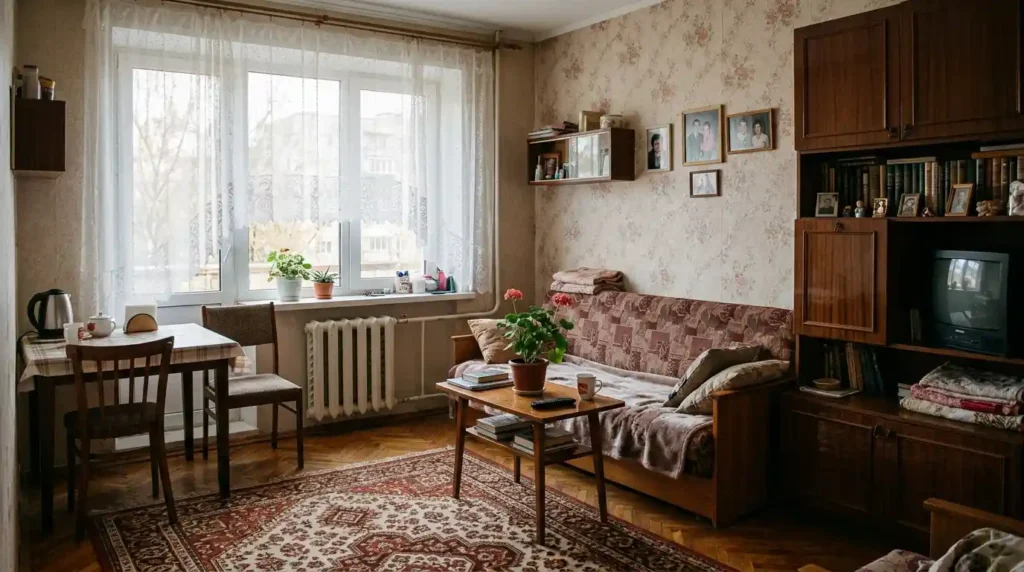
My coworker’s story is what finally made this click for me, she had to walk me through it slowly though. Russians count total rooms, not bedrooms, and the kitchen and bathroom don’t count as rooms at all, so a “three-room apartment” usually just means one living space that doubles as a bedroom plus two more rooms, and those extra rooms can be a bedroom or an office or honestly just extra space depending on who’s living there and what they need that year. Sounds confusing at first but it’s actually more flexible than fixed bedroom counts once you sit with it a bit, a room’s whole job can shift depending on the family.
The biggest room in the apartment usually does triple duty too, living room during the day, dining space in the evening, then it becomes a bedroom at night if the family’s tight on space, which a lot of families are. My coworker’s family used their main room exactly like that growing up and she swears it never felt cramped, even though describing it out loud now makes it sound like it should have.
How Many Rooms Does a Typical Russian Apartment Have?
Most families end up living in something closer to a 1.5 or 2-bedroom setup even though the average stats say something like 2.5 rooms per household, which never quite matches what you’d picture from that number alone. A typical one-bedroom runs around 30 square meters, that’s something like 323 square feet if you’re doing the conversion in your head, and a typical two-bedroom sits closer to 45 square meters, roughly 485 square feet. Compare that to whatever gets called a two-bedroom in most American cities and you’ll start to understand why people house-hunting in Russia from abroad keep getting blindsided.
What Russian Middle Class Homes Actually Cost
Prices swing more by city here than almost anything else about Russian housing, and Moscow just skews the entire national picture, hard. A one-bedroom in the center of Moscow typically rents somewhere between 70,000 and 150,000 rubles a month, based on cost-of-living numbers tracked by sites like Numbeo, and that same size apartment drops to something closer to 62,000 once you’re outside the city center. Same square footage, real gap, just depends which side of the ring road you land on.
Buying gets steep fast though. Price per square meter in central Moscow runs somewhere around 683,000 rubles right now, which honestly puts it in the same conversation as cities like Shanghai rather than anything comparable elsewhere in Russia. Go out to Nizhny Novgorod instead and that number drops all the way to roughly 128,000 rubles per square meter, a gap big enough that “affordable” basically means something totally different depending on where you’re even looking.
How Much Does It Cost to Buy an Apartment in Moscow?
Somewhere around 683,000 rubles per square meter if you’re in the city center, dropping to about 321,000 once you move outside it, and that’s before you even factor in the specific neighborhood. A modest three-bedroom in central Moscow can run about 230,000 rubles a month just to rent, while that same layout out in the outskirts often lands closer to 75,000. Location does more work here than almost anywhere else I’ve dug into.
Why So Much Russian Housing Still Needs Real Repairs
This part actually caught me off guard, and it’s not something most cost-of-living guides bother mentioning up front. Something like 1.6 million Russians currently live in buildings officially classified as slums or otherwise uninhabitable, going by figures RFE/RL has reported on Russian housing conditions. Around 150,000 homes get officially declared uninhabitable every single year, and most of them are buildings sitting at 40 or 50 years old that haven’t seen a real upgrade in two decades or longer.
A lot of it just comes down to basic building envelope stuff rather than anything dramatic. Old wooden window frames let out something close to 80 percent of a home’s total heat loss, at least according to figures the Russian Ministry of Construction has cited, and that matters a whole lot more in a country where entire regions deal with genuinely brutal Siberian winters every single year. Heating runs through centralized systems tied to a handful of massive power plants instead of individual furnaces, so residents don’t really get to control their own temperature the way homeowners in most Western countries do. My coworker brought this up too actually, said her childhood apartment ran uncomfortably warm most winters no matter what anyone tried to do about it.
How Middle Class Families Actually Finance a Home
Russian middle class homes get financed through a pretty specific set of government-backed programs. Rather than the open mortgage market Americans are used to dealing with. The family mortgage program offers a 6 percent annual rate across most of the country. Extended through 2030, open to citizens between 18 and 75 including single parents and families raising kids with disabilities. Loan amounts run higher in Moscow and St. Petersburg. Up to 12 million rubles, versus 6 million in most other regions.
There’s a separate IT-worker mortgage program too. Though it got revised back in mid-2024 and doesn’t cover Moscow or St. Petersburg anymore. The focus shifted toward specialists working in other big cities instead. Minimum income for that one sits around 150,000 rubles a month before tax. Rural and Far Eastern mortgage programs exist on top of all this, offering even lower rates. Sometimes down around 2 to 3 percent a year. Aimed at pulling people toward smaller cities and regions the government’s trying to grow.
What Mortgage Programs Help Russian Middle Class Families Buy Homes?
The family mortgage program is the broadest one out there. A fixed 6 percent rate open to a wide range of eligible citizens through 2030. Regional programs like the Far Eastern and rural mortgage initiatives go even lower for buyers. Willing to purchase somewhere outside the major cities. Most need a down payment starting around 20 percent, with loan terms stretching up to 30 years. Depending on which specific program you’re looking at.
Conclusion
Russian middle class homes run smaller than people expect. Get described in a totally different language than Americans use, and get financed through a much more targeted system overall. Room counts don’t map onto bedroom counts the way you’d assume. Moscow pricing skews the whole national picture pretty badly. And a real chunk of the housing stock genuinely needs structural repair still. If you’re researching this seriously. Anchor your expectations to the specific city and program you’re actually looking at. Instead of trusting any single national average to tell you much.
Frequently Asked Questions (FAQ’s)
No, and this trips up a lot of foreigners house-hunting there. A three-room apartment usually means one flexible living space plus two additional rooms. And none of those rooms are guaranteed to function as a dedicated bedroom. The way “bedroom” implies back in the US.
Around 51 square meters total, based on housing data from the past decade. With roughly 19.7 square meters of space per person on average. That’s noticeably smaller than typical Western European housing, closer to what’s common across much of Eastern Europe instead.
Estimates from city authorities and independent researchers generally land somewhere between 25 and 30 percent of the population. That range shifts depending on whether the estimate leans on income thresholds, homeownership, or some mix of both.
No, rates vary a lot by program and region. The standard family mortgage runs around 6 percent. While targeted regional programs for the Far East or rural areas offer rates as low as 2 to 3 percent. Meant to push buyers toward settling outside the major cities.
