

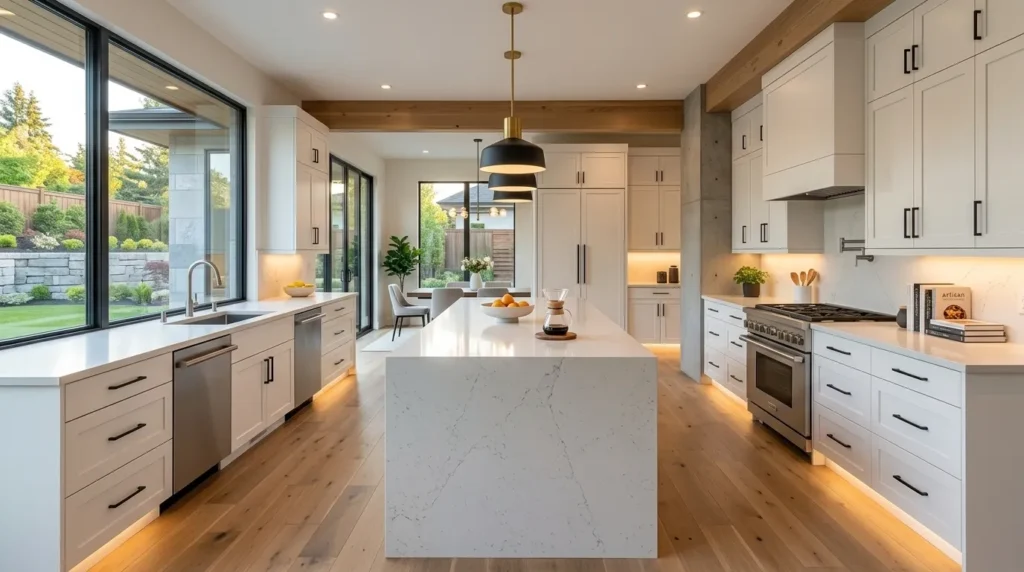
The year I started seriously pricing out kitchen cabinets for a renovation. I got three numbers that genuinely didn’t seem to belong to the same project. One came in around $4,500. Another landed near $14,000. The third quoted me closer to $22,000. All three were for what I described, in roughly the same words, as “shaker cabinets, white, standard 10×10 kitchen.” It took an embarrassing number of follow-up calls before. I understood that the cheapest quote didn’t include installation, the middle quote was using MDF where I’d assumed plywood. And the highest quote had quietly priced in soft-close hardware and under cabinet lighting. I hadn’t actually asked for but also Almost hadn’t thought to exclude.
That experience was far more educational for me on kitchen cabinets than any individual product page could be. This seems like a simple category, at least from the boxes, doors. Hardware that are visible but the number of decisions grows very quickly. And a majority of the difference in cost lies in the unseen elements.
Why Cabinet Type Decides More of Your Budget Than Style Does:
Before color or door style enters the conversation. The kitchen cabinet types question settles a huge share of your eventual cost. Stock kitchen cabinets come pre-manufactured in fixed sizes and a limited set of finishes. The most affordable entry point, running roughly $70 to $400 per linear foot range stock. And the obvious choice for rental properties, budget kitchens, or anyone who needs a fast turnaround without much personalization. RTA cabinets, or ready to assemble cabinets. Sit in a similar price bracket but shift more of the labor onto you or your contractor. Which is often where the real savings come from rather than the materials themselves.
Semi-custom cabinets:
The Semi-Custom Kitchen Cabinets offer a lot of options in terms of sizing, finish, and even the interior layout. Without costing you as much as completely custom kitchen cabinets. At the cost of $150 to $800 per linear foot. While semi-custom is the range within which one can find the best value for money.
Custom Kitchen Cabinets will be constructed for you as per your requirements. With regard to measurements at the price of $500 to $1,200 per linear foot custom kitchen cabinet. The opulent Custom Kitchen Cabinets may even exceed the price of $1,500 per linear foot.
Types Of Cabinets:
The cabinet type decision also determines construction style. Framed cabinets use a face frame across the front of the box. While frameless cabinets sometimes marketed as. European style cabinets rely on a heavier box construction. To hide the frame entirely and hang doors directly off the box sides. Which maximizes interior storage and gives a sleek, seamless appearance. Inset cabinets, also called flush mount cabinets. Sit flush with the face frame openings when closed and typically cost about 20% more than a comparable. Full overlay or partial overlay design using the same materials. Knowing which of these you’re actually being quoted matters more than knowing the door style. Because the underlying box construction is where labor hours and material quantity genuinely diverge.
For a standard 10×10 kitchen which requires roughly 20 to 25 linear feet. 10×10 kitchen of cabinetry total project cost spans an enormous range. Depending on which of these categories you land in: $2,000 to $24,000 10×10 kitchen for stock. Through mid-custom work, and $12,000 to $20,000 custom cabinets standard kitchen for a fully bespoke build. A 12×12 kitchen, closer to the actual average kitchen size in US. Homes today, runs $2,500 to $29,000 12×12 kitchen across the same spectrum. Frameless cabinets specifically can run $6,000 to $30,000 frameless cabinets depending on size and finish level.
The Material Question That Actually Determines How Long Your Kitchen Lasts:
Material composition of the cabinet matters above all else. When it comes to the durability of the product. And here the least expensive-looking quote will always contain its secret compromise. Solid wood cabinets have long been a standard of durability. Made out of white oak cabinets, red oak cabinets, walnut cabinets, maple cabinets. Cherry wood cabinets or mahogany cabinets, costing between $300 and $1,200. And up per linear foot depending on the type of wood used. The white oak has recently turned into the most demanded material for cabinets. Since its dense grain withstands everyday usage better than that of the red oak, yet remains beautiful stained. Walnut cabinets add elegance that more and more often designers prefer. To use only on an island or partial set complementing lighter-colored perimeter cabinets.
Plywood cabinets:
Plywood cabinets are widely considered the best balance of cost and durability for the box construction. Itself running $150 to $300 per linear foot. And resisting moisture and warping considerably better than particleboard or particle board cabinets. MDF cabinets, priced around $100 to $250 per linear foot. Are extremely common for painted shaker cabinets. Specifically because MDF takes paint more evenly than real wood grain. Does the trade-off is lower moisture resistance and a shorter realistic lifespan. If installed near a sink or dishwasher without careful sealing.
Thermofoil cabinets:
Thermofoil cabinets and laminate cabinets feature a manufactured surface bonded to an engineered wood cabinet core. The two types of cabinets have a neat look while being affordable. However the thermofoil type is heat sensitive due to its sensitivity to high temperatures. Therefore, these cabinets should not be used near stoves and ovens. Acrylic cabinets and high gloss acrylic finishes range from $5,000 to $20,000. Or more depending on the base material beneath the finish. Delivering an ultra-modern, hard, glass-like surface that’s genuinely striking in the right kitchen. Stainless steel cabinets and melamine cabinets and wood veneer cabinets round out the material spectrum. Each suited to a specific aesthetic or budget niche rather than serving as a universal default.
Across every material category. The honest answer to which is “best” doesn’t exist. It depends entirely on your climate, your daily use pattern, and your budget. A kitchen near the coast with year-round humidity behaves differently than a dry inland climate. And a material that performs beautifully in one will warp, swell. Or crack in the other over a 15 to 25 year cabinet lifespan.
Style and Door Front: Where Personality Enters Without Changing the Underlying Cost Much
Once material and cabinet type are settled, door style is largely a personal decision rather than a cost driver. Shaker cabinets remain the most popular style. In the country by a wide margin a recessed center panel with clean. Simple lines that works equally well in traditional cabinet style and contemporary cabinet style kitchens. Flat panel cabinets and slab cabinets, sometimes called slab door cabinets. Reduce visual weight in compact rooms and dominate minimalist cabinet design and transitional cabinet style projects. Raised panel cabinets suit classic interiors and remain a strong choice for anyone restoring or matching a more traditional-era home.
Handle less cabinets:
Handle less cabinets and push to open cabinets. Often achieved through finger pull channels integrated directly into the door edge. Keep visual lines completely uninterrupted a defining feature of minimalist cabinet design that’s grown significantly in popularity this year. The combination of two-tone cabinets. Where dark base cabinets come with light wall cabinets. Is now one of the most sought after styles in contemporary kitchen designs. Along with color zoning cabinets where the kitchen cooking area comes in a different color of cabinet. Than the prep area or entertaining area in big spaces. The use of mixed material cabinets, glass front cabinets as a contrast to the solid door blocks. And open shelving in smaller amounts all come from the same trend. That contemporary kitchens have textures layered intelligently instead of just copying every single texture and finish.
Curved island cabinets:
Curved island cabinets, waterfall edge island configurations, reeded door cabinets. And fluted door cabinets sit at the top of the design-complexity spectrum beautiful. But worth understanding that every curve and every non-standard dimension adds engineering, templating. And precision manufacturing time that a simple flat-panel kitchen in a single color never requires.
The Cabinet Types Inside the Kitchen and the Hardware That Makes Them Actually Work
Base cabinets, wall cabinets, tall cabinets, and corner cabinets are the four foundational categories every kitchen layout is built from, with pantry cabinets, floor to ceiling cabinets, and island cabinets layered in depending on available space and storage needs. Blind corner cabinets and the lazy Susan cabinets or magic corner cabinets that solve them are consistently the most awkward and most over- or under-specified part of any kitchen layout get this wrong and you either waste deep corner space entirely or pay for elaborate hardware you didn’t actually need.
Integrated appliance panels:
Panels that surround a dishwasher or refrigerator in order to blend them into the overall kitchen theme via matching cabinetry result in a perfect seamless kitchen look, although they do come at a price due to special hardware and measurements.
Hardware is the detail most homeowners underbudget. Soft close hinges and soft close hardware quality European-grade hinges are tested to 200,000 plus opening cycles hinge rating, which works out to roughly fifteen openings a day for thirty-six years typically add $800 to $2,500 quality hardware cost to a full kitchen. Cabinet pulls, cabinet knobs, cabinet handles, and bar handles range from a few dollars each to considerably more depending on finish, with matte black hardware and antique brass hardware leading current trends. Drawer organizers, pull-out pantry systems, roll out trays, full extension slides, cutlery dividers, and wastebasket pull-out features each add incremental cost but are consistently the features that turn “nice cabinets” into a kitchen genuinely designed around how you actually cook.
LED cabinet lighting:
LED cabinet lighting under cabinet lighting for task work, in-drawer lighting, and toe-kick lighting for ambient effect adds $500 to $3,000 LED lighting cost depending on how many zones get lit, and when it’s engineered into the cabinet design from the start rather than added afterward, the result is dramatically cleaner than visible surface-mounted strip lighting.
What’s Actually Driving Your Final Number :The Costs Nobody Quotes Upfront
Installation is consistently the line item that surprises people who’ve only priced the cabinets themselves. Install-only costs run $1,800 to $4,500 installation only cost depending on kitchen size and complexity, with labor billed at $50 to $250 hourly labor rate. Materials typically represent 25% to 50% materials share of cost of the total project, while cabinets overall make up 29% kitchen remodel budget cabinets to as much as 35–40% renovation budget cabinets of a full kitchen renovation a meaningful chunk of any remodel that’s easy to underestimate when you’re focused purely on the cabinet boxes themselves.
Hidden costs creep in consistently:
Hardware upgrades, demolition of existing cabinetry, and plumbing or electrical adjustments around new cabinet runs can each add several hundred to several thousand dollars beyond the headline cabinet price. The advice that came up across nearly every source I researched after my own three-quote confusion was the same: stick to your existing layout wherever possible avoiding moves to plumbing, appliances, or major walls is consistently the single decision that saves the most money get a clear written breakdown of what’s included before signing anything, and ask specifically whether installation, hardware, and any lighting are bundled into the number you’ve been given or charged separately afterward.
Realistic decision tree is straightforward:
For most homeowners, the realistic decision tree is straightforward under roughly $5,000, stock shaker cabinets with upgraded hardware deliver the best value. At $10,000 or more, semi-custom genuinely earns its premium through better sizing flexibility and finish options. Custom cabinets make the most sense specifically when your kitchen layout is genuinely unusual or you’re planning to stay in the home long enough that the craftsmanship and precision fit pay for themselves over a decade or more of daily use.
Choosing Right cabinets:
Choosing kitchen cabinets ultimately comes down to matching cabinet type, material, and hardware to how you actually live in your kitchen not to whichever quote arrives with the lowest number on the first page. The cheapest option and the best-value option are rarely the same thing once installation, hardware, and the small details get factored in honestly, and the only real protection against the kind of confusion I ran into is asking every contractor the same specific questions and comparing genuinely equivalent scopes before you sign anything.
Conclusion:
In kitchen remodeling, choosing kitchen cabinets is one of the major expenses and not only involves making choices on color and style. It involves understanding different aspects of the cabinets like their construction, materials used, cost of hardware, installation costs, and the list of items that should be considered while getting a quotation. Irrespective of whether you select stock, semi-custom, or custom cabinets, your investment should make financial sense, suit your way of life, and provide longevity.
Frequently Asked Questions (FAQ’s)
Kitchen cabinets generally fall into three groups: stock, semi-custom, and custom. Stock cabinets cost less and come in fixed sizes, semi-custom gives you more flexibility, while custom cabinetry is built specifically for your kitchen dimensions and design requirements.
Plywood is usually the stronger choice for cabinet boxes because it handles moisture, weight, and long-term use better. MDF works especially well for painted doors such as shaker cabinets because it produces a smooth finish, but it needs careful protection around sinks and other damp areas.
A 10×10 kitchen can range from a few thousand dollars for basic stock cabinetry to $20,000 or more for higher-end or custom work. Installation, hardware, lighting, trim, and demolition should be checked separately because they can significantly change the final price.
Stock cabinets are usually best for tight budgets and straightforward layouts, while semi-custom cabinets offer the strongest balance of flexibility, quality, and cost for many homeowners. Custom cabinets make more sense when the room has unusual dimensions or when precise finishes and storage details justify the additional expense.
Ask every supplier or contractor to itemize the cabinet material, box construction, installation, hardware, demolition, lighting, and any electrical or plumbing changes. Quotes that look similar on the first page can represent completely different levels of materials and workmanship once those details are compared.
