

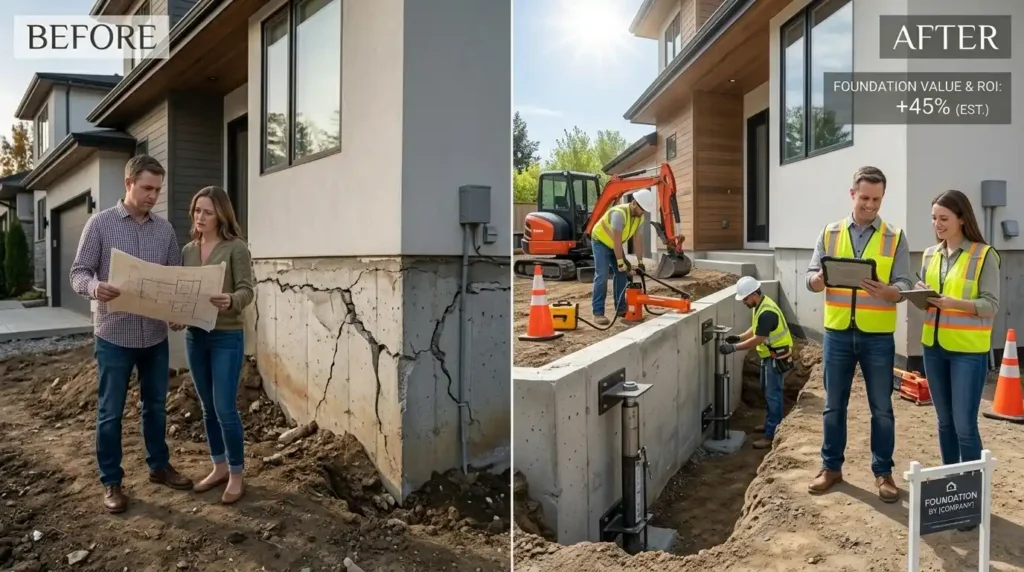
Twenty-five years into owning the same house. A friend of mine started noticing small things she’d brushed off for months suddenly add up. Cracks in the plaster that seemed to be growing, a door that wouldn’t latch properly anymore. Windows\ that stuck in their frames, gutters that weren’t draining the way they used to. She finally called someone for an inspection in 2024. The verdict was a sinking foundation, severe enough to need numerous steel piers driven beneath the home. The work also meant tearing out a failing deck. And a concrete front porch just to get access underneath the house. None of it was covered by her homeowner’s insurance which. As it turns out, is the rule rather than the exception with foundation problems. Her estimates landed above $50,000.
That story sits at one end of a spectrum that’s far wider than most homeowners realize. When they first type “house foundation repair” into a search bar expecting a single number. The same general category of problem can mean a $250 tube of epoxy or a $100,000 house-lifting project. And the entire skill in handling foundation repair well is learning to tell, early. Which end of that spectrum you’re actually looking at.
Why the Type of Foundation Under Your House Changes the Whole Conversation:
Before any foundation repair contractor can give you a meaningful number, they need to know what they’re working with structurally. A slab foundation specifically a concrete slab foundation. Or monolithic slab foundation sits directly on the ground with no crawl space beneath it. And slab foundation repair cost tends to run lower than other foundation types because there’s no substructure to access. A pier and beam foundation, by contrast, raises the structure above ground level on vertical supports. With beams spanning between them a flexible foundation type that performs well in unstable soils. Because it can accommodate ground movement without the same catastrophic cracking a rigid slab might show. Though pier and beam repair cost climbs once individual piers themselves need replacing or reinforcing.
Basement foundations:
Either a full basement foundation or partial basement foundation. The basement foundations will always be the hardest and most costly foundations to repair. Due to the exposure to pressure from water. Changes in structure, and possibility of pest damage that no other foundation type experiences to the same extent. The cost of repairing the basement foundations is in the slightly narrower range of between $2,300 and $7,600. The extra cost here is mainly due to the extra waterproofing effort that needs to be done in addition. To repairing the structure. Crawlspace foundation repairs are unique and can be affected by poor access since they are being done. In a cramped and low clearance area where it takes extra time to do the task.
A stem-wall foundation and raised foundation sit somewhere between slab and full basement. In both complexity and typical foundation repair cost. Doing a genuine foundation type comparison before assuming a single national average applies to your home. Is the first real step toward an accurate estimate. The type alone can shift your number by a factor of three or four. Before anyone has even assessed the damage.
Reading the Cracks: What Your Foundation Is Actually Telling You
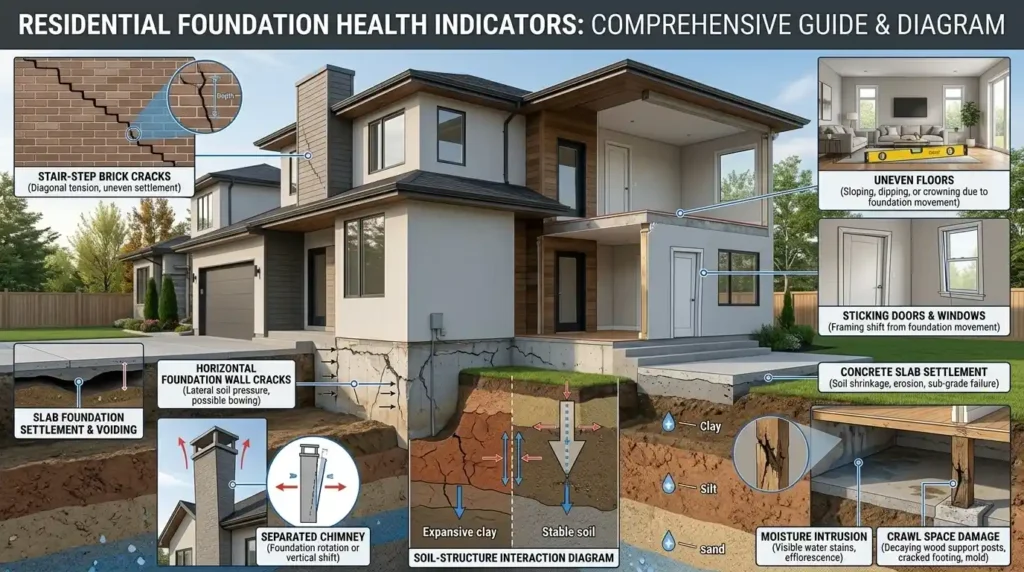
Foundations crack fixing is almost completely based on the kind of crack. And being able to recognize different types of cracks is the one most useful thing that a homeowner can learn. Foundations crack problems that have to do with hairline cracks are shallow. And not necessarily indicative of imminent danger. But still worth watching out for because they may serve as early warning signs of something happening beneath the surface. Diagonal foundations crack problems are a sign of movement and require. An expert opinion regardless of how insignificant they may seem.
Vertical cracks foundation:
Vertical cracks foundation damage is a more serious category. These can point to genuine structural instability and warrant a prompt inspection rather than a wait-and-see approach. Horizontal cracks foundation movement and staircase cracks mortar the stepped pattern. That runs diagonally through brick or block joints are both red flags that experienced inspectors look for first. Because that specific pattern almost always traces back to foundation settling or foundation shifting beneath the affected wall.
Beyond cracks themselves:
uneven floors, sloping floors, sticking doors, sticking windows. And spongey floors are the symptoms that show up inside the house long. After the foundation problem has already started outside. Foundation water intrusion, foundation moisture damage. And the foundation mold growth that follows are a separate. But related category water is often both a cause and a consequence of foundation movement. Since cracks let water in and water intrusion accelerates further movement. Frost heave foundation issues are specific to colder climates. Where freezing and thawing soil cycles physically push against a foundation with enough force. To cause real structural displacement over time. Expansive clay soil damage sits behind a huge share of foundation problems. Generally this soil type swells when wet and shrinks when dry. Creating the kind of cyclical movement beneath a foundation. That no amount of surface repair will fix without addressing the soil itself.
What Each Repair Method Actually Involves and Why the Price Gap Is So Large:
Foundation repair cost varies as dramatically as it does largely because “foundation repair” covers an enormous range of actual techniques. At the simplest end. Eoxy injection crack repair handles foundation cracks under a quarter-inch wide and can sometimes be done. As a DIY project using a kit costing around $100 to $400 genuinely one of the only foundation. Repairs most homeowners should consider tackling themselves. Polyurethane foam injection serves a similar purpose as a temporary fix for minor settling, typically priced at $600 to $800.
Slab jacking:
Slab jacking also called mud jacking lifts. And levels a sunken slab foundation by injecting material beneath it to fill voids. And restore the surface to its original position. This sits in a moderate cost bracket and works well specifically for slab foundations. Dealing with localized sinking rather than widespread structural movement.
serious structural movement:
For more serious structural movement, underpinning foundation work becomes necessary this is the umbrella term for several pier-based stabilization techniques. Steel piers foundation and helical piers foundation work both drive supports deep into stable soil. Beneath the structure to halt sinking and, in many cases, lift the foundation back toward its original elevation. Hydraulic piers foundation systems use hydraulic pressure during installation. And tend to sit at the higher end of the cost range $8,000 to $30,000 while helical piers foundation work. Often used for house leveling support specifically, runs a comparably wide $10,000 to $30,000. Push piers foundation systems function similarly to steel piers and are frequently chosen based on soil depth. And load requirements rather than cost alone.
For bowing or leaning walls specifically. Carbon fiber reinforcement and steel push-bracing are the two dominant wall stabilization techniques. Carbon fiber strips bond directly to the wall surface to resist further bowing. While steel bracing provides a more visible but often more affordable mechanical solution. Foundation leveling and foundation shimming address uneven floors without necessarily addressing the underlying cause. Which is why a foundation repair contractor worth trusting will usually pair. These cosmetic fixes with an actual diagnosis of why the floor became uneven in the first place.
Drainage-related fixes:
Drainage-related fixes French drain installation. Foundation regrading, sump pump installation. And basement waterproofing sit in their own category entirely. Addressing the moisture and water management side of foundation health rather than structural movement directly. Crawl space encapsulation and soil compaction work serve a similar preventive function. At the absolute top of the cost spectrum sits full foundation replacement. Which requires house lifting to access and rebuild the structure beneath a project that can run from $20,000 to $100,000. Depending on home size and damage severity, and one that’s genuinely only necessary. When a foundation has progressed well beyond what Piering or wall stabilization alone can fix.
What Drives Your Specific Number Up or Down:
Soil conditions foundation assessment is where most accurate estimates actually begin. Expansive clay soil, soil compaction issues. And soil moisture fluctuation are the underlying environmental factors behind a huge share of foundation problems nationally. And a geotechnical engineer report typically costing $500 to $3,000 is the tool professionals. Use to understand exactly what’s happening beneath a specific home before committing to a repair method. Poor drainage foundation issues, foundation drainage system failures. And inadequate foundation grading around the property compound soil problems further. While tree roots foundation damage and ongoing foundation erosion add yet another layer of variables. That a generic online estimate simply can’t account for.
Foundation inspection cost:
Itself runs $300 to $1,000 on average with $600 average inspection cost being a reasonable expectation. In most markets money well spent given that catching foundation. Warning signs early consistently keeps repair costs in the hundreds or low thousands rather than the tens of thousands. Structural integrity home assessments and broader structural damage home evaluations become necessary. Once a problem has progressed past simple cosmetic cracking. And at that point the math changes considerably nationally. Foundation problems are linked to roughly 6 million American houses showing some form of structural damage. With a documented foundation problems home value loss of as much as 25% of total property value in serious cases.
How to Actually Decide What to Do Next:
Repairing vs replacing the foundation will be a difficult decision. When you consider the nature of your particular damages. You will need to either repair or replace if you can’t move. And foundation issues tend to get worse with time instead of remaining stagnant. That’s because a $1,000 repair job quickly escalates into a $20,000 or higher one with predictable certainty. When you are trying to sell and the problem is small and only aesthetic. The math changes, and a new question becomes pertinent.
Does homeowners insurance cover foundation repair is one of the most consistently asked questions. And the honest answer is almost always no most policies treat foundation movement. As a maintenance issue rather than a covered loss. With coverage typically applying only when damage results from a sudden. Specific event like a burst pipe or a natural disaster rather than gradual settling. Steel piers vs helical piers and hydraulic piers vs helical piers. Comparisons matter less than soil depth and load requirements. At your specific property a foundation repair contractor with genuine experience. In your local soil conditions will recommend the method suited to your ground. Not simply the method they install most often.
Getting three quotes foundation repair:
Getting three quotes foundation repair from licensed. Insured contractors remains the single best protection against both overpaying and under-scoping the actual problem. Ask each contractor directly about foundation repair warranty terms. Many reputable companies offer lifetime warranties on structural work specifically because. They understand the soil conditions in their service area well enough to stand behind their fix. And if you notice any of the warning signs covered here cracks, sticking doors, sloping floors, water. Where it shouldn’t be the single most reliable piece of advice across every credible source on this topic. Is the same act early, get it inspected, and don’t wait to see if it gets worse on its own. It generally doesn’t.
House foundation repair:
Is one of those home maintenance categories. Where the cost of doing nothing almost always exceeds the cost of doing something. Even when the upfront number feels intimidating. Understanding your foundation type, learning to read what your specific cracks and symptoms are actually telling you. And getting a professional opinion before the problem grows are the three things. That consistently separate a manageable repair bill from the kind of five-figure surprise that derails a household budget. The house under your house deserves the same attention you’d give anything else. Holding your home together because, quite literally, it is.
Conclusion:
Most of the time, foundation issues do not become cheaper as time passes by. This is why an early inspection and wise decision-making is extremely important. No matter if you need to fix some cracks. Improve drainage or require other major repair work for your foundation. Knowledge about the factors that determine the price of foundation repair services will give you peace of mind.
Frequently Asked Questions (FAQ’s)
House foundation repair addresses cracks, settlement, shifting, bowing walls, or other structural problems affecting the base of a home. Warning signs such as widening cracks, sloping floors, sticking doors, or recurring moisture problems are good reasons to arrange a professional inspection.
Neither option is automatically better for every property. The right choice depends largely on soil conditions, foundation load, depth to stable ground, and the type of structural movement identified during the assessment.
Small hairline cracks may only require monitoring, but diagonal, horizontal, staircase, or other changing cracks deserve closer evaluation. Cracks accompanied by uneven floors, sticking windows, or wall movement are stronger signs that the problem may be structural.
Foundation repair costs vary widely because a minor crack treatment can cost only a few hundred dollars, while extensive underpinning or full foundation replacement can reach tens of thousands. Foundation type, soil conditions, water damage, repair method, accessibility, and severity all influence the final estimate.
Repair is generally appropriate when the structure can still be stabilized with crack treatment, drainage work, reinforcement, or pier systems. Replacement is usually reserved for severe deterioration where those methods can no longer provide reliable structural support.

7 thoughts on “House Foundation Repair — How to Tell If You’re Looking at $500 or $50,000 ”