

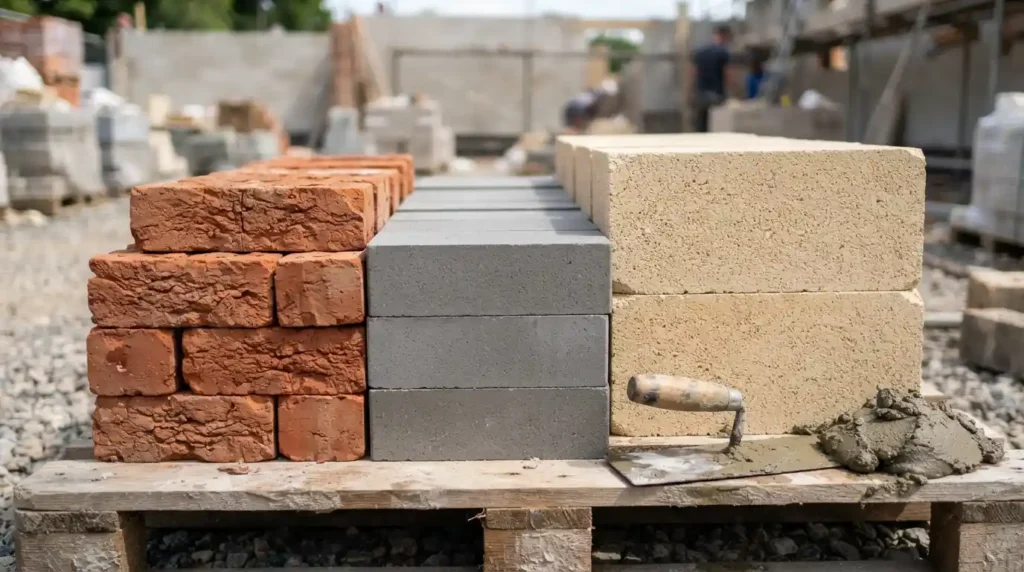
My brother in law built a boundary wall around his place a few years back. And grabbed whatever bricks were cheapest at the yard that week, figuring a brick’s a brick. Eighteen months later there were hairline cracks running along half the wall. And the mason he called in just shook his head and said the bricks never should’ve gone anywhere near ground contact given how much water they soaked up. That’s basically the whole problem with bricks as a material. They all look pretty similar stacked in a pallet at the supplier, red, rectangular, heavy. What’s actually different, and what actually matters, is what’s inside them and where they’re rated to go.
Bricks Aren’t Interchangeable, Even Though They Look It
Walk into any building supply yard and you’ll see rows of bricks that look nearly identical from a few feet away. The differences that actually count are buried in the composition, not the color.
Clay Bricks and Why They Still Dominate Residential Building
Clay bricks are what most people picture when they hear the word brick. And there’s a reason they’ve stuck around this long. Burnt clay bricks get fired at high heat. Which gives them real strength and a natural resistance to weather that’s hard to beat for the price. My uncle’s house, built back in the seventies with straightforward burnt clay brick. Still hasn’t needed a single structural repair, and honestly the color’s only gotten more character with age. Clay handles insulation reasonably well too. Keeping a house cooler in summer without needing much extra help from the wall assembly behind it.
Not all clay bricks are equal though, and this is where people get tripped up. First class bricks come out uniform, well fired, and with water absorption under ten percent. Ehich is exactly the kind of brick you want holding up a wall meant to last a century. Second class bricks are decent enough for a single story build or something temporary. But they’ll absorb more water and show more irregularity. Third class bricks are basically for garden walls and short term structures, nothing you’d trust with real load. My brother in law’s cracked wall, it turns out.Used something closer to third class without him ever being told that upfront. Asking a supplier straight up which class you’re getting saves a lot of grief down the line.
Fly Ash and Concrete Bricks for Modern, Faster Builds
Fly ash bricks have become a genuinely solid alternative to clay. And they’re made from a waste byproduct of coal power plants mixed with cement. Which honestly makes them one of the more sustainable choices out there. They’re lighter than clay, absorb less water, and hold up better against freeze thaw cycles. Which matters a lot if you’re building somewhere with real winters. A friend of mine used fly ash bricks for an entire apartment block a couple years back. Specifically because the lighter weight meant less structural load overall. And the project moved faster since fewer bricks were needed per course. Concrete bricks take a different approach entirely, mixing cement, sand, and aggregate rather than relying on fired clay at all.
They can be made right on site in some cases, which cuts down on transport costs. And manufacturers can pigment them during production to hit whatever color a project needs without painting anything afterward. Concrete bricks show up constantly in facades, fencing, and partition walls. Mostly because they’re dimensionally consistent in a way handmade clay brick sometimes isn’t. Neither fly ash nor concrete bricks are automatically better than clay across the board though.
Specialty Bricks for Jobs Ordinary Bricks Can’t Handle
Some walls need more than a standard brick can offer, whether that’s extreme heat resistance or serious protection against water getting in below ground.
Engineering Bricks and Where Ground Contact Actually Matters
Engineering bricks exist specifically for situations where an ordinary brick would fail, basements, damp proof courses, foundations sitting right against soil and groundwater. They’re rated by class, A or B, with Class A handling the most demanding jobs where water resistance genuinely can’t be compromised. What sets these apart is incredibly low water absorption combined with high compressive strength, which is exactly the combination my brother in law’s wall was missing. If his mason had specified engineering brick for the base courses instead of whatever was cheapest that week, those cracks probably never would’ve shown up at all. Calcium silicate bricks, sometimes called sand lime bricks, take a completely different manufacturing route, mixing sand and lime under steam and pressure rather than firing clay in a kiln.
The result is a smooth, uniform gray brick with a genuinely impressive load bearing capacity, and the smooth surface often skips the need for plastering entirely, which shaves real money off finishing costs. These get used a lot for ornamental brickwork too, since the consistent shape and color make detailed patterns easier to pull off than with slightly irregular clay units. Fire bricks round out the specialty category, built to handle temperatures that would crack an ordinary brick within hours.
AAC Blocks and the Lightweight Shift in Modern Construction
AAC blocks, short for autoclaved aerated concrete, have picked up momentum fast over the last decade, particularly for high rise and commercial work where every bit of weight saved actually matters structurally. They’re made with tiny air pockets baked into the material, which makes them dramatically lighter than solid clay or concrete brick while still holding up surprisingly well thermally. A contractor I spoke with a while back put it simply: fewer AAC blocks are needed per wall compared to standard brick, and the reduced weight means less strain on the foundation supporting everything above it. They’re not technically bricks in the traditional sense, more like a block that’s replaced bricks in a lot of modern applications, but they get lumped into the same conversation constantly since they solve similar problems.
Insulation is where AAC genuinely shines, since those trapped air pockets slow heat transfer far better than a dense, solid clay brick ever could. That matters enormously in extreme climates, whether that’s blazing summer heat or brutal winter cold. The tradeoff is that AAC isn’t always the right call for heavy load bearing work the way a well made engineering brick is.
Getting the Numbers Right Before Any Wall Goes Up
Bricks come with real, measurable specifications, and ignoring them is basically how my brother in law ended up with a cracked wall in the first place.
Standard Sizes and Why They Matter for Quantity Calculations
Most modular bricks run around 190 by 90 by 90 millimeters, though non modular sizes closer to 230 by 110 by 70 millimeters show up plenty too depending on the region and supplier. Knowing the exact size matters more than people assume, since it’s the entire basis for calculating how many bricks a given wall actually needs. The rough formula is wall area divided by brick face area, then adjusted a bit for mortar joints and unavoidable wastage. My brother in law’s contractor apparently didn’t account for wastage properly, which meant a rushed last minute order partway through the job, and rushed orders are exactly when quality control gets skipped.
Getting this calculation right before ordering avoids both an awkward mid project scramble and the temptation to grab whatever’s sitting closest on the yard’s shelf just to keep things moving. Bricks also need to stay small enough to lift comfortably with one hand, which is part of why the width tends to hover around 100 millimeters across most brick types worldwide. That’s not an arbitrary design choice, it’s basically ergonomics baked into a few thousand years of bricklaying practice. Getting size and quantity nailed down early, before the first pallet even arrives on site, is a genuinely boring step that saves real money and real headaches later in the build.
Identifying Good Quality Bricks Before They Go Into a Wall
A few simple checks at the yard catch most of the obvious quality problems before they ever become someone’s cracked wall. Good bricks should look uniform in color, with sharp, clean edges and no visible cracks or crumbling at the corners. Striking two bricks together should produce a clear, almost metallic ringing sound. While a dull thud usually means the brick was under fired and won’t hold up structurally. Water absorption is the number that matters most though. And it’s worth actually asking a supplier for test data rather than trusting a visual once over alone.
Anything absorbing more than twenty percent of its weight in water is heading toward third or fourth class territory, exactly the kind of brick that has no business anywhere near a foundation or a damp proof course. My brother in law never asked a single one of these questions before his wall went up, and it genuinely cost him more in repairs than choosing the right brick from day one would have. A quick scratch test helps too. Since a properly fired brick resists scratching with a fingernail. While an under fired one gives way more easily than it should. None of this takes any special training. It just takes actually asking, and actually checking, before the mason starts stacking anything permanent.
Conclusion
My brother in law’s cracked wall wasn’t really about bad luck. It came down to grabbing whatever brick was cheapest without asking what it was actually rated for. Clay, fly ash, concrete, engineering, calcium silicate, AAC, each of these solves a different problem. And none of them is automatically the right answer for every wall on every job. Getting the class, the water absorption number, and the intended use matched up correctly. Before a single brick goes up is what actually separates a wall that lasts decades. From one that’s cracking within a year or two. It’s a boring step, checking specs and asking suppliers direct questions. But it’s a lot cheaper than the repair bill that shows up later.
Frequently Asked Questions (FAQ’s)
First class burnt clay bricks and engineering bricks both handle load bearing work well. Thanks to their high compressive strength and low water absorption. Calcium silicate bricks are another solid option, offering similar load capacity with a smoother, more uniform finish.
Fly ash bricks are lighter, more affordable, and generally more sustainable. Since they use a waste byproduct from coal power plants. Clay bricks still edge ahead on traditional aesthetic appeal and have a longer proven track record in residential construction.
Good bricks should look uniform in color and shape, with sharp edges and no visible cracking. Striking two together should make a clear ringing sound. And water absorption should stay under ten percent for genuinely high quality construction bricks.
Engineering bricks, particularly Class A, are specifically designed for damp proof courses and foundations exposed to moisture. Their low water absorption and high strength make them far more reliable. Than standard clay or concrete brick in that specific application.
