

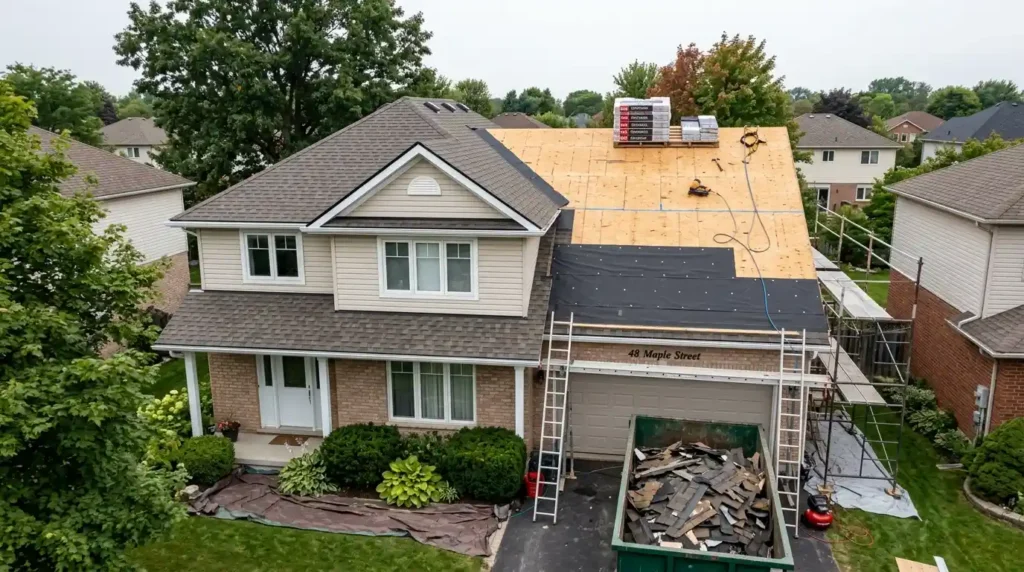
The question “how much is a new roof” gets asked in two distinct emotional states. The first is calm and forward-planning the roof is aging, the 15-year shingles are at year eighteen, and a homeowner wants to budget intelligently before the problem announces itself through a ceiling stain. The second is urgent there’s been a storm, or someone noticed daylight through the roof boards during a loft inspection, or the granule loss in the gutters has finally crossed from something easy to ignore to something impossible to. The answer to the question is the same in both cases, but the sequence of decisions that follows is very different.
I’ve been on both sides of that conversation enough times to know that the figure people find online the national average, the per-square-foot range, the “most homeowners pay between X and Y” does genuine work as a planning anchor and almost no work as a project budget. Your roof is not the average roof. Its pitch, complexity, current condition, and the material going on top of whatever’s coming off are the variables that make the number real rather than illustrative. The purpose of this guide is to work through those variables honestly so the estimate that comes back from a roofing contractor is legible rather than mysterious.
What the Cost Ranges Actually Cover — US and UK Side by Side
In the United States, the figures that appear most consistently across credible sources sit between $10,000 and $30,000 for most homeowners replacing a standard residential roof. NerdWallet puts the average at $9,500, Angi at $9,602, and the 2025 Journal of Light Construction Cost vs Value Report at $30,680 for a full replacement using architectural shingles on a standard 30-square roof with a complete underlayment and flashing system. The gap between $9,500 and $30,680 is not an error it reflects what’s included. A stripped-back asphalt shingle replacement on a simple ranch home in a low-cost labour market sits near the bottom. A full system replacement on a complex two-storey with dormers, valleys, and multiple penetrations in a metropolitan area sits near the top. Most standard three-bedroom homes land between $15,000 and $20,000 for asphalt shingles or $9,800 to $41,800 for a 2,000 square foot property depending on material and complexity.
In the UK, a full pitched roof replacement runs £5,000 to £12,000 for most residential properties, with a standard semi-detached averaging £5,500 to £7,000 in most regions outside London. The £1,125 scaffolding cost sits on top of that unless the written estimate explicitly includes it which it sometimes does and sometimes doesn’t, making that the first question to ask any UK roofer. Flat roof replacement costs differently: £75 to £120 per square metre for most systems, with EPDM rubber roofing sitting at £80 to £100 per square metre and GRP fibreglass slightly above that. A bay window flat roof runs £450 to £1,200 and a dormer flat roof £900 to £2,500 depending on size and access.
Material Choice Is Where the Budget Gets Determined Before Anything Else
Asphalt shingles remain the dominant residential roofing material in North America because they offer the best balance of upfront cost and adequate lifespan. Three-tab shingles run $90 to $120 per roofing square installed a roofing square being 100 square feet and carry a 15 to 25 year lifespan. Architectural shingles, sometimes called dimensional shingles, cost $120 to $180 per roofing square and deliver better wind resistance, a more textured appearance, and a longer warranty period. The 30-year and 50-year labelling on premium architectural shingles reflects manufacturer warranty duration rather than a guaranteed performance period, though the material quality difference is genuine. At $3.40 to $8.75 per square foot installed depending on specification and location, asphalt shingle roof replacement is the entry point for the full roof replacement cost conversation.
Metal roofing sits in a different budget category entirely. Standing seam metal runs $350 to $700 per roofing square installed $7 to $15 per square foot at the mid-range, rising to $6 to $35 per square foot for premium systems including stone-coated steel and copper roofing at the top end. The lifespan differential is where the total cost of ownership argument shifts toward metal: 40 to 70 years for most metal systems against 15 to 25 years for asphalt means two or three asphalt replacements over the same period at current pricing. The 2025 Cost vs Value Report puts the ROI on asphalt shingle replacement at 68% and metal at 50% at resale the metal ROI figure looks lower partly because the installation cost is higher and partly because buyers discount the long-term lifespan benefit they’ll never need to think about during their ownership period.
Slate is the premium end of the residential roofing market regardless of geography. Natural slate runs $19 to $52 per square foot installed in the US and toward £100 per square metre in the UK, with a service life of 75 to 150 years when correctly installed on a roof structure with sufficient load capacity to handle the weight. Synthetic slate at $9 to $15 per square foot closes the cost gap significantly while delivering a 40 to 50 year rated lifespan. Clay tile costs $600 to $1,200 per roofing square installed, concrete tile runs toward $10 to $25 per square foot, and both carry lifespans of 40 to 50 years for clay and 50 to 60 years for concrete tile in UK conditions the cost per year of service life is considerably more competitive at this price point than the upfront figure suggests.
The Components That Drive the Full Roof Replacement Cost Beyond the Surface Material
The roofing material itself is only one part of a complete roof replacement cost. The system underneath and around it underlayment, ice and water shield, drip edge, flashing, ventilation, and decking are not optional extras. They’re the components that determine whether the surface material performs as specified over its rated lifespan or fails early through water intrusion, inadequate ventilation, or deck deterioration that went unaddressed during installation.
Synthetic underlayment costs more than felt but delivers better performance as a secondary water barrier. Ice and water shield at the eaves and valleys adds meaningful protection in freeze-thaw climates. Drip edge installation the corrosion-resistant metal strip that directs water away from the fascia is a code requirement in most US jurisdictions. Step flashing, chimney flashing, and valley flashing are the details that most roof leaks originate from when they fail: these are precision installations that separate a contractor who understands roof systems from one who lays material and hopes the flashing holds. Lead flashing in UK residential applications handles chimney and abutment waterproofing £300 to £500 for flashing repair alone is a common additional line item on UK quotes where the existing lead needs replacing alongside the main roof.
Decking condition is the hidden cost variable that expands the most projects beyond their original estimate. Rotted decking and water-damaged sheathing only become visible after the old roofing material comes off the roof structure. The standard industry contingency for deck replacement runs 5% to 10% of the overall project, translating to $3 to $5 per square foot for OSB or plywood decking replacement where required. A 10% to 20% contingency budget on any new roof project is honest planning rather than pessimism 79% of homeowners report their final cost was approximately as expected according to This Old House survey data, which means roughly one in five experienced a meaningful overrun, typically from structural repairs discovered during tear-off.
Tear-off cost adds $1 to $4 per square foot on most US projects for a single-layer removal, with multiple layer tear-off where a second shingle layer was applied over the original rather than stripping to the deck adding significant labour time and waste volume. Dump fees and waste disposal run toward $100 to $1,000 in the UK depending on volume, with skip hire at £400 per day where required. The waste transfer notes documentation requirement in England and Wales adds administrative process that the most organised contractors manage without prompting.
The Labour Calculation and What Geographic Location Does to the Number
Labour accounts for 50% to 60% of total roof replacement cost on most residential projects, running $40 to $90 per hour per crew member depending on region, with metropolitan area pricing running 30% to 50% higher than rural equivalents. A standard gable roof on a two-storey home in a moderate-cost US market takes a crew of three to four workers one to three days for the tear-off and installation complex roofs with multiple dormers, valleys, skylights, and hips extend that timeline and the associated labour cost proportionally. The $1,000 to $3,000 complex roof add-on that appears in most US roofing cost calculators reflects the additional labour time for cutting, fitting, and flashing around architectural features rather than laying panels on a straightforward rectangular plane.
UK labour rates run £200 to £383 per day for a qualified roofer depending on region, with London and the South East sitting at the higher end. A standard three-bedroom semi-detached pitched roof replacement takes four to seven working days for a two-person crew flat roofing projects on extensions and garages typically complete faster but require different technical skills that not all pitched roofers carry equally.
Off-peak season scheduling late winter through early spring in both the US and UK typically delivers 10% to 20% price reductions or $1,000 to $3,000 in real savings on mid-size projects, reflecting lower contractor demand and better scheduling availability. The spring insurance claim season following winter storm damage is peak demand for most roofing contractors, which pushes both pricing and lead times upward from April through July. A homeowner whose roof shows signs of hail damage or wind damage but doesn’t require emergency repair gets a meaningfully better outcome by scheduling the replacement in November or February than in May.
Reading the Quote Before Signing the Contract
Three quotes is the minimum for a full roof replacement project, and the comparison only produces useful information when the scopes match. A written estimate should specify material brand — GAF, Owens Corning, CertainTeed, Marley tiles depending on market underlayment type, drip edge specification, ventilation system, tear-off assumption, scaffolding inclusion, disposal method, permit fees, payment schedule, and warranty terms. GAF Golden Pledge warranty and Owens Corning and CertainTeed manufacturer warranties require installation by a certified contractor asking whether the contractor holds that certification matters because it affects the warranty coverage that comes with the installed system.
Public liability insurance and a valid contractor license are the baseline verification steps before any roofing contract gets signed. In the UK, CheckaTrade and MyBuilder verification provide a level of vetting. In the US, the state contractor licensing board lookup confirms active license status for the specific trade. An on-site roof inspection by the contractor before the written estimate is non-negotiable any quote produced without a physical inspection of the existing roof structure is a guess rather than a price, and it will likely change after work begins.
Homeowners insurance covers sudden and accidental damage storm damage, hail damage, wind damage rather than wear and tear or age-related deterioration. An insurance claim for legitimate storm damage involves the deductible and the claims process but can substantially offset new roof cost where the damage is genuine and documented. Where insurance isn’t applicable, a home equity loan or HELOC provides financing at lower rates than contractor financing in most cases, though contractor financing arrangements and personal loan options exist across both US and UK markets for homeowners who prefer to spread the cost.
Conclusion
How much is a new roof comes down to five variables applied to a specific property rather than a national average applied to an imaginary one. Material choice sets the budget ceiling before anything else gets discussed. Roof size, pitch, and complexity determine how much labour the project actually requires. The condition of the existing deck and structure decides what gets discovered after tear-off and what the contingency budget needs to absorb. Geographic location sets the labour rate that runs underneath all of it. And the quality of the contractor and the completeness of the written estimate determine whether the figure on the quote bears any relationship to the figure on the final invoice.
The homeowner who gets three written estimates with matching scopes, verifies contractor credentials, schedules in the off-peak window where the project allows, and builds a 10% to 20% contingency into the budget before anyone gets on the roof is the one whose project lands as expected rather than expanding uncomfortably in week two. The 79% of homeowners who report their final cost was approximately as estimated got there through that sequence not through luck or an unusually honest contractor.
A new roof is not a discretionary purchase for a property that needs one. It is the investment that protects every other investment inside the building. Getting the material right, the contractor right, and the scope documented correctly before work starts is what separates a roofing project that holds up for 25 years from one that needs revisiting in five.
