

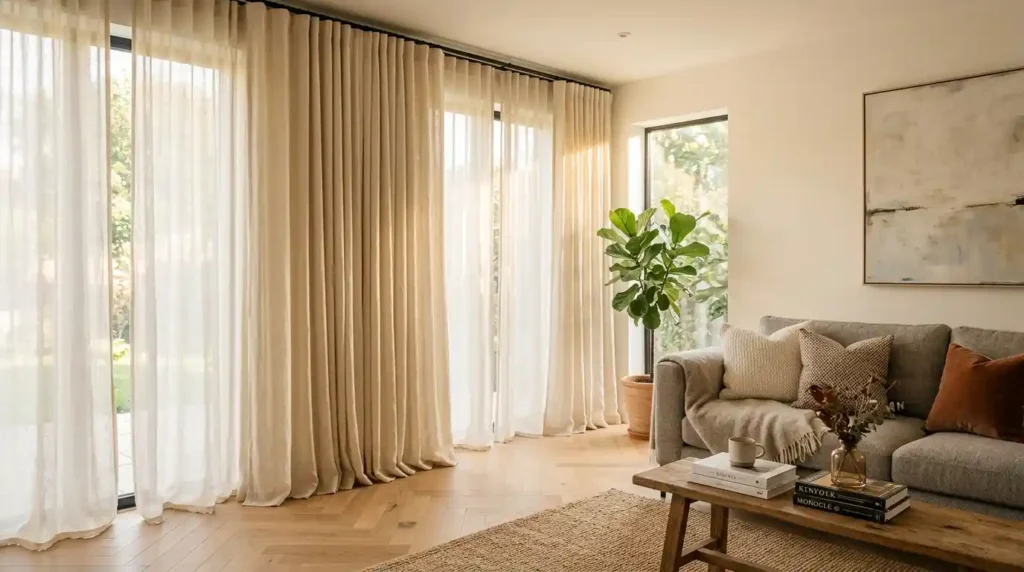
There’s a lounge I keep coming back to in my memory a client’s north-facing living room with one enormous bay window, a grey sofa, and curtains that stopped four inches above the floor like they’d given up. The fabric wasn’t bad. The color was fine. But those four inches of air gap between curtain hem and floor made the whole room feel unresolved. Like a sentence without a full stop. We rehung the rod, ordered new panels three inches longer, and the room transformed without touching a single piece of furniture. That’s what lounge curtain ideas really come down to not just the fabric you choose, but every decision that comes before and after it.
Privacy and Light Control Are Not Competing Goals
Before color, before fabric, before anything else what does the curtain actually need to do in this specific room? I ask every client this before we look at a single swatch. A north-facing lounge that already feels starved of light needs to keep every lumen it gets. A south-facing room that’s genuinely uncomfortable from noon onwards needs something that blocks. These are not the same brief and they shouldn’t result in the same curtain. Sheer curtains and sheer panels let natural light filter through softly and still give you a reasonable degree of daytime privacy not full privacy, but enough. Blackout curtains and blackout panels are the other end: full coverage, improved thermal insulation, useful anywhere solar heat gain turns an afternoon into a problem. The layered curtain approach puts both on the same window sheer inner panels behind heavier outer drapes on a double rod. Light and dark matching in practice: voile curtains during the day, full blackout privacy at night, no swapping required.
The Fabric Decision Changes More Than Most People Expect
Linen curtains and Belgian linen panels have dominated lounge curtain ideas for a while now and honestly the reason isn’t complicated textured linen hangs well, gets better with age, and works across almost any lounge style without trying too hard. Modern minimalist, Scandinavian, eclectic lounge, doesn’t really matter. The wrinkles that drive some people mad are the same thing that makes the fabric look considered rather than just cheap. Cotton curtains are breathable, wash easily, and don’t require much thought. Velvet curtains are a completely different proposition specifically blackout velvet, which is heavy, seriously insulating, and gives a formal or moody lounge a cocooning, cinematic quality that no lighter fabric gets close to. They’re the reason a room with dark walls can feel intentional rather than just underlit. Polyester blend curtains are the sensible choice for high-traffic lounges: wrinkle-resistant, durable, and a fraction of the cost of natural alternatives.
Lined versus unlined is worth thinking through before you order. Thermal lining in a colder climate keeps the room warmer and the energy bills lower. Blackout lining turns basically any fabric into a room-darkening curtain which is useful if you’ve fallen for a light linen but the room still needs full coverage at night. Interlining is the one most people don’t know about until a designer mentions it. It adds body and weight, and it makes fabric that would otherwise hang flat and lifeless fall in the kind of soft, full folds you see in magazines. It’s one of the better kept budget secrets: inexpensive fabric with interlining often looks more expensive than premium fabric without it.
Color Is Doing More Emotional Work Than It Gets Credit For
A cream curtain and a charcoal curtain in the same room feel completely different even before you consciously register the difference. Neutral curtains white curtains, warm white curtains, ivory curtains, warm greige, taupe, beige work by getting out of the way. When a lounge already has a busy rug, patterned cushions, or strong art, neutral curtains let all of that breathe without adding another thing to look at. Earthy curtains are different in function. Terracotta, clay, olive green, muted green, warm brown these colors add tonal warmth that changes how a room feels on a flat grey afternoon in a way a neutral simply can’t. Deep navy curtains or dark teal curtains paired with creamy sheer panels create the kind of jewel tone contrast that reads as quietly expensive without ever getting near custom drapes territory. Color-drenched curtains a full wall of charcoal, deep blue, or any moody saturated hue work best somewhere the window wall genuinely matters: a formal living room, an open-plan lounge, or anywhere the glazing is large enough to make the curtains the dominant visual surface.
Why Layering Is the Lounge Curtain Move Nobody Regrets
Layered window treatment is the single upgrade I recommend most consistently because it adds depth and dimension without changing the architecture of the room. Sheer curtains behind heavier drapes on a double rod gives a lounge a finished quality that single-layer window dressings can’t match. Dark outer panels with sheer white voile curtains in the center creates instant visual weight and depth especially effective in a lounge with a fireplace or high ceilings where you want the window wall to hold its own. Roman shade with curtain panels is another layered approach: the Roman shade or blind handles light control and privacy while the curtain panels add elegance and frame the window without competing for attention. Curtain and blind pairing works well for awkward windows too specialty windows, corner windows, and dual-aspect rooms where a single treatment never quite covers the situation.
Bay Windows, Tall Windows, and the Situations That Need a Different Approach
Bay windows need their own plan. The question of whether to treat each facet separately or run one continuous treatment across the whole bay is genuinely case-by-case it depends on the bay’s size, the room’s style, and whether the architecture itself is something you want to celebrate or soften. An angled curtain track that follows the bay’s geometry gives the most seamless result, but it requires accurate measuring and often professional fitting. Sheer inner panels across the full bay width with heavier curtain panels at the outer flanks is a simpler approach that still layers beautifully and handles the light question without expensive custom tracking. Pelmet toppers and structured valances above a bay window add a formality that suits older houses with high ceilings particularly well they frame the bay in a way that makes it feel like the room was designed around it, which is exactly the impression you’re going for. For floor-to-ceiling windows and tall windows, the curtain panels need enough fabric to do the height justice skimping on fullness ratio in a room with large glass makes the window look underdressed and the curtains look like they’re stretched thin. Wide curtains at 1.5 to 2 times the window width minimum, often 2 to 2.5 times for blackout functionality, are the standard recommendation.
Hanging Height Is the Mistake Most People Make Exactly Once
Mount the rod near the ceiling. Not 2 inches above the window frame near the ceiling, or at least 6 to 12 inches above the window frame at minimum. Hanging the rod too low is probably the most common lounge curtain error I see, and it shows up everywhere not just in budget rooms, in expensive ones too. It makes ceilings feel lower, windows feel smaller, and the whole room feel more compressed than it actually is. Moving the rod up, anywhere from 6 to 12 inches above the window frame at minimum, and ideally to a ceiling-mounted track or rod, creates an unbroken vertical line from ceiling to floor. Visually that single change makes a room feel somewhere between 12 and 18 percent taller according to research that interior designers have been citing for years. Extending the curtain rod 6 to 15 inches beyond the window frame on each side gives the panels somewhere to stack off the glass when the curtains are open which means more natural light during the day and a window that reads as noticeably wider than its actual frame.
As for length floor-length curtains should actually reach the floor. Half an inch above it, touching it, or with a slight break puddle of 1 to 2 inches if you want a softer, more relaxed feel. Puddle curtains with 6 to 12 inches of excess fabric pooling on the floor look romantic in a formal room with tall windows and low foot traffic. In a real working lounge kids, pets, people moving around daily all that fabric on the floor collects dust and gets caught underfoot. Beautiful in a showroom. Annoying to live with.
Hardware Shapes the Whole Look More Than People Admit
A matte black rod on cream linen curtains. A brass rod on deep navy velvet curtains. A wooden rod on linen cotton blend panels in a Scandinavian-style lounge. The hardware isn’t invisible it’s the horizontal line that runs across the wall at eye level, and it either complements the curtain or fights it. Brushed nickel rod hardware reads as contemporary and neutral. Gold curtain rod and brass rod hardware adds warmth and draws a connection to other metallic finishes in the room. Motorized curtain track is worth considering in an open-plan lounge with wide windows the convenience factor is real, and the clean ceiling-mounted appearance removes the visual clutter of a visible rod entirely.
Grommet curtains and eyelet curtains slide easily and suit a contemporary lounge. Ripple fold curtains on a track system create smooth, uniform waves across the window visually neat, very 2026 in terms of lounge curtain ideas, and particularly effective on floor-to-ceiling windows in modern apartments. Pinch pleat curtains and French pleat curtains have structured, almost sculptural folds that suit a more traditional lounge or neoclassical style. Pencil pleat curtains sit between the two in formality. Goblet pleat curtains and box pleat curtains are less common but genuinely striking in a formal lounge with high ceilings where the window treatment needs to make a real statement.
Measuring Before You Buy Anything
Measure the rod placement first, not the window. Standard 8-foot ceilings: mount the rod 4 to 6 inches above the window frame, choose 84-inch curtains, and you get a clean floating effect that works without drama. Move up to a 9-foot ceiling and 6 to 8 inches above the trim with 96-inch panels gives you more vertical presence without needing to rebuild the room. Above 9 feet anything with a proper high ceiling 108-inch curtains hung 1 to 2 inches below the ceiling is the move interior designers consistently reach for. The panels run almost the entire wall height and the room feels genuinely architectural rather than just decorated. Curtain width should be at least 1.5 times the rod width 2 times for a fuller, gathered look that reads as intentional rather than budget-constrained. Use a steel tape measure. Cloth tapes sag and introduce enough error to matter when you’re ordering custom curtains or made-to-measure panels that can’t be returned.
Conclusion
Lounge curtain ideas work best when the decisions stack in the right order function first, then fabric, then color, then hardware, then measurements. Skip one and something downstream feels off, even if you can’t immediately name why. The four-inch gap I mentioned at the start wasn’t a curtain problem. It was a measurement problem disguised as a style problem. Get the basics right and the room tends to sort itself out from there.
Frequently Asked Questions (FAQ’s)
Start with what the room actually needs from the curtains, such as more privacy, better light control, or improved insulation. Once the function is clear, choose the fabric, colour, layering, and hardware to suit the room rather than selecting curtains on appearance alone.
Sheer curtains work well when you want natural light and some daytime privacy, while blackout curtains provide stronger privacy, light blocking, and insulation. If you need both benefits, layering sheer panels behind heavier curtains gives you more flexibility throughout the day.
For a taller, more balanced look, position the curtain rod well above the window frame and closer to the ceiling where the room allows. Extending the rod beyond both sides of the window also lets the curtains stack away from the glass and helps preserve natural light.
There is no single best fabric because the choice depends on how the room is used. Linen creates a relaxed, textured look, velvet adds weight and insulation, cotton is practical and easy to maintain, while polyester blends suit busy spaces where durability matters.
Curtain panels should generally provide noticeably more fabric than the width of the rod so they still look full when closed. The article recommends roughly 1.5 to 2 times the width as a starting point, with extra fullness often working better for blackout curtains and large windows.
