

Don’t enter “window tinting for house near me” in Google and contact the first number on the list without spending twenty minutes learning about what you’re really buying. There’s nothing too complicated about installing film on the windows of your house at first glance some film, some installation, and that’s it; but the difference in performance between the installation that was done according to specifications and an improperly chosen one can be quite noticeable. I’ve heard enough stories from customers who had their DIY installations or incorrectly chosen films replaced within just two years of purchase to know that.
The right residential window film, installed by a qualified window film installer, will genuinely change how certain rooms feel throughout the summer, reduce glare on screens you’ve been avoiding for years, block UV rays that have been fading your flooring and furniture, and deliver cooling cost reduction that compounds year after year. The wrong film or the right film badly applied delivers none of that, and costs the same to install.
Understanding What Each Film Type Actually Does Before You Compare Prices
The residential window tinting market in 2026 carries more film options than most homeowners expect, and the differences between them are performance differences, not just aesthetic ones.
Ceramic Window Film
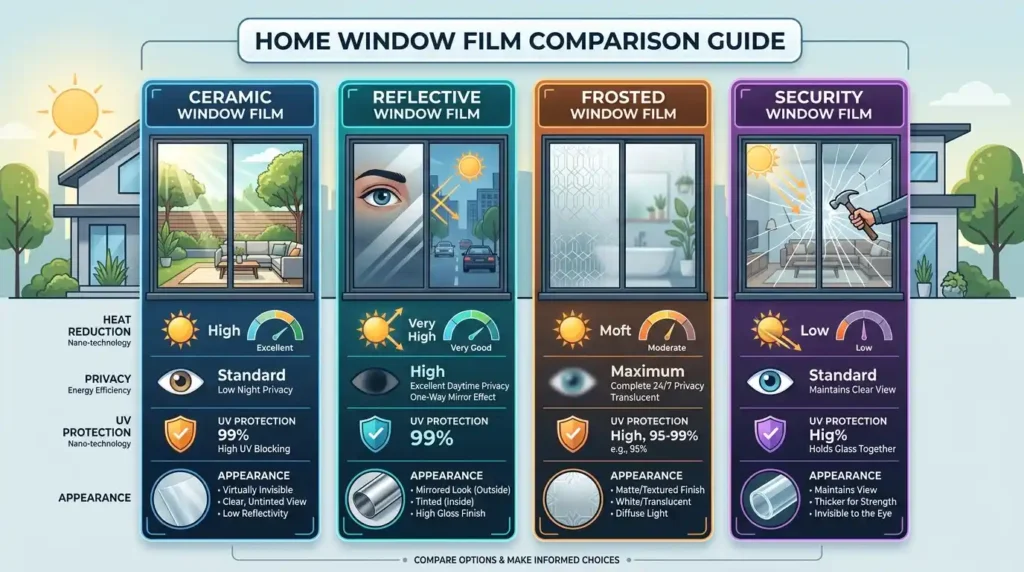
Ceramic window film is the current gold standard for home window tinting. It blocks up to 65 percent of solar heat and unlike darker conventional films, clear ceramic tint achieves that heat rejection without significantly darkening the glass. The infrared blocking technology works on wavelength filtering rather than shade, which is why ceramic tint in a 70 percent shade can outperform a very dark non-reflective window film on actual heat reduction. Dark Shade Window Tint’s BTU meter comparison between a clear ceramic film at 70 percent shade versus a dark non reflective film at 5 percent shade demonstrated exactly this gap in measurable terms.
Ceramic window tinting costs $7 to $12 per square foot installed for standard residential applications, rising to $18 to $45 per square foot for premium ceramic film in high-cost markets like the Bay Area, San Francisco, San Jose, and Concord. One important caveat: ceramic window film absorbs heat rather than reflecting it, which can cause thermal stress crack risk on double pane windows in certain configurations. Always verify double pane window compatibility before specifying ceramic.
Reflective Window Film
Reflective window film and silver reflective window film create a mirror tint finish that provides 100 percent daytime privacy while blocking approximately 75 percent of heat the strongest heat rejection number available outside of security film hybrids. At $7 to $9 per square foot installed, it sits at a competitive price point. The limitation that most installers will tell you upfront: at night, when interior lighting is brighter than outdoor darkness, the one-way mirror effect reverses. Your windows look like mirrors from inside, and the daytime privacy disappears. For ground floor windows in occupied evening spaces, this nighttime limitation matters enough to weigh before choosing reflective film over alternatives.
Non reflective standard tint runs $6 to $7 per square foot installed and blocks roughly 35 percent of solar heat useful for UV blocking and furniture protection, less impactful for serious heat reduction in sun-exposed rooms or west-facing windows that turn rooms into heat traps by mid-afternoon. This is the appropriate choice for rooms where UV protection and mild privacy improvement are the goals, not temperature management.
Frosted Window Film
Frosted window film and decorative window film run $6 to $13 per square foot and provide genuine privacy during day and night unlike reflective or standard tinted films, frosted options obscure visibility in both directions regardless of light conditions. They’re the appropriate specification for bathroom windows, front door glass panels, and any window where nighttime privacy matters as much as daytime. Security window film runs $8 to $15 per square foot depending on thickness, with film ranging from 3 mil to 15 mil. Security film retains glass fragments on impact, slows forced entry, and provides storm protection it’s commonly used on lower floor windows and glass panels in patio doors and French doors where impact risk is higher.
Static Cling Window Film
Static cling window film is the rental market and temporary-application option. Adhesive-free application means it can be removed without residue, making it appropriate for renters, leased spaces, or homeowners who want a reversible upgrade without a permanent commitment. Performance is lower than adhesive films across all categories, but for temporary UV blocking and basic privacy on apartment or leased windows, it fills a real gap.
Smart Glass Film
Smart glass film the electrochromic film category runs $25 to $55 per square foot for retrofit installation, reflecting both the material complexity and the smartphone control integration that allows you to transition the glass from clear to tinted states on demand. For sunrooms or large overhead windows with intense sun exposure that also require clear views at other times of day, smart glass film solves a problem that standard solar window tinting cannot.
Finding and Vetting a Local Window Tinting Contractor
Searching for residential window tinting near me on platforms like Google Maps, Angi, Yelp, or Houzz will present a wide range of contractors, from specialized architectural window film professionals with extensive residential experience to automotive tinting shops that occasionally handle home installations. That distinction matters more than most homeowners initially think. The skills, tools, adhesives, and film specifications for home window tinting differ significantly from automotive window tinting. A contractor who primarily handles vehicle work may lack experience with large architectural glass panels, double pane window compatibility requirements, low-E glass compatible film specification, or the installation precision that floor-to-ceiling residential panels require.
The most reliable approach is to search specifically for contractors who advertise residential window film installation or architectural window film work, then verify through their portfolio that the finished interiors they show are home installations rather than vehicles. Check social media and neighborhood Facebook groups for recommendations from nearby homeowners who’ve completed similar home window tinting projects in your specific region these referrals carry more useful specificity than a generic five-star rating.
Window Tinting Contractor
When contacting a window tinting contractor, request an itemized cost estimate that separates labor costs from material costs. Labor rates for residential window tinting range from $5 to $10 per square foot nationally, with some contractors charging minimum service fees or trip charges for smaller projects. A quote that bundles labor and materials without separation makes it impossible to understand whether you’re paying market rate for each component. Ask specifically about old film removal if you have existing tint that adds $2 to $5 per square foot and should be explicitly included in the scope rather than appearing as a change order mid-project.
Verify the contractor’s license and insurance, ask for references from residential installations, and confirm whether they offer free window film samples before committing to a specification. A professional window film installer who is confident in their work will almost always install a sample on a representative window before the full job this matters particularly for ceramic tint, where the daytime appearance differs significantly from how the film looks on a display board.
What Home Window Tinting Costs in 2026 and How to Budget Accurately
Home window tinting costs in 2026 range from $316 to $941 for most residential projects according to Angi and This Old House data, with a national average around $706 from Thumbtack’s residential pricing guide and $638 from Homeyou’s 2026 survey. The full installed cost range runs $6 to $15 per square foot for most film types and installation conditions, with Bay Area and San Francisco projects running 15 to 20 percent above national averages due to higher local labor rates.
Pricing models vary by contractor and project type. Per square foot pricing is most common and most useful for comparing quotes across different film types and window sizes. Per window pricing works for homeowners with a rough window count but no precise measurements. Whole job pricing gives a fast planning number but obscures the per-unit cost. A useful cross-reference: $30 to $114 per individual 6-square-foot window, and $780 to $1,710 for a 15-window home, gives a rough whole-home estimate range against which any quote can be quickly sense-checked.
Surcharges to build into the budget include $0.50 to $1.50 per square foot for tall ceiling windows or non-standard window shapes that require additional labor and precision, and the $2 to $5 per square foot old film removal cost for retrofit projects replacing existing tint. Minimum service fees of around $392 apply for small projects at many professional window tinting companies. Security film installations at $8 to $15 per square foot and decorative tinted window screen installations at $9 to $20 per square foot sit at the higher end of the installed cost range.
Energy Efficient Window Film Installations
For energy-efficient window film installations, California homeowners should check BayREN weatherization incentive programs and PG&E energy reduction programs that can apply to qualifying solar window tinting projects. California’s property tax exclusion for energy upgrades means qualifying window film work won’t increase your assessed home value a meaningful consideration for higher-cost installations. These incentives combined with 10 to 20 percent cooling cost reduction that most homeowners see after residential window tinting installation in sun-exposed rooms makes the payback period on quality window film considerably shorter than the upfront cost alone suggests.
The Installation Process and What to Expect Afterward
Professional window film installation on a standard residential project follows a predictable sequence: initial consultation and window compatibility check, film specification and sample review, surface preparation including thorough window cleaning, film cutting and application with squeegee smoothing, and a curing period that typically runs several days to several weeks depending on film type, temperature, and humidity.
Cloudiness of fluid presence beneath the surface is considered normal during the period of curing. You should never try moving the bubbles manually as this will result in invalidation of the warranty covering the installation process. Avoid cleaning your windows shortly after installation of the film before any bubbles and cloudiness disappear on their own. Also, avoid using strong chemicals and scratching the film during the whole warranty period to ensure good protection.
Warranty Conditions
The warranty conditions may differ from film type and manufacturer. Frost film with 7-10 year warranty is considered standard for the frosted windows. The lifetime or 10-year guarantee is common for silver reflective window film. The warranty of dyed films lasts 5-10 years because of the shorter life span of dye compared to other film types.
Most residential window tinting does not require building permits. However, HOA restrictions, historic district regulations, and some local building codes require HOA approval or permit for exterior-facing films and mirrored tints in particular. Checking HOA approval requirements and local permit requirements before specifying reflective or silver mirror films prevents installation complications that are considerably more disruptive to resolve after the film is already on the glass.
Conclusion
Finding house window tinting near me is straightforward. Finding the right film for your specific window type, orientation, and performance goals and verifying that the local window film installer has the residential portfolio and technical knowledge to deliver it correctly takes twenty minutes of research that consistently separates a lasting home upgrade from a replacement job two years later. Match the film type to the problem you’re actually solving, verify double pane window compatibility before committing to ceramic, get itemized quotes from at least two residential window tinting specialists, and confirm warranty terms and HOA approval requirements before installation begins.
Frequently Asked Questions (FAQ’s)
Residential window tinting adds a specialized film to home glass to reduce solar heat, glare, UV exposure, or unwanted visibility. The benefits depend on the film type, so homeowners should match the product to the specific problem they want to solve.
Ceramic film is usually better when you want strong heat rejection without making windows noticeably dark, while reflective film offers stronger daytime privacy and high heat reduction. Reflective film loses its one-way privacy effect at night, so the better choice depends on whether heat control, appearance, or privacy matters most.
Look for installers with proven residential or architectural window-film experience rather than relying solely on general ratings. Ask for an itemized quote, residential references, proof of insurance, film samples, and confirmation that the chosen film is compatible with your window glass.
Most professionally installed residential window films cost about $6 to $15 per square foot, although premium ceramic, security, and smart films can cost more. Window shape, accessibility, old-film removal, local labor rates, and minimum service charges can also increase the final price.
Allow the film to cure fully before cleaning the glass, even if temporary cloudiness or small moisture pockets appear beneath it. Avoid pressing bubbles, abrasive cleaners, or harsh chemicals because improper aftercare can damage the film and may affect the installation warranty.

14 thoughts on “House Window Tinting Near Me: How to Find the Right Installer and Choose the Right Film the First Time”