

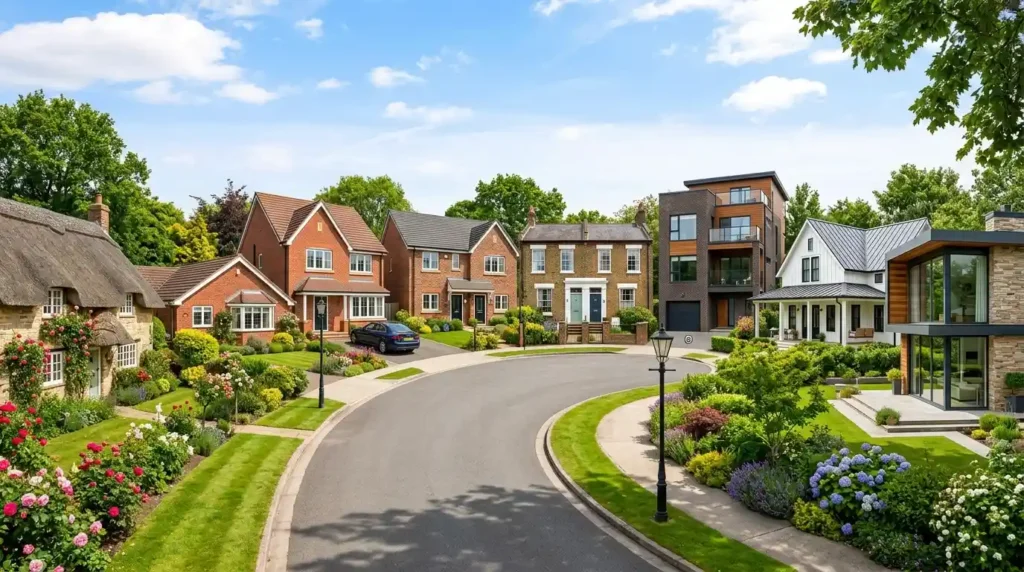
The first house I ever drew a proper set of plans for was a semi-detached in the north of England 1930s stock, bay windows, render-covered walls, the party wall running straight through the middle where the staircase sat. The owners wanted to open it up, modernise it, make it feel like something it wasn’t originally designed to be. What struck me then, and what I’ve come back to across every residential project since, is how much a house’s structure tells you before you’ve measured a single room. The bones of it whether it’s detached, terraced, split-level, a bungalow or a converted barn determine what’s possible almost as much as the budget does.
Understanding types of houses properly isn’t just useful for architects. It’s what every first-time buyer, every person planning a renovation, every self-builder ought to know before the conversation with an estate agent or planning officer begins. The terminology overlaps, the categories blur, and guides that treat house type and house style as the same thing end up confusing both. They’re not the same. A house type describes its structure relative to other buildings how it sits on a plot, how many storeys it has, whether it shares walls. A house style describes what it looks like its architectural language, the era it comes from, the design tradition it belongs to. A Victorian terraced house is both a type and a style at once. A contemporary modular home is a type with a style. Getting these two tracks straight is where most people’s understanding of types of houses clicks into place.
Structure First: The Types That Define How a House Sits in Its Plot
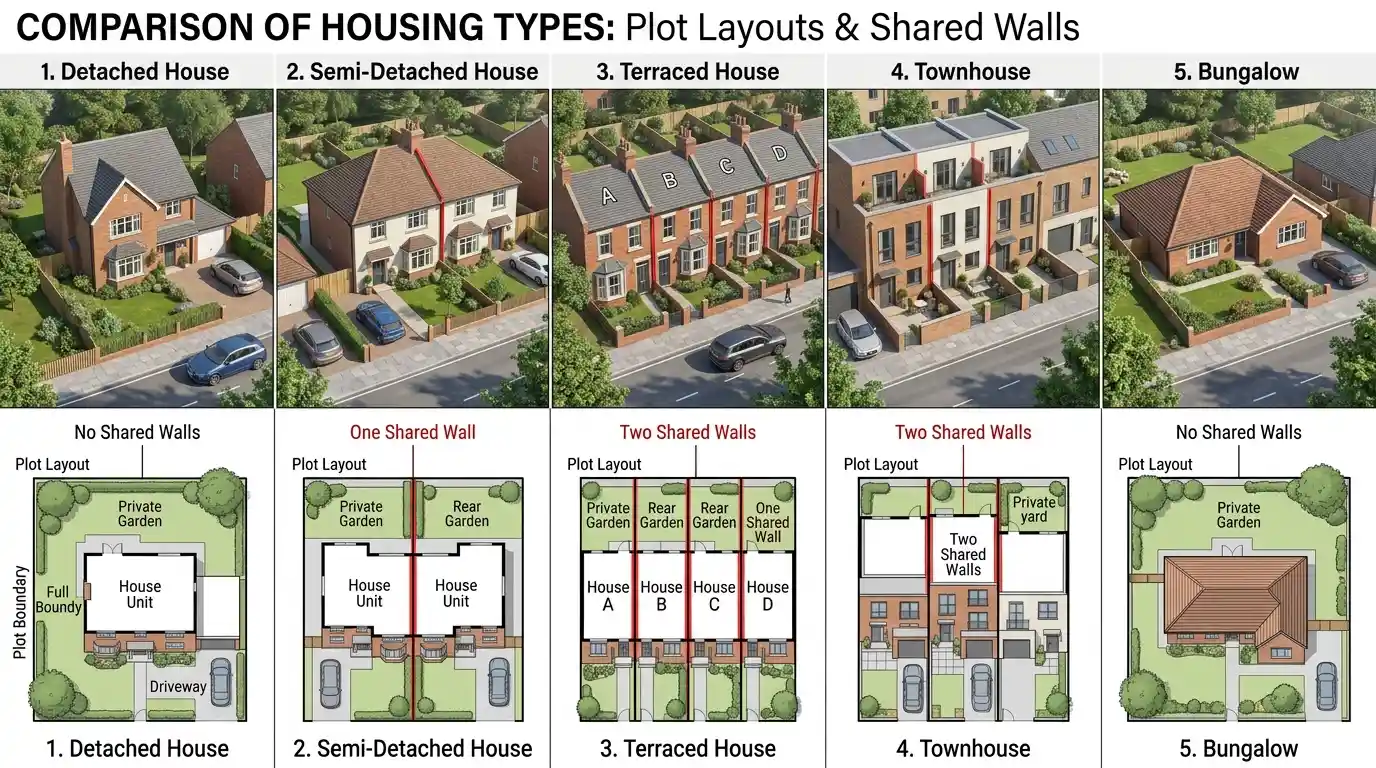
The detached house is the baseline most people measure everything else against. No shared walls, its own plot of land, front garden and back garden typically on separate sides, more privacy than any other residential structure type. That privacy is real and so is the price attached to it — detached houses sit at the top of the residential market in the UK, across most of Europe, and in suburban American markets where single-family detached homes dominate new development. The trade-off is land cost: a detached house uses more ground for the same internal floor space than any attached alternative.
The semi-detached house shares exactly one wall with one neighbour the party wall. Two houses joined, mirrored in plan, sharing the structural boundary between them. The UK built enormous numbers of semi-detached homes between the 1930s and 1950s, and those properties define entire suburban streetscapes today: bay windows at the front, render or brick finish, relatively narrow plots with reasonable garden depth. The noise transfer through a party wall is the standard concern, but a well-built party wall with modern acoustic treatment handles it better than most buyers expect. Semi-detached homes are consistently good value against detached alternatives for the internal floor space they deliver.
Terraced houses or row houses in American terminology, brownstones in the New York context take the shared-wall logic further: every mid-terrace property shares both side walls with neighbours, sitting in a continuous row of attached dwellings that stretch along a street. Terrace housing originated in Europe in the 16th century as a medium-density housing solution in cities where land was at a premium, and it remains the dominant housing type in industrial towns and inner-city areas across the UK. The end of terrace house sits at the row’s edge one shared wall rather than two, often a side gate, sometimes a wider plot, frequently a driveway or garage possibility that mid-terrace properties don’t offer. End-of-terrace properties carry a modest premium over mid-terrace for those reasons.
The townhouse is the terraced house’s taller, more urban sibling typically three or more storeys, a narrow footprint imposed by urban land constraints, vertical living rather than horizontal. Townhouses in British cities have multiplied as developers maximise height on constrained plots. In American real estate, townhouse and row house are used interchangeably, though the British version tends to carry slightly more vertical ambition.
Bungalows are single-storey or occasionally one-and-a-half storey in the dormer bungalow variant, where the upper floor sits within a sloping roof. One floor, more ground coverage for the same square footage as a two-storey house, no stairs. That last point is why bungalows are consistently popular with retirees downsizing and with households where accessibility matters. What confuses buyers is cost: because a bungalow occupies more land for its internal square footage than a two-storey property would, bungalows are frequently more expensive per square foot than equivalent two-storey homes on smaller plots.
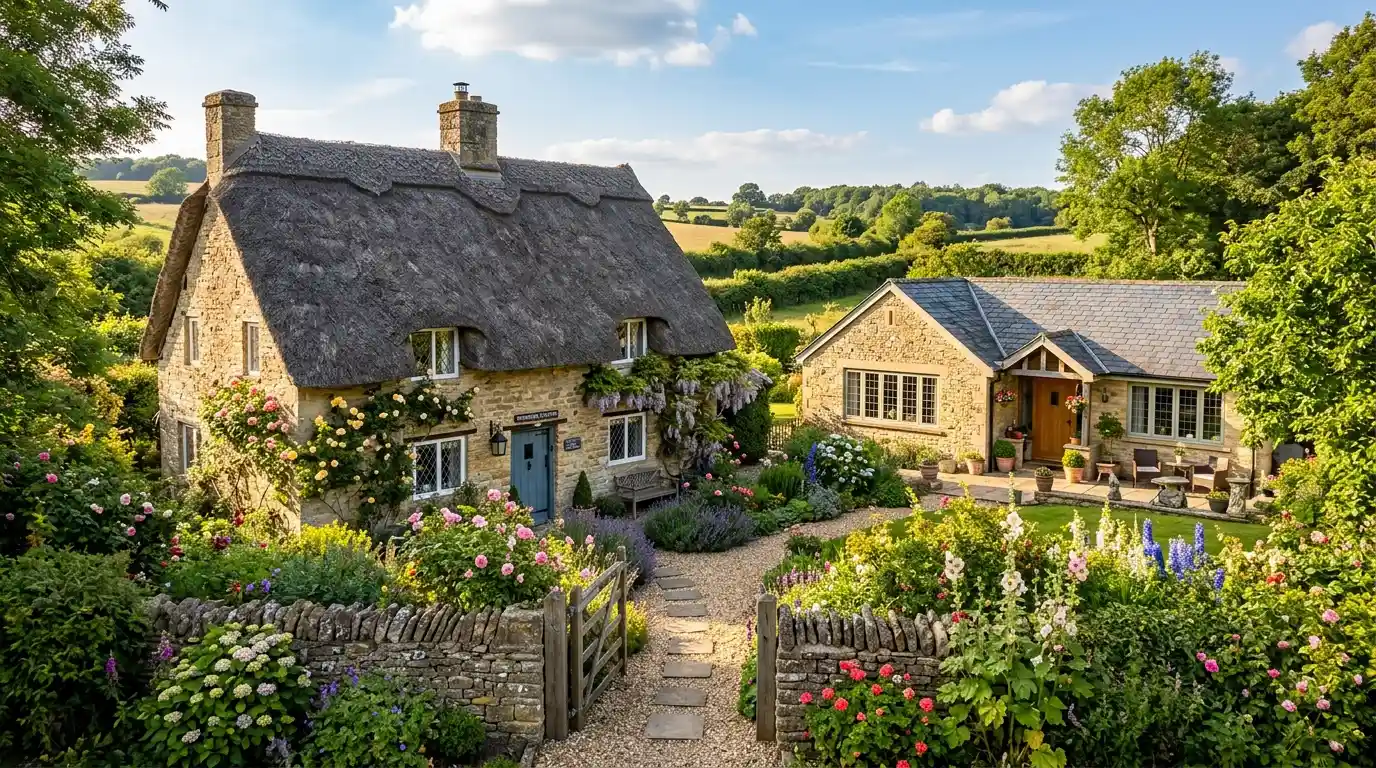
Cottages are where the terminology gets genuinely muddled, because “cottage” describes both a structural character and a romantic idea about rural living simultaneously. Originally, cottages housed agricultural workers post and beam construction, thick walls, small windows, low ceilings, thatched roofs in the oldest examples. They run to about one-and-a-half storeys, the upper floor smaller than the ground because of the roof structure. They can be detached or terraced. A stone cottage in a Cotswolds village and a rendered end-terrace cottage in rural Wales are both cottages structurally, but they’re very different buildings. The “chocolate box” idea of cottage living is real enough as an aspiration, but the thick walls, small windows, and low ceilings that define the type also mean less natural light and more specialist maintenance than most buyers account for.
The maisonette is a flat that occupies two floors of a larger building, with its own internal staircase between them distinct from a flat, which sits on a single level. The distinction matters for mortgage purposes and for building insurance, and it’s one that confuses first-time buyers consistently. A granny flat or accessory dwelling unit is a self-contained dwelling within or attached to a larger residential property a category that’s grown significantly in planning importance as housing density increases in suburban areas.
Style Over Structure: The Architectural Language That Shapes What You’re Looking At
Once the structural type is clear, the architectural style is what gives a house its character, its era, its identity within a streetscape. These are the labels that come from design tradition rather than from how a building sits on its plot.
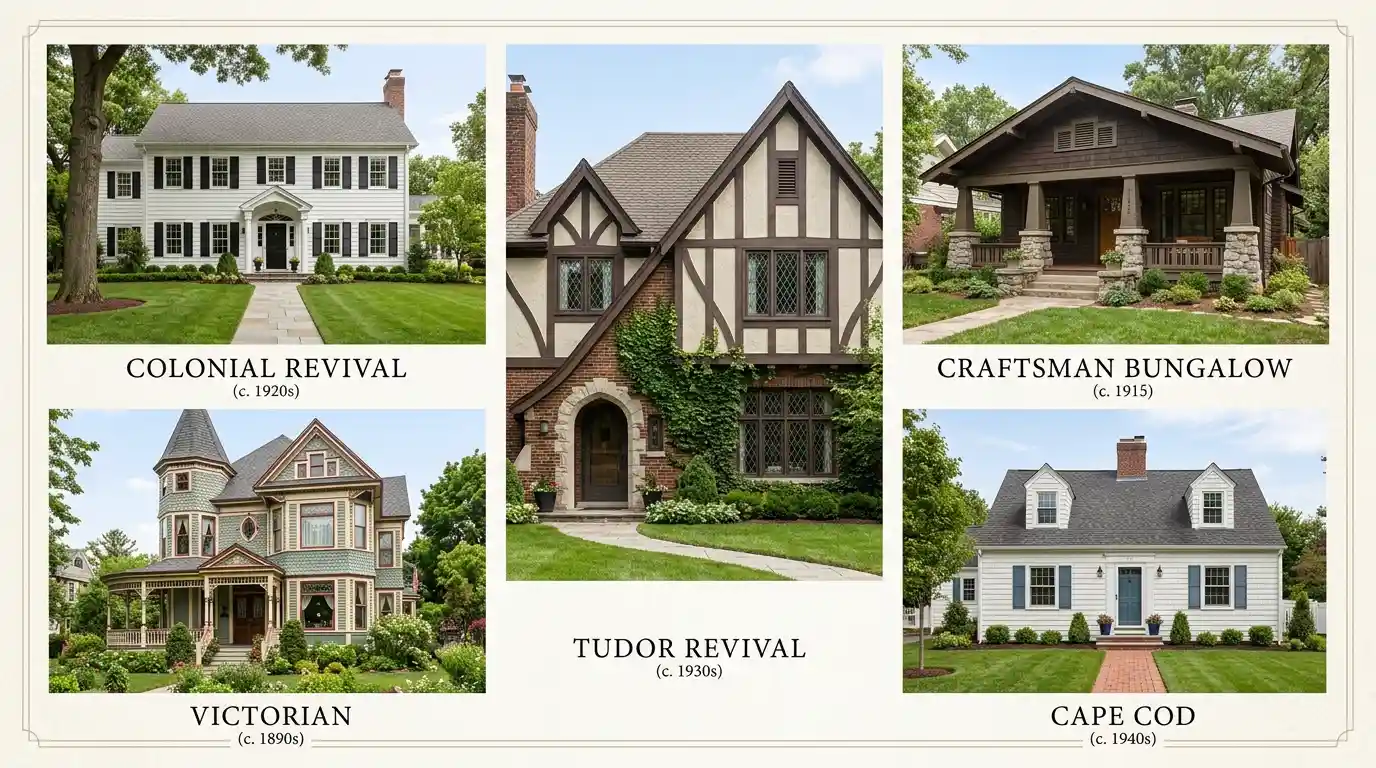
Colonial house design symmetrical facades, gabled roofs, evenly spaced shuttered windows flanking a central front door came to America from Britain and evolved into multiple regional variants. Colonial Revival house styles brought those same formal elements back in the late 19th and early 20th centuries with added polish. Georgian house design is Colonial’s more formal British cousin rigorous symmetry, sash windows, brick construction, restrained classical detailing. The Cape Cod house took Colonial proportions down to their simplest form: steep pitched roof, central chimney, wood shingles, dormer windows for light in the upper floor. It originated in New England in the 1600s and remained popular through the 20th century for its economy and practicality.
Victorian house design covers an enormous stylistic range across the second half of the 19th century from the Gothic Revival elements of early Victorian terraces to the ornate Queen Anne house with its asymmetric design, turrets, decorative arches, and multiple rooflines. Queen Anne sits under the Victorian umbrella but is its own distinct category: exuberant where standard Victorian is restrained, polychromatic where standard Victorian is monochromatic. Edwardian house design followed Victoria’s reign with slightly more generous proportions, larger windows, and more light admitted than the Victorian terrace typically managed.
Tudor house and Tudor Revival house design imported the English country manor aesthetic timber framing, masonry, narrow windows, steeply pitched rooflines into American residential architecture in the late 1800s and kept building it into the 1930s. The visual effect is unmistakable: dark exposed timber against white or pale render, steep gables, small-paned windows.
The Craftsman house and particularly the Craftsman bungalow is the style that came as a reaction against Victorian excess: handcrafted stonework, wide covered porches, thick columns, gabled roofs supported by exposed structural elements, everything honest about its construction. Craftsman bungalows remain some of the most sought-after residential properties in American cities, particularly in California where the style proliferated in the early 20th century.
The ranch house arrived in the mid-20th century and went with American suburban expansion: single-storey, open floor plan, practical, unpretentious, spread horizontally across the plot rather than stacked vertically. The split-level home is the ranch’s more complex variant — multiple floor levels staggered within the same structure, at least two sets of short stairs, typically appearing as a lowered Colonial on one side and a ranch on the other in the tri-level or quad version.
The modern farmhouse is the style that’s dominated residential new builds and renovation targets for the past decade across the US and increasingly in the UK. It takes the traditional farmhouse’s warmth hand-hewn beams, wood flooring, clapboard siding, wrap-around porch, barn-influenced rooflines and combines it with the clean lines and open concept layout of contemporary house design. The result is a style that photographs well, sells consistently, and sits at an interesting point between vernacular housing tradition and modern domestic architecture.
Contemporary house design resists single definition by design it’s whatever residential architecture is doing right now, which in the 2020s means large windows, sustainable home specifications, energy-efficient home technologies, flexible floor plans, and materials that cross between natural and industrial. The passive house standard, net-zero home targets, biophilic home principles these are shaping what contemporary residential buildings look like in Europe and America in ways that will make current new builds as period-identifiable in fifty years as a 1930s semi-detached is today.
The Emerging Types That Are Rewriting the Housing Category
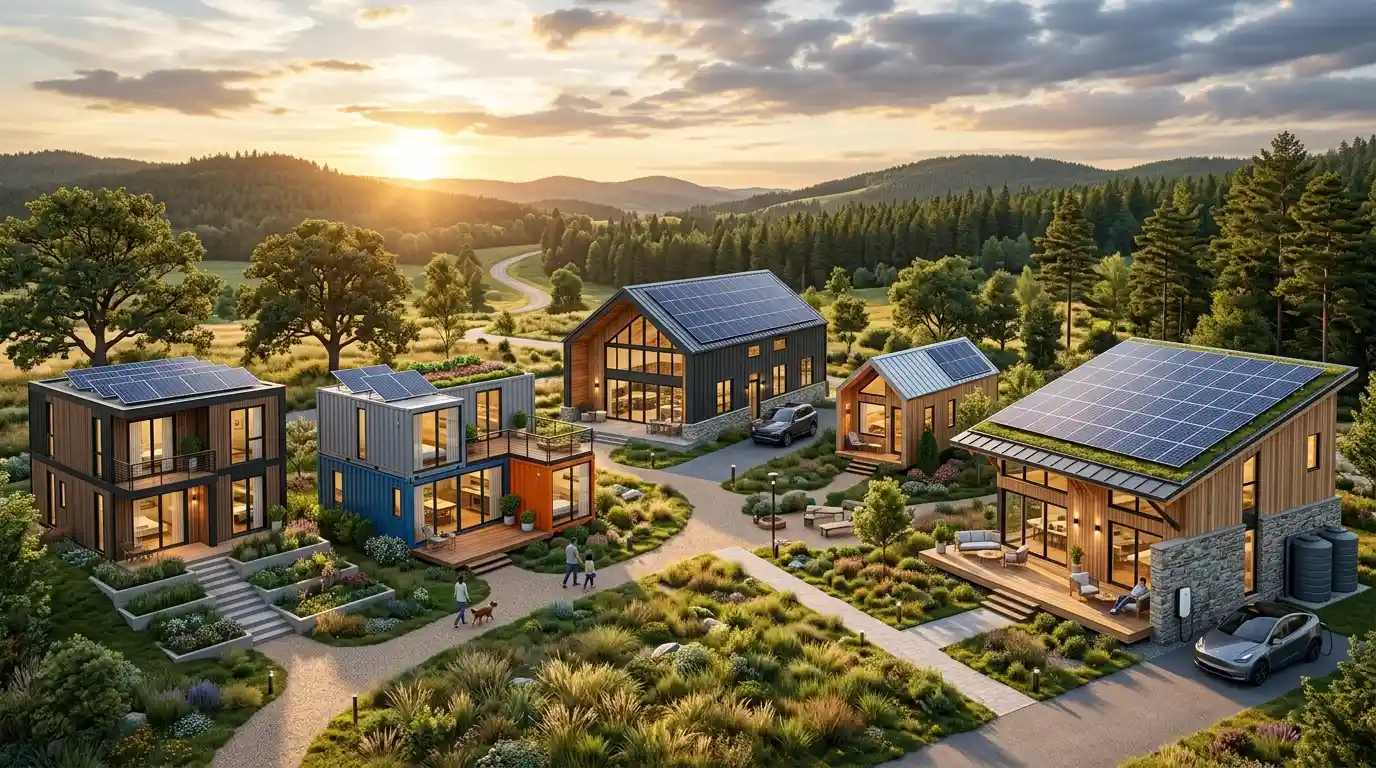
The container house built from repurposed shipping containers, either a single unit or multiple containers combined has moved from novelty to a genuine housing option in the past decade. Durable structure, faster build than traditional construction, lower materials cost at base, unique aesthetic. The challenges are real: insulation and temperature control require significant additional work in a metal box, planning permission is harder to secure than for conventional structures, and modifications push the price upward quickly.
The barndominium took a specific cultural moment barn conversions meeting open-plan luxury residential living and became a recognisable housing type with its own search volume and buyer community. Metal or wooden barn frames supporting a roof without interior load-bearing walls, flexible internal layouts, high ceilings, the visual scale of an agricultural building applied to a family home.
Prefab homes and modular homes have shed the reputation they carried for decades. Today’s prefabricated home is engineered to the same or higher specification than site-built construction, delivered in sections, assembled on-plot faster than traditional builds, and capable of achieving passive house energy efficiency ratings that site-built construction struggles to match consistently. The tiny house movement sub-400 square foot dwellings, often on wheels, designed around the minimum space required for comfortable living sits at the extreme end of this category, driven partly by housing affordability pressure and partly by a genuine design philosophy about what a home needs to be.
The eco home, green home, and net-zero home are less a housing type and more a performance specification applied across structural types a detached house, a semi-detached, a modular home, or a renovated period property can all achieve net-zero energy status given the right insulation specification, renewable energy systems, and building fabric. What matters is the energy efficiency rating at the end of the process, not the structure that got you there.
What this range of types of houses reveals, taken together, is that the category is far wider than most buyers or builders initially assume. The question isn’t just detached versus semi-detached, Victorian versus contemporary. It’s about what the structure allows, what the style communicates, and what the combination of both will mean for how a building performs, maintains, and holds value across the decades that follow.
Conclusion
Choosing between different types of houses is about more than appearance. The structure of a home influences privacy, maintenance, renovation potential, energy efficiency, and long-term value, while its architectural style reflects its character and history. Whether you’re considering a detached home, townhouse, bungalow, cottage, or modern modular build, understanding both the house type and its design style helps you make a smarter buying, building, or renovation decision.
Frequently Asked Questions (FAQ’s)
Common types of houses include detached homes, semi-detached houses, terraced properties, townhouses, bungalows, cottages, maisonettes, modular homes, and tiny houses. The type mainly describes how the building is structured, how many floors it has, and whether it shares walls or land boundaries with neighbouring properties.
A house type describes the physical structure, while a house style describes its architectural appearance and design tradition. For example, a property can be a semi-detached house structurally while also having Victorian, Edwardian, Tudor, Craftsman, or contemporary design features.
A detached house generally provides greater privacy because it does not share external walls with neighbouring homes. Semi-detached houses share one party wall, but they often provide similar usable floor space at a lower purchase price than comparable detached properties.
A bungalow is usually one of the most practical choices because most or all living areas are located on one floor. This removes the need for regular stair use, although bungalows can cost more per square foot because they require a larger plot for the same amount of living space.
Look beyond appearance and compare privacy, shared walls, plot size, maintenance needs, renovation potential, accessibility, energy performance, and long-term value. Understanding both the structural type and architectural style helps buyers judge how well a property will suit their lifestyle and future plans.

9 thoughts on “Types of Houses: A Complete Guide to House Styles and Structures”