

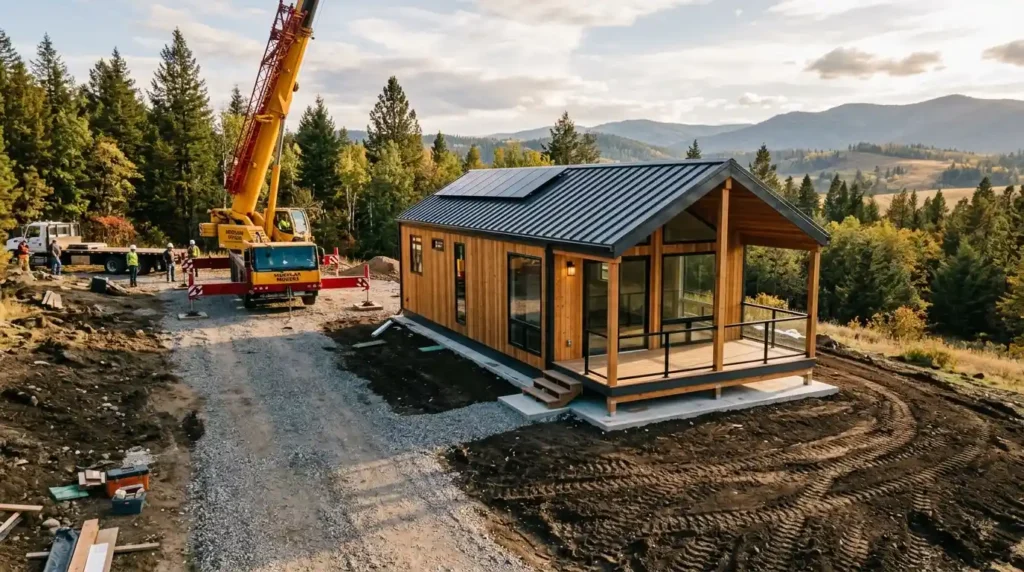
My coworker spent months comparing small modular home options before landing on a 600-square-foot unit outside Boise. She started out assuming one number would cover everything. It didn’t. Factory price, delivery, site prep, foundation, permits, each one showed up separately. On her final tally, and together they nearly doubled her original budget. That’s the trap most first-time buyers fall into. This piece breaks down the real price tiers. What’s actually included at each level, and where her budget went sideways so yours doesn’t have to.
What Counts as a Small Modular Home Right Now
Size matters here more than people expect going in. My coworker looked at a studio loft first, something in the 380 to 450 square foot range. Before deciding she actually wanted a bedroom separate from her living space. That pushed her toward a one-bedroom cottage instead. Which typically lands somewhere around 550 to 650 square feet depending on the builder. She almost went bigger still, a den adds it up past 750 square feet pretty fast. But decided against it once she saw what that jump did to the price.
She ended up in that one-bedroom range eventually. Factory-listed price started around $80,000, reasonable enough on paper. Delivered and installed though, her final number crept closer to $150,000 once everything got tacked on. That gap between factory price and delivered price is honestly the single biggest thing buyers underestimate. And it’s not just her either, it shows up pretty consistently across the pricing guides tracking this market right now.
How Small Can a Modular Home Actually Be?
Smaller than most people assume, honestly, some units drop well under 400 square feet into tiny home-adjacent territory rather than a proper modular build. A few European models get down to something like 200 to 320 square feet. Which surprised me when I looked into it after my coworker’s search. Fannie Mae draws a hard line at 400 square feet for their manufactured housing financing programs though. So anything smaller than that usually means a totally different set of financing rules to navigate.
The Price Tiers Nobody Explains Clearly
Pricing splits into rough tiers, and knowing which one you’re shopping in changes everything about how the process actually feels. My coworker started out browsing. What turned out to be entry-level shell kits without really realizing it. Bare structures without much finish work, prices that looked shockingly low until she understood what wasn’t included. Once utilities and basic finishing get factored in, that entry tier stops looking quite so cheap.
She eventually landed in mid-range prefab territory. Structure alone costing somewhere in the high tens of thousands before she’d picked a single upgrade. Premium and luxury builds sit well above that. She toured one showroom model that would’ve run past $200,000 with the full package, smart home features, higher-end finishes, more customization than she personally needed or wanted to pay for.
What’s the Real Difference Between Factory Price and Total Cost?
Factory price only covers the structure itself, built and ready to ship, nothing else. Total cost tacks on transportation, crane fees for setting the unit down, site prep, foundation work. Utility hookups my coworker’s version of all that added tens of thousands more than she’d originally budgeted for. Her rural lot needed extra grading before delivery could even happen. An expense that never once showed up in any online calculator she’d checked beforehand.
What Actually Drives the Price Up
Site conditions matter more than most buyers realize walking into this. A flat, accessible lot near existing utilities costs a lot less to prep than a remote or sloped one does. My coworker’s Boise lot needed a longer driveway cut just so the delivery truck could actually reach the pad. Something that never showed up in any calculator or estimate she’d looked at ahead of time.
Customization is where things really get away from people though. She wanted a smart home package and some upgraded appliances, small choices individually. But they stacked up fast once she started adding them together. Import duties are a separate headache entirely if you’re sourcing something European or specialty, and the exact percentage really depends on your specific manufacturer and current trade terms, worth a direct call rather than trusting any general online guide on that specific number.
Why Did My Site Prep Cost So Much More Than Expected?
Honestly, lot access and slope are usually the culprit, more than anything else people tend to blame. A rural or sloped lot, like my coworker’s, often needs extra grading, a longer driveway, or longer utility runs that a flat suburban lot just never requires. Getting a site evaluation before finalizing a budget catches most of this early, which is the one step she said afterward she wished she’d done first instead of last.
Financing a Small Modular Home
Financing works differently than a typical mortgage, and this trips people up constantly, my coworker included at first. Fannie Mae’s MH Advantage program allows down payments as low as 3%, loan-to-value up to 97% for units meeting specific design and construction standards. Standard manufactured home loans usually want 5% down instead, which is a real difference once you’re talking about a $150,000 purchase.
A Fannie Mae policy change back in December 2022 dropped an older requirement that manufactured homes be built within the past ten years to qualify for certain loans, opening things up for older or resold units that used to get shut out entirely. My coworker didn’t end up qualifying for MH Advantage specifically, her unit missed one design criterion, so she went with the standard 5% down option instead, still workable, just a bit more upfront than she’d hoped going into it.
Can I Get a Conventional Mortgage for a Small Modular Home?
Yes, as long as the unit sits on a permanent foundation and meets specific construction and titling requirements. Programs like MH Advantage extend conventional 30-year mortgage terms to qualifying modular homes now, something that genuinely wasn’t broadly available even a decade back. Units missing those specific standards, older builds especially, often still qualify for regular manufactured home financing, just with that higher down payment my coworker ended up paying.
Choosing Between Manufacturers
Quality varies a lot more between manufacturers than the marketing photos ever let on, and my coworker learned this the slow way, touring three separate showrooms before settling on anything. She said the difference between the cheapest and most expensive options she’d looked at was obvious the second she actually touched the cabinetry in person, something no website photo had shown her.
Ask specifically about factory completion percentage too, most reputable builders finish somewhere around 80 to 90% of the work before a unit ever leaves the factory floor, which matters a lot for quality control down the line. And ask what’s actually included in that base price versus what counts as an upgrade, since two builders quoting nearly identical numbers can end up wildly apart once you’ve added whatever features you actually wanted.
Conclusion
A small modular home can genuinely work out cheaper than traditional construction, but only if you actually understand which price tier you’re shopping in and what’s included at each level. My coworker’s final number came in higher than she expected, not because she got a bad deal exactly, just because factory price alone was never the full picture to begin with. Budget for site prep, delivery, and financing terms specific to modular construction from the start, and the surprises that hit her mid-process become a lot easier to plan around instead.
Frequently Asked Questions
How much does a small modular home cost on average?
Total costs typically range from $80,000 to $250,000 depending on size, finish level, and site conditions. Factory price alone often understates the real number significantly, since delivery, site prep, and foundation work usually add tens of thousands more.
Is a small modular home cheaper than a traditional house?
Often yes, especially for smaller footprints under 1,000 square feet, since factory construction cuts labor costs and waste compared to traditional site-built methods. The gap narrows once site prep, permits, and customization get factored in, so it’s not automatically cheaper in every situation.
Can you get a mortgage for a small modular home?
Yes, programs like Fannie Mae’s MH Advantage offer conventional 30-year mortgages with down payments as low as 3% for qualifying units. Units that don’t meet the specific design and construction requirements can still often qualify for standard manufactured home financing instead, typically requiring 5% down.
How long does it take to get a small modular home installed?
Factory build time typically runs a few weeks to a couple months depending on the manufacturer and how much customization you’ve chosen. Site preparation, permitting, and utility hookups often take longer than the actual factory build, so total project timelines commonly stretch three to six months from order to move-in.
