

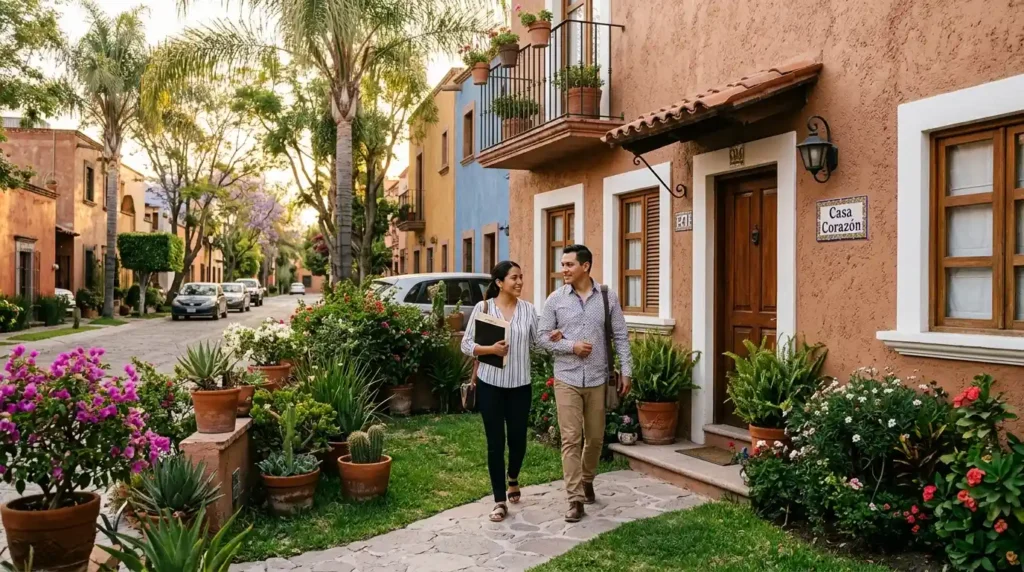
A friend of mine moved to Querétaro last year. Good job, solid income, exactly the kind of buyer who should’ve had options. Six months of looking later, she was still renting. Home prices there kept climbing faster than her savings could catch up. Turns out that’s not just her experience. Sociedad Hipotecaria Federal, Mexico’s federal mortgage authority, tracked national housing prices up 8.7% in the first quarter of 2026 alone. Wages didn’t move anywhere close to that. Middle class homes in Mexico haven’t vanished. They’ve just gotten harder to actually land, and this piece walks through why, what the government’s doing about it, and where the math still works out.
What “Middle Class” Actually Means for Housing in Mexico
Definitions vary depending on who you ask, INEGI, a bank research team, a random online calculator. Most land in a similar range though. Roughly MXN 16,000 to 28,000 a month for an individual. Higher for a family unit, often cited closer to MXN 22,000 to 40,000 depending on household size and region. That’s not a precise legal category. It’s a working range most Mexican economists and housing researchers use when they talk about the “middle” segment. My friend’s income sat right in that band, comfortably even. Didn’t matter. The homes she could actually afford kept shrinking in number every month she waited.
What income counts as middle class in Mexico?
Somewhere between MXN 16,000 and 40,000 a month, depending on household size and where you live. Individual earners tend to land toward the lower end of that range. Families with two or more members typically need to clear the higher end just to maintain a comparable standard of living. Regional cost of living shifts this a lot. Middle class in Mexico City means something different than middle class in Durango, even at an identical paycheck.
How Fast Prices Have Climbed: The SHF Numbers
National housing prices rose 8.7% year-over-year in Q1 2026. That’s per SHF’s own price index, which tracks mortgage-financed home purchases nationally. New construction climbed even faster, 9.1%. Existing homes rose 8.3%, still well above wage growth for the same period. The national average appraisal value hit roughly 2,024,337 pesos in that quarter. Median came in lower, 1,331,000 pesos, which tells you the market’s being pulled upward by a smaller number of expensive transactions. By the first half of 2026, cumulative growth had eased slightly to 7.9%, still nowhere close to slowing down in any meaningful way. Mortgage rates sat around 11.4% in the same period, according to Banco de México data cited alongside SHF’s report. Not catastrophic. Not cheap either.
How much have home prices risen in Mexico in 2026?
8.7% nationally in the first quarter, according to SHF’s official price index. That eased slightly to a 7.9% cumulative rate through the first half of the year. Some metro areas ran far hotter than the national number, Guadalajara’s metropolitan zone posted appreciation above 12% in the same quarter, well ahead of slower-moving areas like the Valle de México, which grew closer to 5%.
INFONAVIT’s T100 Program and Vivienda para el Bienestar
The government isn’t ignoring this, to be fair. INFONAVIT rolled out a new scoring system this year, called T100, that cut the qualification threshold from 1,080 points down to just 100. Dramatic change on paper. Workers who’d have needed a decade of steady contributions to qualify under the old system can now clear the bar in as little as six months, provided they’re actively registered with IMSS and haven’t used a prior INFONAVIT credit. The program pairs with Vivienda para el Bienestar, a federal housing initiative offering homes starting around 600,000 pesos, some running up to 1.1 million, aimed specifically at workers earning one to two minimum wages. My friend didn’t qualify for that program, her income sat above the bracket it targets, but plenty of first-time buyers in a lower income range genuinely have.
What is the INFONAVIT T100 program?
A simplified credit qualification system that dropped the points threshold from 1,080 to 100. Workers need at least six months of continuous formal employment and active IMSS contributions to reach the new minimum, compared to years of contribution history required previously. It’s currently paired with the federal Vivienda para el Bienestar program, though INFONAVIT has indicated the model may expand to more housing types and regions depending on results from the initial rollout.
Where Middle-Class Buyers Still Find Value
Not every city is running this hot. Prices vary enormously depending on where you’re looking, sometimes by a factor of five between the priciest and most affordable metro areas. Cancún and other coastal tourist hubs sit near the top of the national price range per square meter. Durango and several intermediate cities in the Bajío region sit dramatically lower, sometimes a third of coastal pricing for comparable square footage. Nearshoring-driven industrial growth has actually helped some of these intermediate cities, more formal jobs, steadier local demand, without the same tourist-driven price pressure hitting coastal markets. My friend eventually looked outside Querétaro’s core and found meaningfully more inventory in nearby areas, at prices that actually matched her budget.
Which Mexican cities still have affordable middle-class homes?
Generally, intermediate cities in the Bajío corridor and parts of northern Mexico, where nearshoring-driven job growth hasn’t yet pushed housing costs to coastal or capital-city levels. Durango, León, and several similarly sized cities have shown meaningfully lower per-square-meter pricing than Mexico City, Cancún, or Guadalajara in recent SHF and market data. Checking city-specific price data before committing to a search area matters here more than almost anywhere, since national averages hide enormous regional swings.
Conclusion
Middle class homes in Mexico haven’t disappeared, but the pace of price growth has genuinely outrun what most paychecks can absorb. An 8.7% quarterly increase against wage growth nowhere close to that pace is the core problem, not any single city’s market quirk. INFONAVIT’s T100 reform and the Vivienda para el Bienestar program are real attempts to widen access, particularly for lower-income formal workers. For everyone else, the practical move is the same one my friend eventually made: widen the search past the hottest metro core, check actual regional pricing instead of national headlines, and go in with a realistic number instead of last year’s.
Frequently Asked Questions (FAQ’s)
National housing prices rose 8.7% in the first quarter of 2026 alone, according to SHF’s official price index, well ahead of wage growth over the same period. Limited new construction in high-demand metro areas combined with strong mortgage-financed demand has kept upward pressure on prices even as overall inflation has moderated.
It’s a federal housing program offering homes starting around 600,000 pesos, aimed at formal workers earning one to two minimum wages who don’t currently own a home or hold an active mortgage. It pairs with INFONAVIT’s new T100 credit scoring system, which dramatically lowered the qualification threshold for eligible workers.
Rates have hovered around 11.4% based on recent Banco de México data cited alongside SHF’s housing reports, which is elevated compared to many international markets but has stayed relatively stable through 2026. Rates can shift with broader monetary policy, so checking a current bank quote is more reliable than relying on any single reported average.
Intermediate cities in the Bajío corridor and parts of northern Mexico, including Durango and León, have generally shown lower per-square-meter pricing than Mexico City, Guadalajara, or coastal tourist hubs like Cancún. Nearshoring-driven job growth has helped some of these cities maintain steadier, more affordable housing markets relative to the capital and coastal regions.

1 thought on “Middle Class Homes in Mexico: Why Prices Rose 8.7% While Wages Barely Moved”