

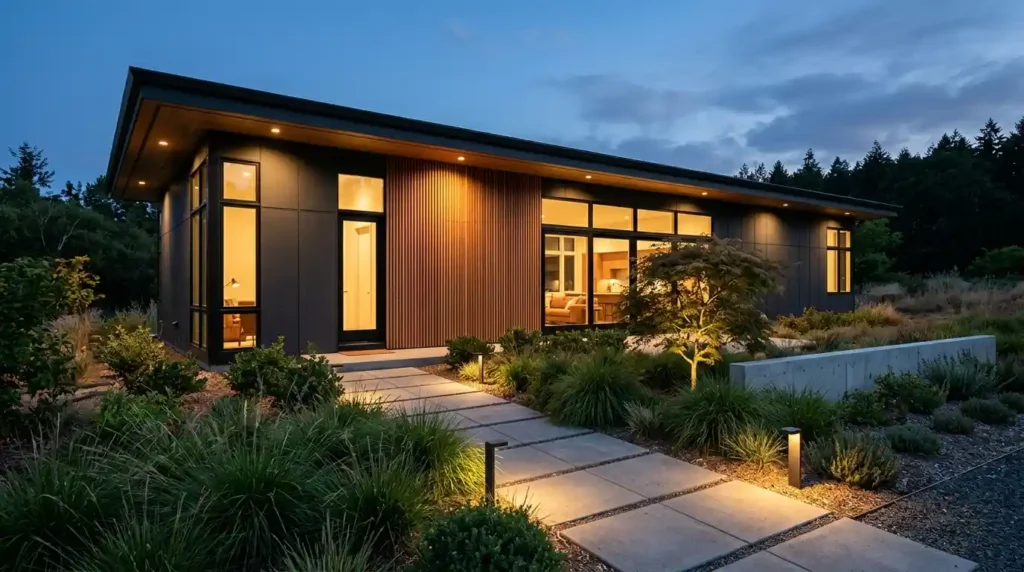
My neighbor spent three years slowly turning a beige 1990s colonial into something that actually looks current. Never touched the structure once. New cladding on one section, darker exterior paint, black window frames, better outdoor lighting, that’s basically the whole list. That’s really the trick behind modern home outside design, it’s rarely a full teardown. It’s picking the two or three changes that carry the most visual weight and doing those properly instead of doing everything halfway. This piece walks through materials, color, glazing, lighting, landscaping, the stuff that actually reads as modern from the street. Real cost ranges too, so you know what you’re signing up for before a contractor gives you a number that makes you sit down.
What Actually Makes an Exterior Read as Modern
People assume modern means flat roof, glass walls, done. Not really, or not just that anyway. Restraint, more than any single feature. Clean lines. A tighter color palette. Materials that don’t fight each other, that combination does more work than a dramatic roofline. My neighbor’s house has a pitched roof, always has, and it still reads modern now, purely because everything under that roofline stopped competing with itself. Picture a facade juggling five materials at once versus one running with two, chosen on purpose. Architectural Digest and House Beautiful both keep landing on the same point in their exterior coverage. Cohesion over novelty. One bold move, a cantilevered entry canopy, a full wall of black-framed glazing, reads as more confident than a dozen scattered small updates.
What is considered modern exterior house design?
Clean geometric massing. A restrained material palette. Big expanses of glazing, minimal ornamentation, that’s the short version, horizontal lines and simple shapes instead of pitched roofs and decorative trim, though plenty of modern homes keep a pitched roof anyway, my neighbor’s for one. Modern isn’t one fixed look. A Scandinavian-leaning white render home reads completely different from a Japanese-inspired timber-and-stone build. Same discipline underneath though, if you look close enough. Material restraint. Clean sightlines. Nothing extra sitting around.
Choosing Exterior Materials That Actually Hold Up
Material choice is where most modern exterior remodels quietly succeed or fail, usually within five years. Timber cladding looks fantastic on day one, no argument there. Untreated wood weathers unevenly though, which is part of why modified wood products from companies like Kebony USA have caught on, the treatment resists rot and warping better than raw cedar or pine. Fiber cement siding from brands like Allura USA gets you the crisp panel look of concrete without the weight or cost. Stone veneer and exposed brick add texture without the upkeep real timber demands. My neighbor mixed dark fiber cement panels with one section of vertical wood slats. Four years in, the wood needs re-oiling. The panels still look brand new.
What materials are best for a modern house exterior?
Fiber cement panels. Stone veneer. Metal cladding. Those three hold up best, generally, resisting rot and warping and fading better than raw timber over time. Wood still earns its place on accent sections, some warmth, some texture, plan on re-sealing every three to five years depending on climate and sun exposure though. Concrete and render give the cleanest look overall. Watch for hairline cracking in regions with real freeze-thaw cycles every winter, my neighbor’s contractor mentioned that one almost as an afterthought and it turned out to matter a lot.
Color Palettes That Read Modern Without Looking Cold
Color signals modern faster than almost any structural choice you could make, and it’s the cheapest lever available if a full material swap isn’t in the budget yet. White and warm gray render remain the most common modern exterior colors across Europe, increasingly in American new builds too, but pure white looks sterile fast without something grounding it, a wood door, a dark roofline, planting pushed right up against the base of the house. Black exteriors had a real moment a few years back. Haven’t fully faded either. The trend’s shifted toward softer near-black charcoal instead of true matte black though, which shows dust and water spots way more than people expect walking in.
What exterior color makes a house look expensive?
Warm gray. Deep charcoal. Both read as more expensive than stark white or beige, they hide dirt and weathering better and pick up more depth in natural light. Pair a dark or neutral body color with a contrasting warm wood accent, a front door, a section of cladding, outperforms any single-color scheme most of the time. Olive and sage green picked up traction too lately. Middle ground, a true neutral and something bolder, not fully committing either way.
Windows, Doors, and Facade Features That Define the Look
Glazing changes a facade’s whole character faster than nearly anything else you can do to a house. Expansive, floor-to-ceiling windows read as unmistakably modern. Black-framed windows especially have turned into shorthand for the entire style, they’re everywhere across HGTV renovation coverage and Houzz project galleries. An oversized front door, solid wood or paired with a narrow glass sidelight, works as a focal point the same way a fireplace anchors a living room. Ben and Erin Napier’s work on HGTV leans more farmhouse than strict modern, sure, but it proves the same point, one confident focal element beats five scattered small updates.
Do black-framed windows work on every house style?
Not really, no. They work on most contemporary and farmhouse-adjacent exteriors just fine, but they can look heavy-handed on a smaller cottage-style home without enough facade to balance them out. On a compact house, a charcoal or bronze frame usually reads just as current while feeling less visually dense. One rule holds no matter the frame color though, bigger and fewer windows almost always beat several small ones for a genuinely modern read.
Lighting and Landscaping for a Finished Modern Look
Lighting’s the upgrade people skip most, and it’s honestly one of the cheapest ways to make an exterior actually look finished after dark, not just during the day. Recessed soffit lighting, low-profile LED strips along a walkway, one motion-activated spotlight near the entry, that covers most of what a modern exterior needs without turning the yard into a runway. Landscaping matters just as much, arguably more. Native, low-maintenance planting reads more intentional than a manicured lawn ever does, and it survives a dry summer without a hose running every evening.
What outdoor lighting works best for a modern exterior?
Warm-toned recessed and strip lighting. Cooler blue-white LEDs, and a modern facade can end up looking closer to a parking garage than an actual home, my neighbor made that mistake first round and swapped the bulbs within a month. Uplighting on one architectural feature, a stone accent wall, a mature tree near the entry, creates more depth after dark than spreading light evenly ever will. Keep fixtures low-profile. Mostly hidden during the day, so the lighting doesn’t become the statement itself.
Sustainable and Energy-Efficient Exterior Upgrades
Sustainability’s moved from a niche add-on to something buyers actually ask about now, and a lot of what makes a modern exterior look better also happens to perform better. High-performance glazing cuts heat loss substantially versus older single-pane windows. Darker exterior colors, somewhat counterintuitively, can help with passive solar gain in colder climates, while lighter tones do the opposite in hot ones. Rainwater collection and permeable driveways both reduce runoff, and that matters more every year as storm patterns keep shifting. None of this stays invisible either. A green wall or native planting along a boundary fence does double duty, softening a hard modern facade while cutting down on watering through a dry season.
Is it worth adding solar panels to a modern exterior remodel?
Generally yes, if your roof gets consistent sun and you’re planning to stay put for at least seven to ten years, that’s roughly the payback window most homeowners see before panels start generating pure savings instead of just breaking even. Panel design has improved enough now that low-profile, all-black options blend into a dark modern roofline instead of standing out the way older silver-framed panels always did.
Budget: What a Modern Exterior Refresh Actually Costs
Cost is where a lot of modern home outside design plans stall out, mostly because people price the whole facade at once instead of phasing it. A full re-clad on a mid-size home can run well into five figures depending on material choice, no way around that. A targeted refresh though, new paint, updated lighting, a new front door, some landscaping, that often lands in the low thousands and still delivers most of the visual impact. My neighbor’s project stretched across three years and cost noticeably less overall than one full renovation would have, mostly because she wasn’t paying a contractor mobilization fee five separate times.
How much does a modern exterior renovation cost?
Fifteen to sixty thousand dollars or more for a full renovation, depending on material choice and how much structural work’s involved. A phased approach, cladding one year, lighting and landscaping the next, usually costs less in total and lets you course-correct after each stage. Get three contractor quotes either way, still the most reliable way to gauge a fair local price.
Conclusion
Modern home outside design comes down to restraint over budget. A tighter material palette. A confident color choice. Glazing that opens the facade up, lighting that carries the look after dark. You don’t need to touch the structure to get most of the effect, my neighbor’s colonial proves that much on its own. Phasing it in over a year or two usually costs less overall than one big renovation, and it leaves room to change course if the first phase teaches you something you didn’t expect. Pick the two or three changes carrying the most visual weight. Do those properly. The rest of the house reads as intentional even before anything else gets touched.
Frequently Asked Questions (FAQ’s)
Start with paint or render color, exterior lighting, and a new front door, three changes that carry a disproportionate amount of visual impact for a relatively small budget. Swapping window trim to black or charcoal and adding low-maintenance native planting rounds things out without touching the home’s actual structure.
Warm gray and soft charcoal, currently the most common modern exterior colors across both European and American new builds, having mostly overtaken the starker whites and grays that were everywhere five or six years back. Olive and sage green have gained ground too, a warmer alternative to a strict neutral.
Yes, though it usually works better as a partial update than a full conversion. Updating windows, color, and lighting on a traditional home can shift it toward something more contemporary without erasing the original architecture, which tends to read as more intentional than forcing a full modern rebuild onto an older structural footprint that was never designed for it.
No, not necessary at all, plenty of genuinely modern exteriors keep a low-pitched or standard roofline instead. Clean lines, a restrained material and color palette, and bigger windows do more to signal modern than roof shape alone ever could, worth remembering if a flat roof just isn’t practical for your climate or local code.
