

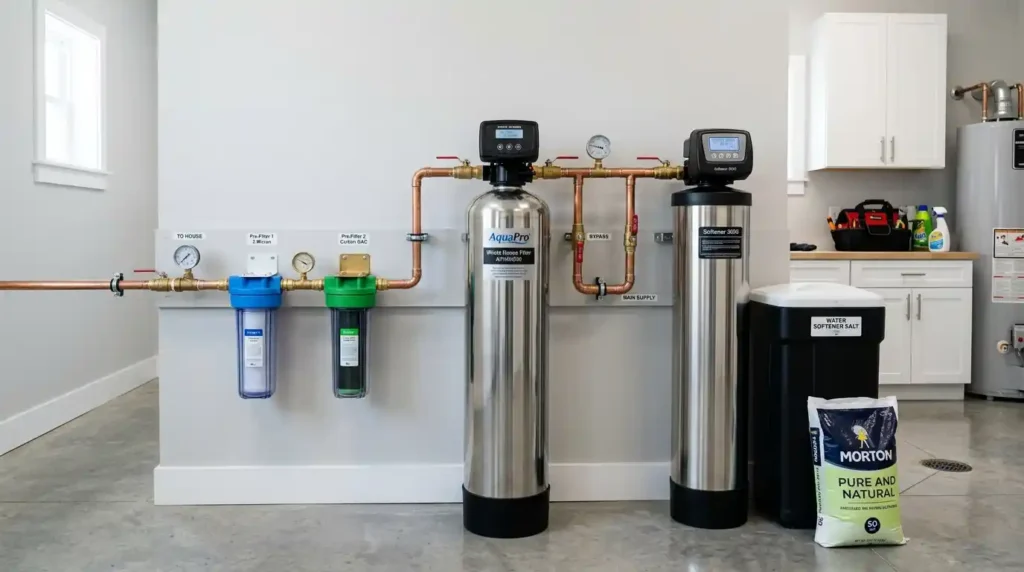
I knew my water wasn’t bad; the municipal Consumer Confidence Report said so. Yet, after each shower, my hair felt dry. In addition, the water coming out of the kitchen sink had a hint of chlorine smell. Which tainted the taste of my coffee. A water quality specialist advised me to have my water tested before making any conclusions. From the mail in test, the results showed high levels of total THMs at 31.83 ppb. Some traces of lead and chloramines together with free chlorine.
It all made sense now. Neither the pitcher filter nor the shower filter would solve the problems. Whole house water filtration was the solution not because it is the best for everything. But because it solves the right problems.
Why Whole House Water Filtration Outperforms Every Single Point Solution
Whole house water filtration connects to the main water supply line and treats all water entering the home before it reaches any fixture. Unlike point-of-use filters that improve one tap, this approach delivers consistent water quality throughout the house kitchen sink, shower, laundry room, appliances, and outdoor spigots alike.
The Health Case: Chlorine Shower Steam and Appliance Protection
Homeowners tend to think about drinking water. It is necessary to think about bathing water as well. According to research by Aquasana, shower steam may contain 20 times more chlorine than regular tap water. Breathing this steam leads to breathing problems due to irritation of the lungs. Chlorine also affects rubber elements that are present in dishwashers, washing machines, water heaters, and refrigerator water valves. Whole house water filtration not only protects your health but also increases the life expectancy of your household appliances.
According to 2025 national water quality survey of 1,147 American adults conducted by Aquasana, 87 percent of Americans have concerns about tap water quality. It has been proven by data from the EPA that there are contaminants in municipal water in all fifty states of the USA. 43 million people in America rely on private wells. Therefore, their concern is even higher as there is no water quality control for private wells on the federal level.
Microplastics, PFAS, and the Emerging Contaminant Problem
Contrary to popular belief, bottled water does not present a safer option for consumers. Evidence reveals that bottled water has 2,125 percent more microplastics than filtered tap water. In terms of costs, people paying $100 each month on bottle purchases spend up to $1,200 yearly for a product which is definitely inferior in terms of microplastics when compared to the water produced through whole-house water filtration systems. Perfluoroalkyl Substances (PFAS), also called the forever chemicals, can be found in drinking water supplies all over the country. The water filtration systems global market is expected to value $14 billion in 2024 while it will reach almost $35 billion by 2034, with a growth rate estimated at 9-10 percent annually.
How Whole House Water Filtration Technology Actually Works
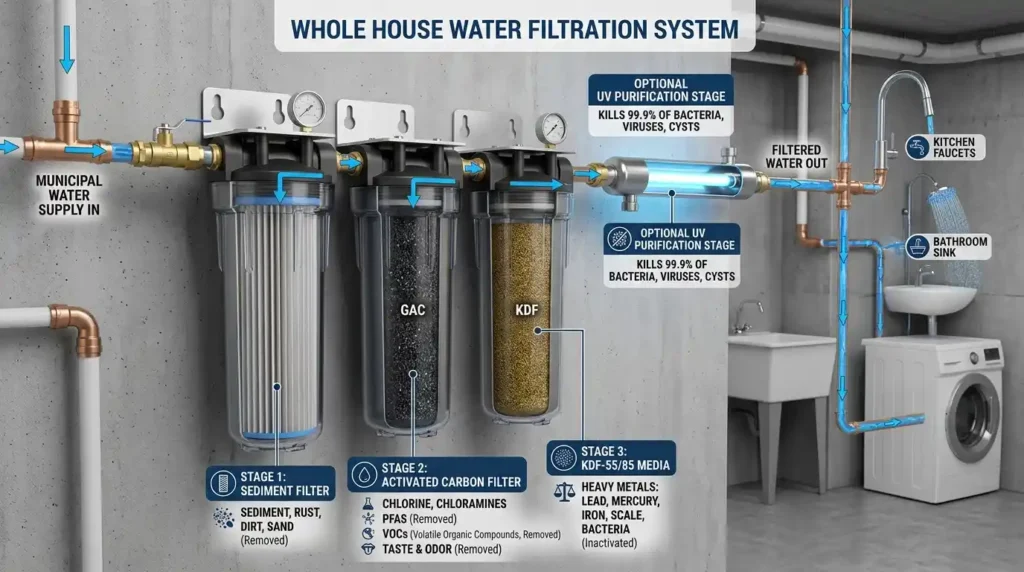
The technology stack in any multi-stage whole house water filtration system follows a logical sequence. Each stage targets a different contaminant category, and understanding that sequence helps you match a system to your actual water problem.
The Five Filtration Stages and What Each One Does
A sediment pre-filter acts as a first line of defense, trapping particles such as rust, silt, sediment, debris, and sand from clogging the rest of the media. After that comes activated carbon or catalytic carbon which works by adsorbing chlorine, chloramines, VOCs, pesticides, herbicides, taste-causing elements, and odor-causing elements. Catalytic carbon is necessary specifically for chloramines since ordinary carbon cannot act on chloramines in the same manner as it acts on free chlorine. It should be known that the Water Quality Association has verified that the removal of chloramines requires significantly higher empty bed contact time, EBCT, compared to free chlorine.
Water treatment experts on Reddit state that undersized cartridge housing, although convenient, always fail chloramine users. Copper-zinc KDF media helps reduce heavy metals and control microorganism growth at a chemical level. UV purification, when used, works by using ultraviolet light to deactivate bacteria, viruses, and cysts without using any chemicals. Salt-based water softeners using ion exchange technology help eliminate calcium and magnesium hardness minerals, but it should be noted carefully that a softener does not help remove chemical contaminants while carbon filter does not remove hardness.
What Whole House Water Filtration Cannot Do Alone
A vital clarification regarding whole house water filtration is that it filters water throughout all plumbing fixtures in a house, but does not equate to the contaminant filtration capacity of a point-of-use reverse osmosis system that would be used at the kitchen sink. A whole house carbon filtration system cannot remove total dissolved solids, fluoride, nitrates, and arsenic. For those substances, a point-of-use reverse osmosis system needs to be installed downstream as in the case of the Cloud RO which quality water testing labs use downstream after a SpringWell CF1 whole house system. Whole house reverse osmosis systems are available for purchase although they are quite expensive, costing between $4,000-$10,000 to install, waste lots of water, require storage tanks, and pH adjustment to avoid corrosion of copper pipes.
Choosing and Maintaining a Whole House Water Filtration System in 2026
The 2026 market for whole house water filtration has never been larger or more varied. Choosing correctly starts with testing your water, then matching system capabilities to your contaminant profile.
The Top Systems Worth Considering and Their Real Ownership Costs
The independent Tap Score testing of the SpringWell CF1 by ETR Labs and Microbac ensures the most impressive performance of this system among city water in 2026. Total THM decreased from 31.83 ppb to non-detect after 3+ years of consistent daily usage. The amount of lead was reduced to 0.0007 PPM that is far below the 15 ppb threshold set by the EPA. This model possesses NSF/ANSI 61 and NSF/ANSI 372 component certifications, comes with a lifetime warranty, and requires 48 hours of carbon soaking before connecting the tank with the water line. Schedule installation on a weekend. The CF1 model provides filtration for 1-3 bathroom homes with a rate of 9 to 20 GPM. For larger homes, you can choose CF4 and CF+ models.
Estimated cost: roughly $0.00144 per gallon during 10 years life span with yearly $40 sediment filter replacement costs. In case you are searching for a cartridge system that is less expensive initially, then Kind E-1000 is about 30% cheaper than SpringWell CF. Cartridge lasts up to 80,000 gallons or 1 year which is much more than 6 months for POUs. The AutoShip plan from Kind provides filter replacements at a cost that is 15 percent lower than the price online. The SoftPro Whole House Upflow Carbon Filter caters to those who have strict budget requirements and can provide filtration of 600,000 to 1,000,000 gallons over five years. In case you have well water with potential biological hazards, then UV filtration is a crucial addition.
Maintenance Habits That Keep Every System Performing
Maintenance of whole house water filtration is an absolute necessity for getting predictable results. Sediment filters must be replaced two to four times per year. Carbon filters are replaced once per year. UV lamps require replacement every year, regardless of whether or not they look good the dose indicator, not the appearance, is the right criteria. Pressure readings from pressure gauges in each filter housing will indicate the time to change sediment filters before the flow becomes noticeable. For carbon systems, chlorine/chloramine testing at the output faucet at regular intervals will show whether the media is doing its job.
For UV systems, testing hardness downstream is done separately. The cost of maintenance will be between $80 and $500 per year, depending on the model and local water conditions. For a middle range system it usually amounts to about $170-$300 per year. In comparison with the $1,200 that people are spending on bottled water per year for replacing tap water by bottled water, whole house water filtration covers its own maintenance expenses multiple times. NSF certification, particularly NSF/ANSI 53 for lead issues and NSF 401 for PFAS, must be checked against the NSF database before buying.
Conclusion
The issue that a whole house water filter solves and that point of use filters fail to address is that there is only one source of water for all fixtures in the household, and it would be incomplete to provide filtration for one faucet but neglect all the others in bathrooms and washing machines and the kitchen appliances. An appropriate system involves taking a certified water test, matching technologies to the contaminants present in the water catalytic carbon for chloramine, KDF for heavy metals, UV light for bacteria, and using point of use RO for TDS and fluoride; using NSF-certified components with independent lab tests. Whole house water filtration installed properly costs less than bottled water on an annual basis.
Frequently Asked Questions (FAQ’s)
Some whole house systems reduce PFAS compounds when sized correctly for proper contact time and maintained on schedule. Look specifically for NSF 401 certification, which independently confirms PFAS reduction performance. Always verify performance with pre- and post-installation testing using a certified lab. For the most complete PFAS removal at the drinking water tap, pair a whole house system with a point-of-use RO system certified under NSF/ANSI 58.
Most well-maintained whole house water filtration systems last 10 or more years. The SpringWell CF media lasts 10 years or 1 million gallons before replacement. SoftPro’s upflow carbon system handles 600,000 to 1,000,000 gallons over approximately five years. Cartridge-based systems like the Kind E-1000 require filter replacement annually at up to 80,000 gallons per cartridge. UV lamps replace annually regardless of system type.
Annual maintenance runs $80 to $500 depending on system tier and local water quality. Mid-range systems like the SpringWell CF cost approximately $40 per year in sediment filter replacements with longer-lasting main media. Cartridge-based systems like Kind E-1000 run $150 to $200 annually. Compare this to $1,200 per year for families replacing tap water with bottled water which also contains 2,125 percent more microplastics than filtered tap water.
