

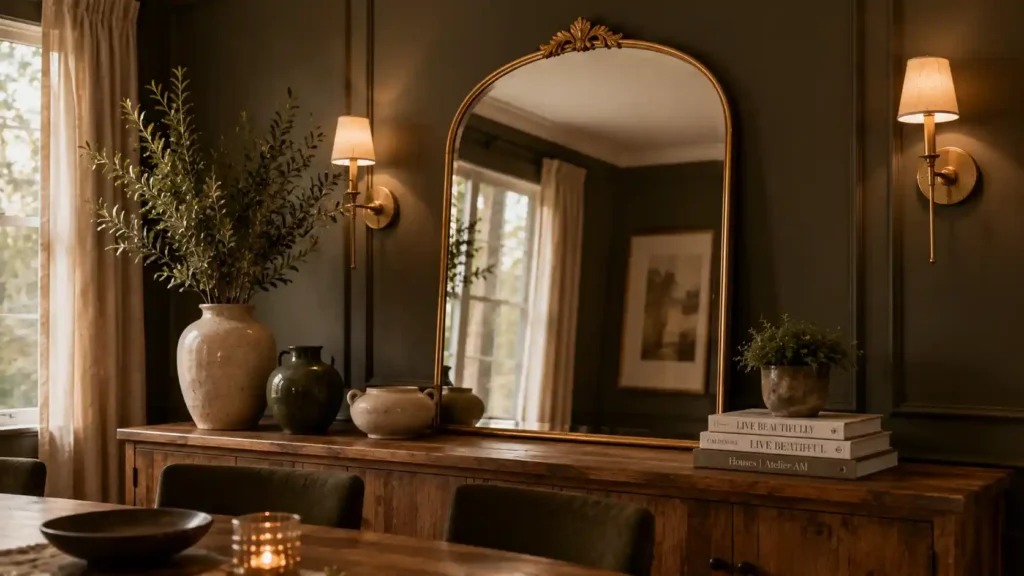
I stared at a blank wall in my dining room for four months before doing anything about it. Not because I didn’t have ideas I had too many. One week it was going to be a gallery wall. The next, a single oversized canvas. Then I got briefly obsessed with a plate wall. Eventually I put up a large horizontal mirror above the sideboard and stopped overthinking it. The room looked finished in forty minutes.
That experience is why I think most dining room wall decor guides start in the wrong place. They give you a list of options. What you actually need first is a way to narrow that list down before you buy anything.
Start by Diagnosing What Your Wall Is Actually Missing
Before anything else, figure out what the blank wall dining room problem really is. Not every wall needs the same fix.
If the room feels unfinished
One clear dining room focal point solves this faster than anything else. A dining room statement wall behind the table anchors the whole space. A large canvas print, an oversized mirror, or a paneled wall behind the main seating does the job cleanly. Don’t scatter five medium pieces across the wall and expect them to read as one decision. They won’t.
If the room feels dark or small
Mirror. Full stop. An oversized mirror or a large horizontal mirror above a sideboard reflects light back into the room and adds depth that paint and art alone never quite match. A wall to wall mirror is the extreme version of this genuinely useful in a dining nook or apartment dining wall where square footage is tight. The mirror reflecting pendant light is a specific trick worth knowing: angle it to catch the chandelier above the table and you double the light for free.
If the room feels cold or echoey
Texture is the fix, not more art. Vertical wood slat panels with acoustic felt backing do two things simultaneously they add warmth visually and actually dampen the noise of conversation at a dinner table. An exposed brick wall or faux brick panels give a similar warmth without the acoustic benefit. Wood slat panels installed floor to ceiling also raise the perceived height of the room visually, which matters especially in open floor plan dining wall situations where the ceiling feels lower than it is.
Wall Treatments That Do More Than Paint Ever Could
Flat latex paint is quietly on the way out in dining rooms. The shift toward texture over flat color 2026 is real, and the dining room is where most people feel brave enough to try it first since it’s not an everyday space.
Limewash and plaster finishes
Limewash paint changes as daylight moves across it throughout the day. A limewash accent wall reads almost cloudy in morning light and warmer and denser by evening. Venetian plaster and hand-troweled plaster do something similar the Old World plaster finish they produce pairs surprisingly well with modern furniture, which is why the warm minimalism 2026 aesthetic leans on it so heavily. DIY limewash dining room wall cost runs lower than most people expect; it’s labor-intensive but the materials aren’t expensive.
Paneling and molding
Board and batten creates a clean, modern farmhouse dining room wall feel without committing to shiplap. Picture frame molding and dado rails add architectural depth and a built-in feel a wall molding kit can replicate at a fraction of custom millwork pricing. Wainscoting protects the lower wall from chair scuffs while adding that paneled wall 2026 architectural detail that makes a room read as designed rather than just decorated. Shaker style panels and dado rails both sit in this category.
Wallpaper still earns its place
Floral dining room wallpaper works specifically in dining rooms because the room’s more contained use means people actually stop and look at the walls. Grasscloth wallpaper and scenic mural wallpaper are the high-volume choices right now. Peel and stick wallpaper has genuinely improved renter-friendly wall decor doesn’t have to mean bare walls anymore. Color drenching takes this further: paint the walls, trim, ceiling, and even paneling in a single rich hue, and the room becomes an immersive environment rather than just a backdrop.
Art and Mirrors: The Decisions That Define the Room’s Character
Sizing is where most people get this wrong
The most common mistake in dining room wall decorating is going too small. The art too small mistake makes a room look unfinished even when everything else is right. For a rectangular table, horizontal art that echoes the width of the table reads naturally from every seat. The practical sizing rule: multiply your wall’s height by 0.6 for the low end of ideal canvas height, and by 0.75 for the high end.
For placement, art at eye level 57 to 60 inches from the floor is the standard rule. In a dining room specifically, you can push this down slightly to art center 55 inches seated dining since people spend most of their time sitting, it makes sense to calibrate the view for that position rather than for standing.
Gallery wall done right
A gallery wall layout works when it has internal discipline consistent frame color, consistent mat style gallery wall, or a consistent color palette across the pieces. Without that, it reads as clutter. A sentimental gallery wall built from family photos, vintage framed art, and gilded frame prints carries real personality. An art ledge along an entire wall, layering framed pieces at different scales, lets you swap things out seasonally without re-drilling anything.
When one piece beats many
An abstract wall art piece or abstract landscape art at large scale does more for a formal dining room wall than a gallery wall could. Cosmic space art and NASA James Webb prints have become genuinely compelling choices a celestial wall art print in a deep, dark frame creates real drama against moody dark walls. Single statement piece logic applies everywhere: one prominent piece anchors the eye, then lets the furniture and lighting do the rest.
Lighting as Wall Decor, Not Just Function
Wall sconces change a dining room in a way overhead lighting alone never will. A brass wall sconce, a candle sconce, or any dimmer approved sconce flanking artwork or a mirror creates depth through layered lighting dining room design. Sconces flanking artwork give the art its own spotlight without requiring a ceiling track.
A statement chandelier or gold starburst chandelier pulls double duty it’s both the room’s primary light source and its most visible decorative element. Pendant cluster arrangements, where multiple pendants hang at staggered heights above the table, create a sense of movement and geometry that single-fixture setups don’t produce. These are lighting as focal point choices, not just illumination decisions.
Form meets function lighting matters more in a dining room than almost anywhere else in a house. People sit there. They look up. They notice the fixture.
Plants, Baskets, and Natural Elements on the Wall
A moss wall or oversized botanical mural brings the biophilic wall decor 2026 direction into a dining room without committing to real plant maintenance. Both read as dramatic and intentional. A vertical garden wall and indoor plant wall versions exist too real or artificial, depending on how much upkeep you want.
The basket wall trend has genuinely held on. Woven wall baskets clustered together add more texture than flat photos and more personality than a single large canvas. Yellow and green baskets against a neutral wall create color and movement together. Natural fiber wall accent choices woven wall art, macrame wall hanging, tapestry wall hanging, flat weave rug wall hanging all operate in the same register: organic texture, warm, harder to date than trend-driven art.
A brass wall planter sconce housing air plants or succulents is one of those small finds that most people overlook until they see it in person. Then they immediately want one.
Functional Wall Pieces That Pull Double Duty
A plate wall dining room is having a serious moment and it’s not going away. Decorative plates wall clusters, large wall plates, and ceramic wall displays add pattern and history in the same move. The appeal is the same as the basket wall: three-dimensional texture instead of flat imagery.
Open shelving on a dining room wall serves as storage, display, and decor all at once. Vintage glass bottle display on a narrow floating shelf, teacup display shelf, or a small collection of meaningful objects grouped on a floating shelf all read as intentional rather than cluttered, as long as similar items cluster together.
A library dining room, where built in bookshelves line one full wall, is one of the more ambitious options in this list. It’s also one of the most impactful. It adds warmth, a sense of collected history, and practical storage in one move. Sideboard styling below a large mirror or canvas, with a few well-chosen objects on the surface, does something similar at a smaller scale.
Match Your Decor Choice to Your Table Shape
This is the rule most guides skip, and it’s genuinely useful. Rectangular table horizontal art elongates the room further and draws the eye across the full table length. Round table arched mirror repeats the curve and creates a harmonious visual loop. Oval table organic wall sculpture woven basket arrangements or ceramic wall flowers echoes that oval softness back from the wall.
Wall decor matches furniture finish is the broader version of this principle. A wood dining table works with warm art, woven texture, and cream tones. A black dining table can carry brass accents, warm lighting, or high-contrast prints. A stone or marble table looks cleaner with abstract art, thin metal frames, or a simple mirror profile. The wall and the table should feel like they’re in conversation, not competing.
Conclusion
Dining room wall decor works best when it starts with diagnosis rather than shopping. Figure out whether the wall needs light, scale, texture, warmth, or a focal point then choose the solution that answers that specific problem. A large mirror above a sideboard fixes a dark room. Wood slat panels fix a cold one. A single oversized canvas fixes an unfinished one. Get the sizing right using the 0.6 to 0.75 wall-width rule, hang art at 55 to 57 inches in a dining space, and match the wall treatment to the table shape underneath it. The rest is personal. The dining room is genuinely one of the easiest spaces in a house to take a risk on it’s not a daily-use room for most households, so bold choices feel lower-stakes and usually end up looking better than the safe option did anyway.
Frequently Asked Questions (FAQ’s)
Start by identifying what the room is missing: light, warmth, texture, scale, or a clear focal point. For example, mirrors can brighten a dark dining area, while oversized artwork can make an unfinished wall feel more intentional.
A large mirror is usually the stronger choice when the dining room feels small or lacks natural light because it reflects light and adds visual depth. Wall art works better when the main goal is to introduce personality, color, or a strong focal point.
Avoid artwork that looks undersized compared with the wall and dining table. The article recommends using roughly 60–75% of the relevant wall dimension as a sizing guide and positioning the artwork slightly lower when it will mainly be viewed while seated.
Choose one oversized piece when you want a clean, strong focal point, especially in a formal or minimal dining space. A gallery wall works better when you want to display several meaningful pieces, provided the frames, mats, or colors share enough consistency to keep the arrangement cohesive.
Use shapes and materials that visually relate to the furniture below them: horizontal artwork suits rectangular tables, while arched mirrors complement round tables and organic wall pieces work well with oval tables. Matching wall accents to the table’s finish also helps the room feel connected rather than visually competitive.

1 thought on “Dining Room Wall Decor That Actually Changes How the Room Feels”