

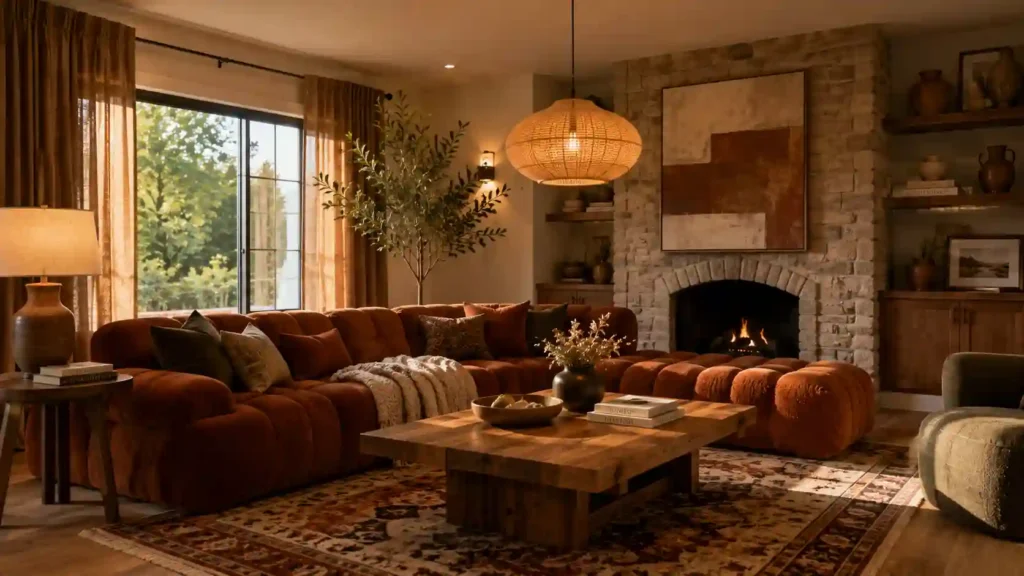
I redid my lounge twice in three years. The first attempt looked great in photos. By week three it felt wrong. Too many trend pieces. Nothing built around how I actually use the room. The second attempt started differently. I asked one question first: what does this space need to do every single day? That question changed everything. Most lounge interior ideas guides skip it entirely and jump straight to furniture.
This isn’t a trend roundup. It’s roughly the order I’d actually make these decisions in, if you asked me to walk through your room with you.
Start With the Layout, Because Nothing Else Matters Until This Is Right:
Pick one focal point and build outward from it:
A lounge feels directionless without somewhere for the eye to land first. Plenty of homes already have a fireplace sitting there, half-ignored, that could easily be doing this job. If yours doesn’t, a bold sectional can be your statement sofa instead. I’ve watched people try giving a room three focal points at once. None of them stick. The room just gets noisy. Pick one and commit to it.
Build seating around actual conversation:
Get the seating arrangement right and half the room solves itself. Sofas and armchairs facing each other create a real conversation area. A row of chairs all aimed at a TV doesn’t do that. When seating curves inward toward the center of a room, it pulls people in instead of scattering them along the walls like waiting room furniture. Symmetry creates calm, sure. But if your room genuinely isn’t symmetrical, forcing it rarely feels honest. Sometimes the asymmetrical version just works better.
Match furniture to what you actually do here:
Write down what really happens in this room before buying anything new. Board games need a sturdy surface. Reading needs a chair near decent light, not just any chair. Hosting needs enough seats that nobody’s left standing for an hour holding a drink. There’s one rule in this entire guide that gets ignored constantly: every seat needs a table within reach. People forget it every time.
Furniture Choices That Earn Their Floor Space:
The big seating piece comes first. Before tables. Before lighting. Before anything purely decorative gets considered at all. Once that anchor piece is settled, a lounge chair or an extra armchair can fill out the seating count around it.
Table placement follows the shape of your seating, not some universal rule pulled from a magazine. Round seating wants a centered table. Linear seating usually looks better with something shaped to match the sofa run beneath it. And wherever people actually sit down, a side table within arm’s reach solves a small but constant annoyance: nowhere to put a drink down without getting up.
Storage deserves more planning than most people give it. An ottoman that opens hides clutter without adding visible bulk. A media center with solid doors keeps cables and remotes out of sight completely. A floating TV shelf goes further still, freeing up real floor space this matters more in a smaller lounge than people tend to assume going in.
One trick gets underrated constantly: ledges for photo display. A gallery wall built this way lets you swap photos by season. No new holes in the wall every time your taste shifts, which it will.
Color Strategy: Pick Restraint Before You Pick a Palette:
The three-to-five rule actually works;
Planning a color scheme without a rule gets overwhelming fast. The three to five colors rule helps a lot here. Some designers go tighter still: three main colors plus neutrals, full stop, nothing more. A palette built this way reads as intentional. Not indecisive.
Neutral doesn’t mean boring if you layer it right:
Soft whites and warm grays form a base that lets everything else stand out against it. Friendly warm beige works the same way. Creamy beige specifically has been quietly replacing flatter grey tones lately. It sits comfortably next to raw wood or brass hardware without fighting either one for attention, which is harder to pull off than it sounds.
Bold color earns its place with commitment:
An amber sofa set against gem-colored armchairs creates real visual rhythm. Especially when it sits over simple black and white basics underneath. Color drenching pushes this further walls, trims, even cabinetry, all wrapped in one cohesive hue instead of color spread thin across a few small accents. Sage green and terracotta both work well within this approach. Tied loosely to a broader biophilic instinct that grounds a room in something calmer than pure trend-chasing ever manages.
Texture-driven neutrals are having a moment of their own:
Dark timber tones are showing up in cabinetry and flooring right now. Walnut. Deep chocolate browns. They don’t overpower a room the way you’d expect them to. Set against something lighter on the walls, the whole combination balances permanence with breathing room. Burgundy velvet sits at the opposite end of this spectrum entirely a bold, committed choice for one statement piece, not color scattered everywhere at once.
Lighting Layers That Actually Get Used After Dark:
Overhead lighting alone rarely carries a room. Table lamps and floor lamps fill the gaps ceiling fixtures consistently miss. Especially in corners that go dark the second the sun sets behind a neighboring building.
Statement lighting earns its cost when it does double duty. A dramatic chandelier works as illumination and decor simultaneously, no extra effort required on your part. Modular lighting represents a real shift worth understanding properly. Individual components click together differently depending on the moment a focused task light during the afternoon, something softer once evening settles in around it.
A reading spot needs its own dedicated light. Not whatever’s left over from elsewhere in the room. A spotlight aimed at art does real work once the sun goes down and natural light stops doing the job for free. Warm lamps and the soft shadows they throw add an intimacy brighter, flatter lighting just can’t replicate, no matter how many bulbs you add.
Texture and Material Choices That Separate Good Rooms From Forgettable Ones:
A lounge that photographs well isn’t always a lounge that feels good to actually sit in. Layered textures are usually the difference between the two. A velvet sofa adds tactile richness flat fabric can’t deliver alone. So does faux fur thrown over a single chair. Recycled textiles have genuinely improved in quality too sustainable doesn’t have to mean sacrificing how something feels under your hand anymore.
Raw wood brings warmth paint simply can’t replicate. Brass hardware against polished surfaces creates contrast without needing bold color to carry the whole room by itself. A rich-toned sectional set against warm wood flooring with visible grain grounds a space in materials that age gracefully. They don’t date the way trend pieces do.
The fireplace shifts a room’s whole tone depending on the material you choose. Stone reads heavier. Tile reads cleaner. A ribbon-style fireplace reads more modern than either. Wood, stone, and woven fiber throughout all tie back to the same biophilic instinct running through most current lounge interior ideas, whether anyone names it that out loud or not.
Style Direction: Pick a Lane Before You Buy Anything:
Clean lines and restraint define a modern or contemporary lounge. Transitional design splits the difference between traditional and modern, which suits anyone who can’t fully commit to either extreme. Rustic open concept and French country styles bring in more texture and history. Cabin-core glam mixes that same warmth with an unexpected bit of sparkle thrown on top.
Quiet luxury drives monochrome lounge design more than color variety ever could on its own. Modern loft energy works especially well in open-plan spaces with high ceilings and exposed structure left visible rather than boxed in. Eclectic style mixes eras on purpose. Japandi blends Japanese minimalism with Scandinavian warmth into something calmer than either tradition manages alone.
A handful of named directions are worth researching before committing a whole room to one. Modern Coastal. Modern Heritage. Box Modern. Barn style. Mid-Century Modern. Modern Classical. Wabi-sabi decoration, built around imperfection rather than polish, has grown past niche status into something a lot of lounges now borrow from, even just partially.
What’s Actually New in 2026 Lounge Design:
The biggest shift this year points toward curated maximalism. A deliberate step away from showroom-perfect rooms. Toward spaces that feel collected over time instead of purchased in one single trip. Decorating with vintage reflects that instinct directly. Antiques, patinated furniture, secondhand pieces, thrifted decor all of it carries the same idea, character nothing fresh from a box quite replicates. Vintage rugs and vintage mirrors specifically bring that instant weight a new piece can’t fake.
Functional drama is having a real moment too. Movable partitions, statement ceilings, sculptural elements they push rooms toward something closer to operational beauty than static display. Sensorial immersion and the growing overlap between AI and sustainability point toward systems that respond to mood and climate as the day actually unfolds. The irregularity trend reflects something similar: a push toward materials and shapes that feel less manufactured. More genuinely lived-with over time, the way a good leather jacket gets better with wear instead of worse.
Expressive comfort sums up the whole shift well. Rooms get built around how people actually live in them now. Not how they photograph for five minutes before anyone sits down.
Accessories and Final Layering Touches:
Throw pillows refresh a tired sofa for less money than almost anything else in this guide. Patterned rugs add texture underfoot. A single bold cushion does the same job at a smaller scale, if a full rug change feels like too much right now.
A gallery wall works as evolving decor rather than fixed art that never changes again. So does a simpler photo ledge display. Trinkets collected over time carry more weight than anything bought purely to fill a shelf there’s a difference, and people can usually tell. Botanical prints and fresh florals echo whatever season it actually is outside the window.
Light, airy curtains let daylight through during the day. Blackout curtains matter more once a lounge starts doubling as a media room at night. One rule keeps a rug from looking like it’s floating disconnected from the furniture sitting on top of it: front legs on the rug, always. Not beside it.
Where to Start If You’re Using a Mood Board:
A mood board solves the biggest problem most lounge projects run into. Buying pieces that don’t actually belong together once they’re all sitting in the same room. Whether it’s built digitally, sketched on paper, or pieced together with paint swatches and magazine cutouts, the format matters less than the discipline behind using it consistently.
Whatever piece you’ve chosen as the room’s anchor should drive every other decision on the board from the start. Not get added in afterward as an afterthought once everything else is already picked. A palette built around the three-to-five color rule keeps the whole project cohesive from planning through to the finished room. The harder half of this process isn’t building the board at all. It’s translating that board into an actual room without losing what made it work on paper in the first place.
Conclusion:
Lounge interior ideas that last start with layout, not decor. Pick one focal point. Build conversation-style seating around it. Choose furniture that earns its floor space before adding anything purely decorative on top. Commit to a tight color palette. Layer lighting in at least three forms. Let texture do as much work as color ever could on its own. Pick one style direction instead of blending everything at once, and treat this year’s shift toward curated maximalism as permission to stop chasing showroom perfection altogether. The lounges that hold up past the first photo are the ones built around how people actually live in them, every single day.
Frequently Asked Questions (FAQ’s)
Start with how the room needs to function every day, then choose one clear focal point and arrange the main seating around it. Getting the layout right first makes later decisions about furniture, lighting, colour, and accessories much easier.
Symmetry can make a lounge feel calm and organised, especially when the room itself has balanced proportions. An asymmetrical layout can work better in awkward or open-plan spaces, as long as the furniture still feels visually balanced and supports conversation.
Choose furniture that earns its floor space, such as storage ottomans, compact side tables, and floating media units. Light curtains, carefully positioned mirrors, fewer bulky pieces, and keeping clutter behind closed storage can also make the room feel more open.
A limited palette of roughly three to five colours usually creates a more cohesive result than using many competing shades. Neutral walls can provide the foundation, while stronger colours such as sage green, terracotta, burgundy, or amber work best when used deliberately rather than scattered throughout the room.
The strongest direction is toward rooms that feel collected and personal rather than perfectly matched, with vintage pieces, richer textures, natural materials, and expressive comfort becoming more prominent. Curated maximalism works best when every item still has a reason to be in the room instead of simply adding more decoration.

1 thought on “Lounge Interior Ideas That Actually Hold Up Once the Photo Shoot Ends”