

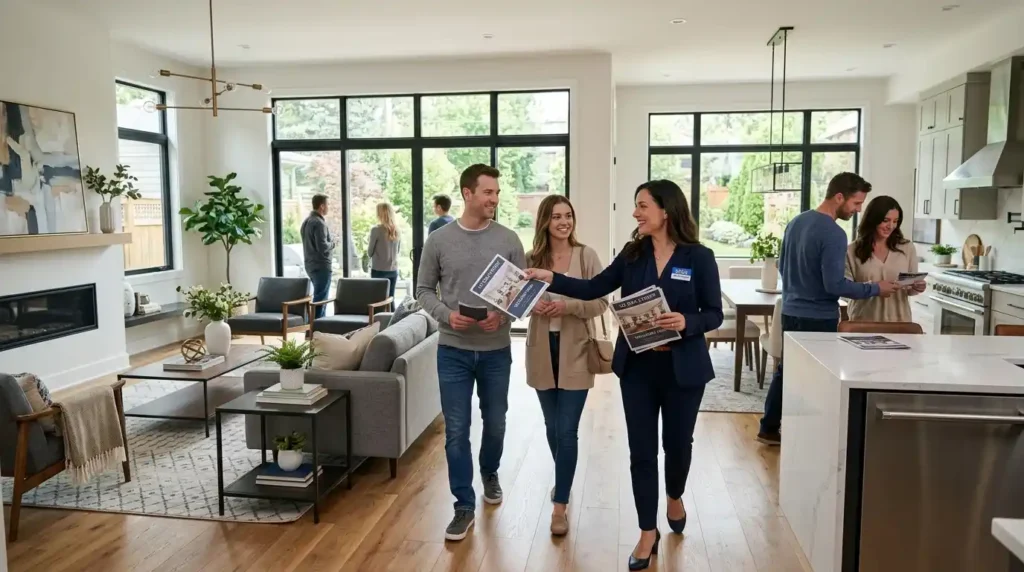
As soon as you start typing “open house near me” on your search engine. You are automatically one step ahead of most new home buyers. Because you are approaching the search strategically rather than just casually browsing during the weekends. This is a crucial point, which most people underestimate. Going to an open house does not mean viewing. This is your chance to gather intelligence for free. And those who come out of it with full awareness of their own are those. Who approached it in such a way before going there.
I have been to many open houses as a home buyer and home buying advisor. And I see that the only thing, which makes one of them successful and another one useless, is preparation.
Where to Actually Find Open Houses Near You:
Discovering open houses nearby was once an exercise of driving down streets and searching for yard signs. This is still relevant today, but there is no better way to find open houses nearby than searching online. With the new tools that have been developed. It is not just easier to discover open houses nearby the information is more specific. Than it was five years ago.
Platforms:
On platforms like Zillow, Redfin, Trulia, and Realtor.com. You can refine open house searches by date, location, price range. And property type to find listings that match your needs. In addition, Homes.com, HAR.com, and Hommati all have open house search filters, albeit with different databases. Finally, HomeLight and Homebuyer.com include additional services. Such as matching with buyers for open house listings, rather than simply including a calendar feed of open house events. What is especially noteworthy about all of these sites is that most use the data from MLS and MLS GRID data. Which includes active listings, listing prices, price drops, and days on the market.
The most practical way for any serious search. Would be to create saved searches on at least two platforms with push notification. The real time alerts allow you to get updated on new open houses immediately. After their listing becomes active in MLS instead of waiting till next day when half of the weekend goes by. Map view feature that is present in most real estate apps comes handy. When there are multiple open houses nearby in one go. For example, if there are three open houses within a distance of 400 meters of each other on the same Sunday. Then you can make your schedule accordingly.
Real Estate Offices:
Real estate offices and brokers in the neighborhood also have mid week broker open houses. Which do not show up in the larger consumer websites. As a request from the buyer’s agent or REALTOR to be given access to these listings provides you with an opportunity to know. What is available before the open house weekend comes around.
Another source for finding open house listings is through social media sites. Especially for markets such as New York, New Jersey, Los Angeles, Tampa, Florida, and Texas. As local real estate people use their social media presence to post future open house dates directly on the community page prior to the complete listing on the MLS website.
How to Read a Listing Before You Walk Through the Door:
The open house visit itself begins online, not at the front door. Before attending any open house, spend 30 minutes with the property’s listing details. Listing description, property history, listing history, seller’s disclosure, and comparable sales data from the surrounding quarter mile. Sold within 6 months at comparable sizes and conditions gives you. The clearest picture of whether the listing price is rational, ambitious, or below appraised value. And therefore likely to attract multiple offers.
Days on market is one of the more useful data points in any listing. A property that’s been active for 90 days. Or more in a competitive market has usually either been overpriced from the start. Carries some condition issue that pushes buyers away or suffers from a location problem that photos don’t fully communicate. Second market fatigue is real stagnant listings tend to generate lower offers than fresh ones. And if you’re attending an open house on a property with a high days on market number. That’s negotiation room you should factor into your offer strategy before the visit rather than after.

New listings, hot homes flagged by platforms, price drop alerts. And builder incentives available on new construction homes all tell you something about the current competitive environment around a given property. In a seller’s market with low inventory. A price improvement on a recently listed home is unusual enough to warrant immediate investigation. In a buyer’s market with high inventory, a motivated seller with a closing timeline alignment issue may accept offer terms that would have been refused three months earlier.
What to Bring, What to Check, and What to Never Say Out Loud:
The buyer’s checklist during an open house can be categorized into things to take, things to check, and things to leave out.
Take Your Pen And Paper:
Take your pen and paper, a measuring tape, and the list of items you definitely want or don’t want in the house, respectively, before even stepping inside the property. Flashlight will come in handy while inspecting crawl spaces, attic entries, basement, and dark corners of the garage where overhead lighting does not reach. Marble can serve as an approximate tester of flatness of floors by placing it in suspected areas and seeing whether it rolls toward one direction or another. Take photographs of each room, each ceiling, and areas adjacent to plumbing facilities, water heater, heating ventilation and air conditioning (HVAC), and electricity panel.
List Of Items:
The list of items to check during the open house tour is not the same thing as having a professional inspection done, but it tells you what items must be covered in that inspection. Examine the ceilings in all rooms for evidence of water stains because this can be one of the best ways to detect problems with your roof, with your plumbing, or with your HVAC system. Examine window frames and door frames for any evidence of staining or deterioration, which indicates moisture infiltration over time. Sticking doors and windows may actually point to foundation problems or structure shifting as opposed to mere neglect.
Basement Area:
For the basement area, consider checking for basement leaks, mold, mildew, and musty odor. Poor drainage issues, erosion, and any indication of floods in the backyard leading to the foundation are also factors to look out for even when the basement is immaculately finished. The use of an air freshener to cover up for any odor in the vicinity of plumbing fixtures requires attention. Pet odors and cigarette smell trapped in the drywall are cosmetic issues, but drainage smell and musty odor close to structural parts require attention.
Ages Of The Roof:
The ages of the roof, HVAC system, water heater, furnace, and appliances are things that need confirmation from the listing agent if they do not exist in the seller’s disclosure form. The average lifespan of an asphalt shingle roof is 20 years meaning that a 20-year-old roof installed in 2004 is nearing the end of its life cycle. New roof installed in 2024 or 2025 appliances are real marketing assets worth something in the negotiations. Knowledge of these figures prior to making an offer will prevent one from losing money unnecessarily.
The Five to Ten Questions Worth Asking the Listing Agent:
Every open house visit should include five to ten questions for the listing agent. These questions serve two purposes simultaneously: they give you information you can’t get from the listing itself, and they give you a read on how transparent and knowledgeable the agent is about the property they’re representing.
Seller motivation questions why is the seller leaving, what’s their timeline, have they received offers are the most strategically valuable. A seller who needs to close quickly has a different negotiation posture than one who is testing the market with no urgency. Price reduction history tells you whether the property has been chasing its own market downward or arrived at its current price rationally. Offer history questions whether previous offers fell through and why reveal inspection issues, financing problems, or title complications that wouldn’t otherwise surface until you’re already under contract.
HOA Question List:
HOA Question List includes monthly HOA fees, HOA rules, HOA rental or renovation restrictions, HOA amenities, and if the development is gated with 24-hour guarded access or a no HOA development with no CDD. Questions regarding renovation permits ensure that any visible renovations such as finishing a basement, adding a new bathroom, or extending the kitchen area have been done legally through the municipality or illegally without permission from the city.
Keep financial details private during the open house visit itself. Qualified buyer status, mortgage pre-approval letter, maximum budget, and how urgently you need to move should not be shared with the listing agent during a casual walkthrough the listing agent represents the seller, not you. An independent buyer agent with MLS access attending separately can handle negotiating leverage and offer strategy without that information being used against your competitive offer.
After the Visit: How to Compare What You Saw
Wander through each room twice, once for the emotional reaction, once for the checklist. Allow at least 15 to 30 minutes per property, not more than three or four per day, as after that point details begin to get jumbled in your head.
Notes made directly following each open house viewing will be far more accurate than anything written days later. The virtual tour, 3D tour, drone aerial video, and video slideshow provided with the listing are all good tools for looking back, but remember they are all intended to portray the property positively. Your photos from the viewing, especially those of ceiling damage, window frames, and mechanicals, will be far more candid.
The home buying process after an open house moves toward mortgage pre-approval confirmation, professional inspection scheduling, comparable sales review, and offer strategy discussion with your buyer’s agent. A $300 to $500 home inspection cost is one of the better investments available at this stage, particularly given that average home repair costs run $300 to $5,000 for standard issues and $2,000 to $7,000 for foundation repair costs that a thorough home inspection report can identify before they become your financial responsibility post-closing.
Conclusion:
The value of an open house nearby search all depends on the preparation made beforehand and the discipline used in the process of evaluating the home for purchase. The hard work is in locating open houses using sites like Zillow, Redfin, Trulia, Realtor.com and MLS listings; but being equipped with a checklist, the right set of questions to ask of the listing agent, and comparable sales information transforms an ordinary open house visit into one with purpose.
Frequently Asked Questions (FAQ’s)
Start with real estate platforms such as Zillow, Redfin, Realtor.com, or Trulia and filter listings by location, date, price, and property type. Saving searches and enabling alerts can also help you spot newly scheduled open houses before the weekend.
Real estate websites are useful for quickly comparing multiple public listings, while local agents may know about broker open houses or upcoming properties that have limited online exposure. Using both sources gives buyers a broader view of what is available in the area.
Review the property’s listing history, days on market, seller disclosures, recent price changes, and nearby comparable sales before visiting. This background makes it easier to judge whether the asking price and condition of the home deserve closer attention.
Ask about the seller’s timeline, previous offers, price reductions, major repairs, renovation permits, HOA rules, and the age of major systems such as the roof and HVAC. Keep details such as your maximum budget and negotiating position private because the listing agent represents the seller.
Yes, especially when you are seriously considering making an offer. An open house can reveal warning signs such as moisture, unusual odors, sticking doors, or aging systems, but a professional inspection provides a much deeper assessment before you take on the property’s repair risks.
