

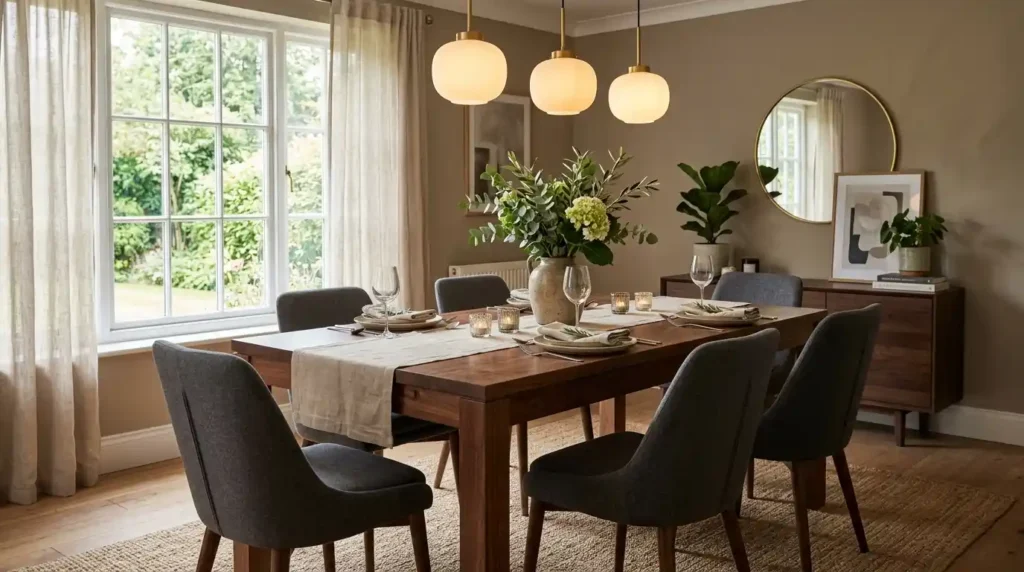
The dining room is the one place in a home that people always fail to appreciate enough. It does not get as much consideration as the kitchen. Nor as much budget as the living room, and no creativity as the bedroom. However, it is the only place where real human events occur. This includes meals, disagreements that are solved at dessert, birthday candles, homework done under bad light. And those conversations that should have ended earlier. Amidst all of this, one common thread can be found: the dining table. It plays a crucial role in the proper functioning of any dining room. Its size, material, and proportions with respect to everything else will make it either work for you. Or become just an extravagant hallway between the kitchen and the couch.
A lot of years of experience with this particular kind of room have taught me to think differently about it. I have helped others renovate their dining rooms, made expensive errors myself, and eventually found out why this is such a common problem.
Shape Is a Decision About People, Not Just Space
Before considering furniture for the dining room, consider who uses it and what kind of frequency they have. The answer to the first question will provide the best answer to the second question much faster than the dimensions of your room.
Rectangular Tables
A rectangular table looks great in a long dining room. It makes sense according to the room design, seats more people. And gives a logical accent to it. It is a perfect option for families or hosts who love guests and want to create a multifunctional room. That also works as an office or homework area.
Round Tables
A round table is unique in how it breaks away from conventional wisdom. For starters, it creates an egalitarian arrangement; there is no seat of honor here. All participants are equally distant from one another. Hence round dining table trend discussions invariably touch upon the intimate nature of round shaped configurations. Round pedestal dining tables are particularly effective in compact spaces as much as they eliminate corner legs. Which often inhibit knee movement and thus reduce seating options. When it comes to designing a dining table for limited space. A round pedestal table will always be more effective than a rectangular one.
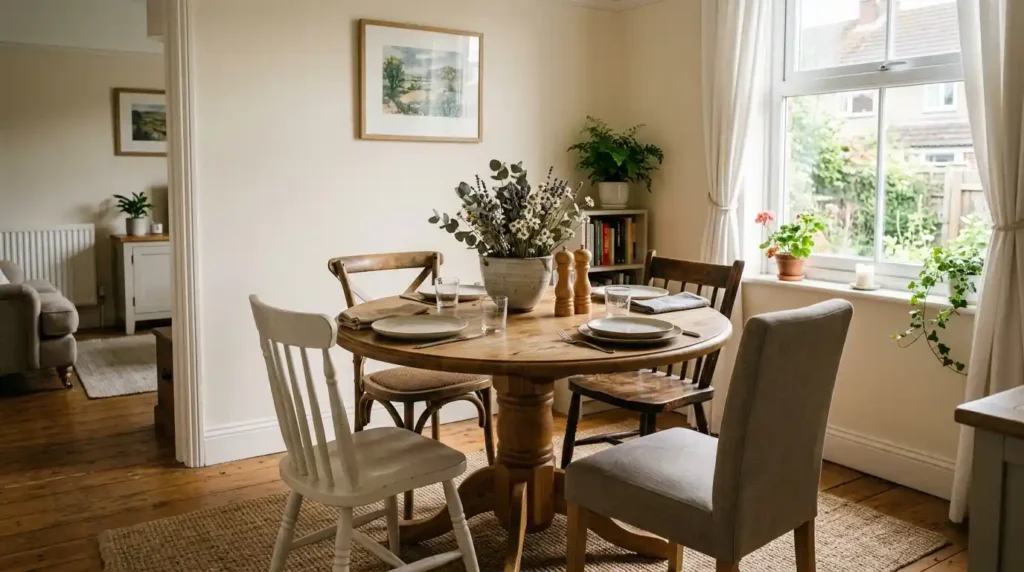
Oval Tables
The popularity of oval tables is at an all-time high, and this makes perfect sense. Like any other round design, it creates a friendly, social ambiance. Yet at the same time manages to provide more seating options due to its elongated shape. This is the reason why oval table trends are mostly defined by the fact that such a table can effectively bring warmth and elegance into any open concept kitchen diner interior. Oval corners allow you to create smooth transitions between different units.
Symmetrical Tables
A symmetrical tables and sculptural table designs with carved table base details, unique table legs, and unexpected organic shapes are newer territory. They read as statement pieces in a way that conventional shapes don’t. But they require more confidence in the surrounding design. In a room that’s already busy, an asymmetrical table tips into chaos. In a room that’s mostly calm and minimal, one sculptural table can define the entire space.
The Material You Choose Is the Material You Live With
This is where I see the most regret not in shape, but in material. Because material choice in a dining table isn’t aesthetic first. It’s behavioral.
Marble Tables
A marble table, whether European marble or honed stone, is one of the most beautiful choices available. It’s also one of the least forgiving. Marble is porous, it stains, it scratches, and if your household runs at the pace most house holds actually run kids, dogs, wine, tomato sauce, someone doing art projects at the table a marble table will look distressed within eighteen months. That’s not a design failure. It’s a lifestyle mismatch.
Sealed Timber And Solid Wood Tables
Sealed timber and solid wood tables walnut table, oak table, smoked oak table, reclaimed wood table, live edge table are the most forgiving materials in real daily use. They develop a natural patina rather than simply aging badly. A good walnut table with a properly sealed surface can handle 60 seconds wipe down after dinner. And look better in ten years than it did on delivery day. Timber veneer table options offer similar warmth at a lower price point. Though they’re less repairable over time if surface damage occurs.
For the dining room table that needs to pull double duty workspace one hour, dinner table the next composite tabletop options, matte ceramic tabletop surfaces, and sealed timber remain the most practical. Glass table and tempered glass table surfaces look clean but show every fingerprint, every watermark, every crumb. Concrete table tops are striking but heavy, cold to the touch, and require sealing maintenance most people don’t know about when they buy them. Resin table designs incorporating artistic glass or natural elements can be genuinely beautiful and genuinely unique they’re worth considering if the craftsmanship is sound.

In 2026, demand for eco-friendly materials is expected to rise by 20%, and FSC certified timber, reclaimed wood, recycled composites, and natural fiber reinforced composites are increasingly where the most interesting work is happening. Sustainable dining room design isn’t a niche category anymore it’s the direction the best furniture is moving.
Sizing the Table to the Room Without Getting It Wrong
While there are a number of layout mistakes that can be made, the single biggest mistake in a dining room is not selecting the right size. In this case, it is making the dining room too large.
The appropriately proportioned dining table will have at least 36 inches of clearance from wall to table on all sides and ideally, 42 to 48 inches, allowing room to sit, stand and navigate around the table in comfort. To put this another way, this means 90 to 100 centimeters of space on each side. A table seating four people will require a dining table footprint of 110 to 140 centimeters across. A six-seater table requires at least 180 to 200 centimeters in width. A table seating eight to ten guests needs room to accommodate them. Trying to seat 10 people comfortably in a room offering no more than 36 inches of traffic flow is an interior decorating dilemma that no amount of dining room decorating style can overcome.
It is also necessary to pay attention to the table footprints when choosing the right size for the rug under dining table. In general, a dining table rug must be large enough to allow all the legs of all chairs to stay on the rug when the chairs are pulled away from the table. Under sizing a rug for the dining area is often responsible for an unfinished feeling in dining room decor.
Seating That Works With the Table, Not Just Next to It
A dining chair is not just an accessory but an important part of furniture itself because of which the proportion between chair height and table height becomes essential. Ideally, there should be a distance of around 25 – 30 cm between the seat of the chair and the table surface for easy legroom, which is a criterion most dining sets conform to.
Mix And Match Dining Chairs
Mix and match dining chairs and dining room chairs that are not all alike are a trend that has been happening for some time now, and a successful execution makes for an inviting dining room rather than something more sterile and sterile like a furniture showroom. The basic principle is to make sure there is consistency in either finish, fabric, or style of chair while changing up everything else. Chairs in velvet with forest green or charcoal hues and the same finish for legs along with an upholstered dining bench create just such a look as one wishes to linger over meals.
There are certain families that benefit from upholstered dining chairs and wipeable surfaces and there are other families that would find woven seats and natural fibre seats far more appealing. Architectural back dining chairs and sculptural dining chairs are definitely statement pieces of furniture and should be incorporated into a dining room design with a less flamboyant dining table.
Lighting Above the Table Is a Room Decision, Not Just a Fixture Decision
There is nothing that can complete your dining table like lighting. A well-placed chandelier or pendant light will give emphasis to the whole dining room by defining the area around the dining table, creating intimacy, and making clear to whoever comes in that this is a place worth being gathered in.
Pendant Height
Pendant height becomes extremely important in determining good dining room lighting. The hanging light fixture needs to be about 3 feet off the table; just high enough so that no one sitting at the table can stare straight up into the bulbs but low enough so that it illuminates the space effectively. When dealing with larger, rectangular-shaped dining tables, two or more chandeliers can be placed along their length to distribute light properly, solving the problem of placing one light source in the center while leaving the ends dim.
Where there is a round table, one pendant can be used provided the diameter of the fixture follows the ½ to ¾ table diameter principle. For example, while a table that measures 48 inches in diameter will match well with a pendant measuring 24 or 32 inches, the 36 inch table will match well with the 18-inch pendant.
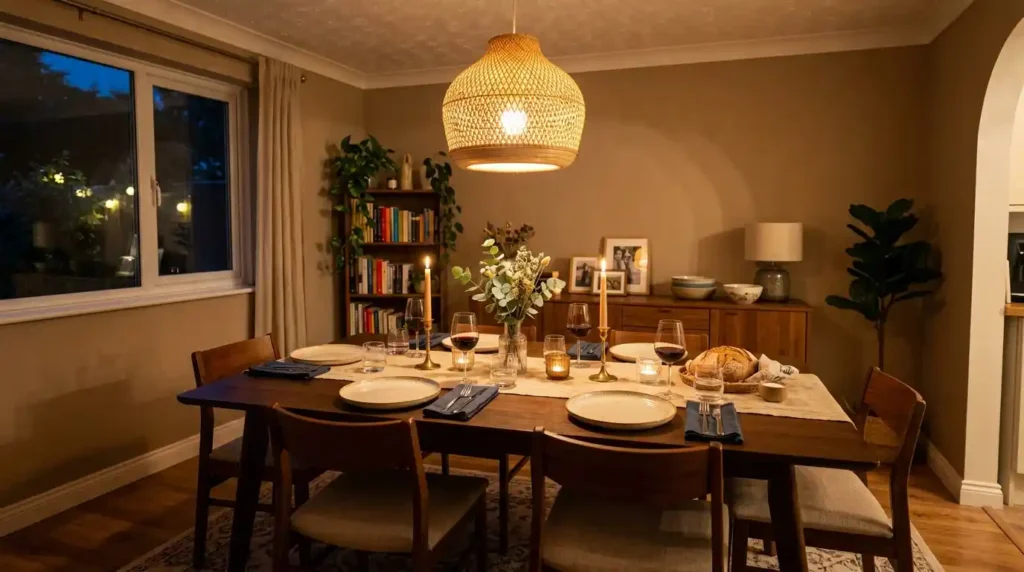
Whether you choose a sculptural chandelier, rattan pendant, wooden bead pendant, crystal chandelier, drum shade chandelier, or ceramic shade cluster, the light fixture must be in harmony with the table and not competing against it. The two items should complement each other and not overwhelm the space. The chandelier is a statement piece that should dominate while the table is a secondary element to support the design of the space. Lighting must always be dimmable because a dining area must accommodate the bright lights needed for homework and also dimmed lights for guests.
How to Style the Table When It’s Not Being Used for Eating
An empty table at the family house occurs more often than when food is being served on it. This is why the things that can be found on it become just as important as the table itself.
Creating A Layered Composition
The best solution is in creating a layered composition: using either a runner which could be either a linen runner or a striped linen runner as the bottom layer, an item such as a rattan serving tray or a ceramic vase as the anchor, and height variations created with the use of candlesticks, sculptural candles, or candle holders. A rustic vase, a sculptural bowl, or an oversized bowl with seasonal foliage provides the right amount of life to the table but does not require daily care. Fresh cut flowers and foraged leaves make for the most organic option, whether paired with a mercury glass vase and magnolia leaves or with just flowers.
Bowl With Shells
The key is in the absence of excess. A bowl with shells placed by itself on a completely empty table is more effective than several different items put together. One ceramic vase placed on a striped linen runner works better than a bunch of items arranged on a table. “It should look like something that has been forgotten there,” as my favorite designer said about her tables.
A part from the focal point, the walls and storage furniture surrounding the dining room also play a part in the design scheme of the dining room. Sideboards and buffets across from the dining table give additional visual weight while providing functional storage solutions. Drinks cabinets and bar cabinets are added to make entertaining easier. Wall art or modern abstract art above the table gives a sense of depth to the room. Wallpaper with a pattern, decorative wallpaper, or even hand-painted wall coverings on one accent wall will turn your boring dining room into an interesting interior design green or dark blue remain designers’ favorite colors in 2026 when Scandinavian minimalism starts falling out of favor.
Dining rooms are not places that need immediate solutions. This kind of room requires careful planning with shape and material in mind. Only then will you find a dining room worth its place in the lives of those using it.
Conclusion
The table in a dining room is never simply an object of furniture. It serves as the true focal point of a home, reflecting more of a person’s everyday life than any other room, which is why it deserves the same thoughtful consideration as any decision that influences daily living. Make sure the form suits the people who will sit around it. Pick a material that works for your actual life. Size it to the room. Then let lighting and seating follow suit. Get all of those things right, and everything else falls into place. Ignore even one element, and nothing else will make up for it.
Frequently Asked Questions (FAQ’s)
Start with how many people regularly use the table, how often you entertain, and how the room functions day to day. The best dining room table should suit both your available space and the way your household actually uses it.
A round table works especially well in smaller spaces because it encourages conversation and avoids awkward corner legs. A rectangular table is usually better for longer rooms, larger families, and households that need extra seating or workspace.
Allow at least 36 inches of clearance between the table and surrounding walls or furniture. Around 42 to 48 inches is even better when you want people to move comfortably behind seated guests.
Sealed timber and solid wood are among the most practical options because they handle regular use well and can develop an attractive natural patina over time. Marble offers a more luxurious appearance but needs greater care because stains and scratches are harder to avoid.
A pendant or chandelier should generally hang about three feet above the tabletop. For a round dining table, choosing a fixture around one-half to three-quarters of the table’s diameter can help keep the lighting visually balanced.

5 thoughts on “Table in a Dining Room: Best Choices for Middle Class Homes That Balance Style and Function”