

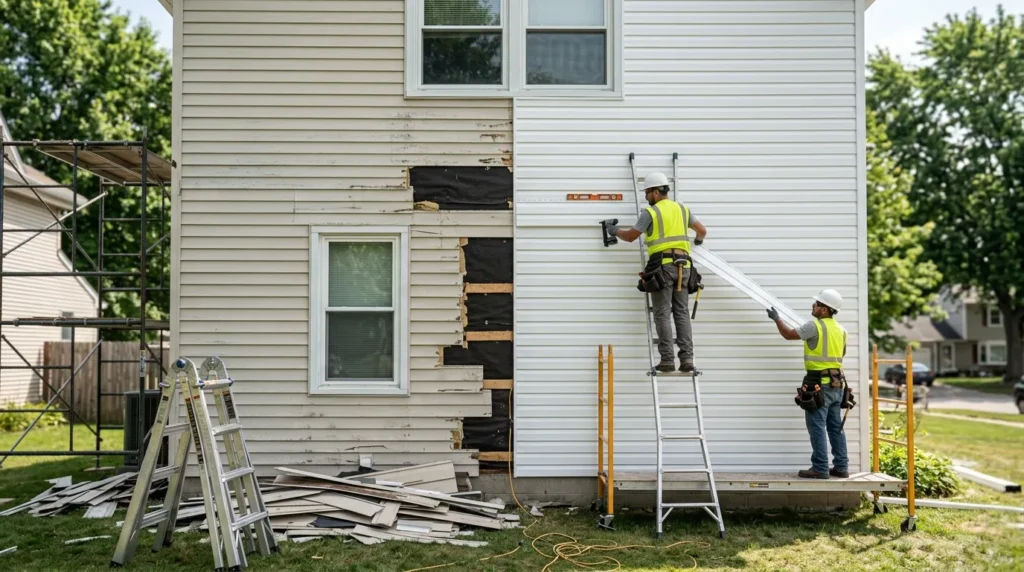
The first time I compared vinyl siding quotes side by side for my own house. I genuinely thought one of the contractors had made an error. Same square footage. Same general style of siding. One quote came in around $9,000. The other came in just under $17,000. Both contractors seemed competent. Neither seemed obviously wrong. It took a long phone call and a fair amount of patience to understand that they weren’t quoting the same project at all they were quoting two different grades of vinyl, two different scopes of trim work, and one of them had priced old siding removal cost into the number while the other had quietly left it out, assuming I’d discover that line item later.
That gap is the entire story of vinyl siding cost. The per-square-foot number you see in any guide is real, but it’s also incomplete until you understand what’s hiding inside it.
Why the Per-Square-Foot Number Means Almost Nothing Without Context:
Vinyl siding cost per square foot sits at $3 to $12 per square foot overall range, with the average vinyl siding cost installed landing around $4.50 to $8.20 per square foot. The national figure as of May 2026 sits even higher at $7.32 to $12.51 per square foot in some markets, which tells you immediately how wide the swing can be depending on region, grade, and scope.
Breaking that figure into its components matters more than memorizing the headline number. Materials only run $3 to $7 per square foot materials only, and installation labor only adds $2.50 to $5 per square foot installation labor only on top. Combined, that’s the $4 to $12 per square foot installed total you’ll see most often. The labor percentage of total cost sits at 40% to 60% labor percentage of total cost on multi-story or architecturally complex homes which is the single biggest reason two quotes for the same square footage of siding can differ so dramatically. One home is a simple rectangular footprint. The other has dormers, gables, and twelve windows that each need J-channel trim cost to work around the frame.
For a typical project, vinyl siding cost for 2,000 sq ft house runs $8,000 to $24,000, with $10,000 to $24,000. The average sized home being the range most homeowners should budget toward realistically. Vinyl siding national average cost for a complete job currently sits around $12,000 average complete job cost, with the full typical range running $6,000 to $18,000 typical total range. Angi’s data set puts the figure slightly different again $6,370 to $18,378 total project Angi, averaging $12,299 average total project cost which illustrates exactly why “the average cost of vinyl siding” depends heavily on which dataset, which region, and which grade of vinyl siding you’re actually comparing.
Grade and Thickness: Where Most of the Real Price Difference Actually Lives
Vinyl siding thickness:
the variable that explains more price variation than almost anything else in a quote. Builder’s grade vinyl siding measures 0.04-inch vinyl siding to 0.042-inch vinyl siding thick and costs $2 to $6 per square foot builder’s grade. It’s the thinnest option on the market, the most prone to warping in direct sun, and the choice most often seen on rental properties and new-build developments where upfront cost is the dominant priority.
Standard residential grade:
Vinyl siding steps up to 0.044-inch vinyl siding to 0.046-inch vinyl siding, priced at $4 to $7 per square foot standard grade. This is genuinely the sweet spot for most owner-occupied homes meaningfully better impact and warping resistance than builder’s grade, available in a far wider range of colors and profiles and supported by the major manufacturers’ stronger product lines at this thickness.
Premium grade:
Vinyl siding runs 0.048-inch vinyl siding up to 0.05-inch vinyl siding and 0.055-inch vinyl siding at the top end, priced at $6 to $10 per square foot premium grade. The vinyl siding durability grade and vinyl siding impact resistance grade improve meaningfully at this thickness premium panels resist hail, foot traffic during installation, and accidental impact far better than thinner alternatives, and the vinyl siding fade resistance grade is typically stronger too thanks to better UV-stabilized color technology.
Insulated vinyl siding sits:
At the top of the cost ladder at $7 to $12 per square foot insulated vinyl, sometimes benchmarked around $8 per square foot installed as a round figure. The siding foam backing cost is what you’re paying for here a layer of rigid foam laminated to the back of each panel that improves insulated siding thermal performance, adds rigidity that reduces visible waviness on sun-exposed walls, and meaningfully improves vinyl siding warping resistance compared to hollow-back standard panels. Is insulated vinyl siding worth the extra cost is a genuinely common question, and the honest answer depends on climate: in regions with serious heating and cooling cost pressure, the energy-efficient siding option pays for itself faster than in a mild climate where the thermal benefit matters less.
Style and Profile — The Choice That Changes Both Looks and Labor Time:
Vinyl siding profile and vinyl siding design style decisions affect price in ways that aren’t always obvious from a sample board. Clapboard vinyl siding the most common style on the market runs $2 to $6 per square foot and resembles traditional horizontal lap siding without the deeper shadow lines of fancier profiles. Smooth vinyl siding, secured with straightforward fasteners rather than interlocking beads, costs a similar $2 to $6 per square foot but trades some installation security for simplicity.
Beaded Vinyl Siding
Beaded vinyl siding, which includes a hidden bead detail along each panel’s bottom edge for a more polished, dimensional look, averages $2 to $7 per square foot. Dutch lap vinyl siding, designed to mimic thick overlapping boards, runs $3 to $7 per square foot. Vertical vinyl siding essentially clapboard rotated 90 degrees and board and batten vinyl siding both sit at $3 to $8 per square foot and $3 to $9 per square foot respectively, with board and batten’s large vertical panels and accent battens adding both material cost and installation time.
Vinyl Shake Sding
Vinyl shake siding, molded to resemble cedar shake texture without the natural color variation of real wood, runs $3 to $10 per square foot for materials and labor combined a meaningful premium over clapboard for a decorative effect. Scallop vinyl siding and log cabin style vinyl siding sit at the most decorative end of the spectrum, both commanding premium pricing because the molding detail and installation precision required pushes labor time up considerably compared to a simple horizontal lap siding job.
Panel length is a detail most homeowners never ask about, but it affects the finished look meaningfully. Standard panels come in a 12.5-foot standard panel length, while higher-quality options run to 16.7-foot premium panel length or even 25-foot premium panel length. The vinyl siding seam visibility difference between these lengths is real shorter panels create more seams across a wall, which some homeowners notice immediately and others never see at all. Longer panels reduce seams but require more careful, time-consuming installation to keep them straight, which is reflected in labor pricing.
What’s Actually Inside the Final Number the Components Beyond the Panels:
A complete vinyl siding cost breakdown includes considerably more than vinyl siding materials cost and vinyl siding labor cost. Vinyl siding trim cost covering J-channel trim cost, corner post trim cost, starter strip cost, and window and door trim cost siding adds $0.50 to $2.00 per square foot of wall area and is frequently underestimated, pushing total project cost up by 15% to 25% beyond the headline panel price. Soffit cost siding and fascia cost siding are separate line items again, and not every quote includes them by default.
Old Siding Removal Cost
Old siding removal cost typically ranges from $1,000 to $3,000, while most homeowners can expect to pay between $1,500 and $3,750 for siding removal on an average-sized home. For larger properties with more exterior surface area and material to remove, siding removal costs often start at $1,400 and can increase significantly depending on project scope and disposal requirements. Debris disposal cost siding the dumpster rental siding removal and tipping fees adds another $300 to $500 debris disposal cost on top, scaling with the volume of old material generated.
Structural repair cost siding and sheathing repair cost siding: Are the variables that can’t be priced accurately until the old siding actually comes off. Mold remediation behind siding is one of the most expensive issues uncovered during a siding replacement project. Moisture trapped behind aging siding for years can cause hidden rot and mold growth that may not be visible from the exterior. Because these problems cannot be fully assessed until the old siding is removed, reputable contractors typically treat remediation work as a contingency rather than including it as a guaranteed fixed cost in the initial estimate. Siding permit cost and siding delivery cost round out the components that a genuinely complete quote should itemize, alongside a standard 10% to 20% extra material waste allowance built into account for cutting losses around windows, corners, and rooflines.
Comparing Vinyl Against Other Siding Materials on Pure Cost:
Vinyl vs fiber cement siding cost is the comparison most homeowners run first. Fiber cement siding cost, including James Hardie siding cost and Hardie Board cost specifically, runs noticeably higher per square foot than vinyl, trading upfront affordability for superior fire resistance and a longer service life. Vinyl vs wood siding cost shows an even larger gap natural wood siding cost sits well above vinyl on a per-square-foot basis once you factor in the ongoing maintenance that wood requires and vinyl doesn’t.
Vinyl vs aluminum siding cost and vinyl vs stucco siding cost both favor vinyl on pure upfront affordability, though aluminum siding cost and stucco siding cost each bring different durability profiles that matter more in some climates than others aluminum resists fire and pests well, stucco performs strongly in dry, hot regions. Natural stone siding cost sits at the extreme premium end of the comparison entirely, priced well beyond any of vinyl’s realistic competitors and reserved almost exclusively for accent areas rather than full-house applications.
Across this whole comparison set, vinyl remains the most affordable siding option and cheapest siding material on a pure cost-per-square-foot basis, while still offering low maintenance exterior siding benefits no painting required siding, no sealing required siding, no staining required siding that materially reduce the total cost of ownership over a 20-to-40-year vinyl siding lifespan.
What Actually Moves the Final Price Up or Down:
Geographic location siding cost is a real and underappreciated variable. Labor rates show a 20% to 40% Northeast West Coast labor premium compared to the Southeast and Midwest, which means the same vinyl siding cost calculator inputs can produce meaningfully different quotes depending purely on where the home sits. Regional vinyl siding cost variation also shows up in material availability vinyl performs and is priced differently depending on local climate exposure, with extreme heat in Southern states increasing the risk of warping on lower grades.
Home size siding cost factor and architectural complexity siding cost compound each other. A simple colonial-style box with few windows costs noticeably less per square foot than a Victorian with elaborate trim detail, even at identical exterior wall surface area, because every dormer, gable, and window opening adds cutting time, fitting time, and additional J-channel trim cost
Smart Ways to Save Money on Vinyl Siding Installation:
Practical ways to reduce siding installation cost without sacrificing the finished result include choosing in-stock material 10% to 25% in-stock material savings versus custom orders and scheduling for the slow season, where 10% to 20% off-season labor savings is realistic when contractors have more availability. The 13% to 22% general contractor markup applies when a general contractor is managing subcontracted siding work rather than a direct specialist installer and understanding that markup before comparing quotes prevents the kind of apples-to-oranges confusion that made my own first round of quotes so difficult to reconcile.
Frequently Asked Questions (FAQ’s)
Installed vinyl siding typically falls around $4 to $12 per square foot, although local labor rates, siding grade, trim work, and architectural complexity can push the price higher. A complete quote should separate materials, labor, removal, trim, disposal, and any repair allowances.
Two contractors may be pricing different siding thicknesses, panel lengths, trim packages, removal work, or repair assumptions. Compare each estimate line by line rather than judging the project by the total price alone.
Insulated vinyl siding can make sense in climates with high heating or cooling demands because its foam backing adds rigidity and improves thermal performance. In milder climates, standard residential-grade vinyl may provide better value if energy savings are limited.
Vinyl is usually cheaper upfront than fiber cement and natural wood siding, while also requiring less routine maintenance because it does not need regular painting or staining. Fiber cement and wood can offer different durability and appearance benefits, so the lowest installation cost should not be the only deciding factor.
Choose an in-stock profile, schedule work during a contractor’s slower season, and get detailed quotes directly from siding specialists when possible. Savings should come from material availability and scheduling rather than skipping trim, removal, proper installation, or necessary sheathing repairs.
