

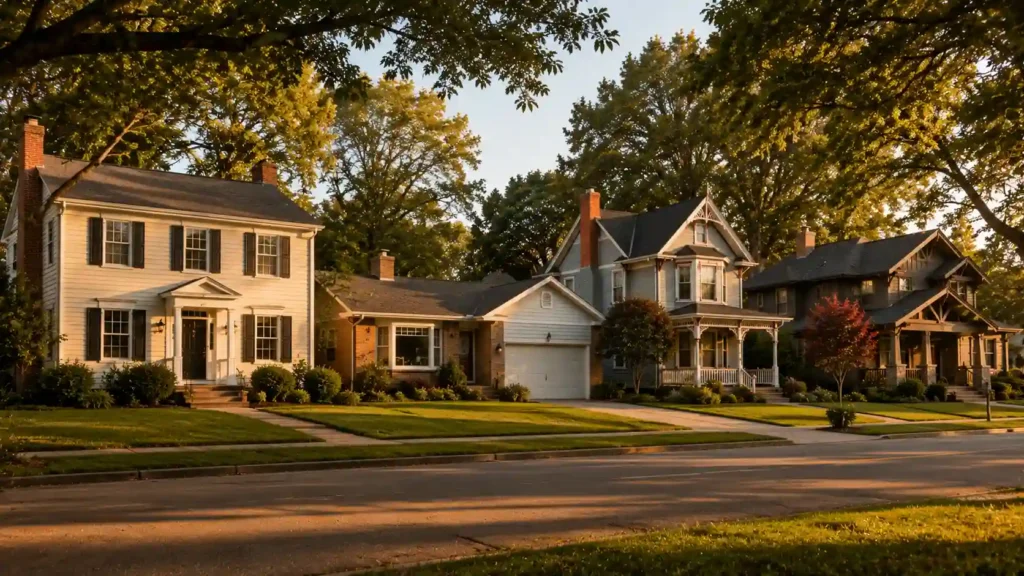
The first house I ever seriously considered buying was a townhome on the edge of a mid-sized city, listed inside a planned unit development. Three different people described it three different ways. The listing said single-family home. The agent said townhouse. The mortgage officer said condominium. All of them were right, and not one of them mentioned the part that mattered that I’d be paying HOA fees every month, couldn’t touch the front door color without committee sign-off, and owned nothing past the interior walls. I walked away not because anything was wrong with the house but because nobody had explained that house style and ownership structure are two completely separate things.
Most buying guides treat them as one topic. That’s where the confusion starts.
Who Actually Owns What: The Legal Structure Behind Every Property Type
Before style, before square footage, before neighborhood the ownership question is the one that shapes everything else. Residential property types split into two systems. One describes the physical structure: how it’s built, how many units it contains, whether it’s a detached house standing alone on its lot or an apartment building stacking dozens of households vertically. The other describes the legal ownership model: who holds title to what, where maintenance responsibility lands, and how the property gets classified for mortgage eligibility and property taxes.
With a single-family home, both systems point the same direction. You own the structure. You own the land. The roof, the exterior, the yard all yours. No common areas shared with neighbors, no homeowners association collecting monthly fees, no HOA community rules telling you where to plant shrubs. Fee simple ownership means the property is yours outright, and that’s both the appeal and the full weight of it. Maintenance responsibility falls entirely on you. In the US, roughly 60% of housing stock in markets like Nashville is single-family, and that percentage climbs considerably in rural housing and suburban housing contexts where land is less scarce.
A condominium is a different animal. Most people think “condo” describes a building type the high-rise, the garden flat, the walkup apartment. It doesn’t. Condo is a legal ownership structure. You own the interior of your unit, walls-in property in the technical sense, and share ownership of everything outside those walls roof, exterior, common areas, landscaping with every other owner in the development through a common interest development arrangement. The homeowners association handles exterior maintenance and collects HOA fees to fund it. What you can do with your unit, how it can look from outside, what renovations require approval HOA community rules govern all of it. Real property classification still applies to a condo, but mortgage eligibility, home insurance requirements, and property taxes work differently than they do for a detached house.
A co-op goes further. Cooperative housing development means you don’t own a unit at all you own shares in the corporation that holds title to the entire real estate development. Shareholder occupancy of your specific apartment is authorized by those shares. Joint ownership decisions, shared expenses, community rules all of it gets decided collectively. Co-ops dominate certain dense urban housing markets, New York City especially, where the apartment vs condo vs co-op question has real financial weight. The legal term cooperative describes an ownership structure, not a building type, same as condominium.
Townhouses are where the confusion between structure and ownership gets thickest. A townhouse or townhome is a structural description: an attached home, two-story typically, sharing at least one exterior wall with a neighbor, with its own ground-floor entrance. But the ownership behind it can go either way. Fee simple ownership in a townhouse means you hold title to both the structure and the land beneath it same rights as a detached house owner. Condominium townhouse ownership means you own only from the walls in, with everything else falling under a condominium corporation. Row house is what mid-Atlantic cities call the same structural type. A brownstone is a specific version multi-story, built from sandstone or brick, common in East Coast urban housing that’s been restored so many times in so many cities it’s become shorthand for a whole category of attached home.
Reading a House by Its Architecture: Styles That Actually Tell You Something
Once ownership is straight, the architectural styles question becomes useful rather than just aesthetic. These are the house styles people picture when they search and knowing what defines each one cuts through listing-site browsing faster than any filter.
Ranch homes are the most common residential architecture in America. Dominant across 34 US states, especially through Midwest and East Coast suburban housing, the ranch layout is single-story, wide rather than tall, with an open floor plan, attached garage, and a low-pitched gable roof or hip roof that keeps the whole profile grounded. There’s nothing fussy about a ranch home. That’s the point. Versatile for various climates, practical for families, cheap to heat and cool relative to two-story layouts.
Colonial homes are among the cheapest types of houses to build the rectangular floor plan is simple, the symmetrical layout requires no structural gymnastics, and the central chimney serving every room is efficient. British Colonial is the version most people mean: two stories, centered walkway to the front door, sidelights or transom window framing the entry. Dutch Colonial swaps the standard gable roof for a gambrel roof, the wide barn-shaped profile that reads instantly different against a skyline. French Colonial adds a wrap-around porch and steeper roof lines suited to warm, humid climates. These homes built between the 1600s and much later eras are the foundational template of American residential architecture most house styles that followed borrowed something from them.
Cape Cod homes came out of New England in the same 1600s era and solved a different problem: cold. The steep roof sheds snow before it accumulates weight. Dormer windows pull light into upper rooms without full dormers cutting into the structural ridge. The central chimney anchors the thermal core. Colonial vs Cape Cod isn’t a style preference so much as a scale and formality question Cape Cods are compact and plainspoken where Colonials lean toward ceremony.
Victorian homes want to be noticed. Named after Queen Victoria, arriving in the US in the 1830s and running hot for decades, they load every surface: bay windows, ornate decor, steep gable roofs, large porches, tall ceilings, decorative moldings that take real time to replicate when damaged. The Eastlake Stick style is a Victorian sub-type where the ornamentation turns linear — visible stickwork that suggests the structural framing underneath without being it. American Foursquare homes are what happened when builders got tired of Victorian complexity: same two-story footprint, symmetrical layout, spatial practicality, and all the ornamentation stripped away. Foursquare homes are honest in a way Victorian homes aren’t trying to be.
Tudor homes carry stone masonry, timber framing, half-timbering on bay windows, leaded windows, and steep gable roofs from late Medieval and early Renaissance England into American suburbs. They peaked in the 1920s to 1930s and never fully left — the asymmetrical design and rounded doorways give them a storybook quality that photographs well and holds resale value in Northeast suburban housing consistently.
Craftsman homes came out of a rejection of industrial mass production. Exposed beams, wide wrap-around porch, large windows, handcrafted detailing, exterior materials chosen to age visibly rather than be hidden the Prairie style home philosophy runs through all of it. Victorian vs Craftsman isn’t just a style comparison, it’s a values comparison. One piles on. The other edits down.
Mid-century modern home design covers the 1950 to 1970 era: clean lines, flat roof or low-pitched gable configurations, large windows chasing natural light, open floor plans that blur indoor and outdoor living. Contemporary home design gets confused with it constantly, but they’re different things. Modern refers to a finished historical period. Contemporary means whatever’s being built right now asymmetrical design, flexible layouts, creative use of materials combining stone, brick, wood, and glass, eco-friendly building techniques baked in from the start. The modern vs contemporary architecture question matters practically: a “modern” listing from 1962 has different maintenance realities than a “contemporary” build from last year.
Mediterranean home and Spanish Revival home styles are built for warmth. Terracotta roof tiles, stucco walls, arched entryways, open courtyard layouts, cross-gabled roof forms that funnel airflow these work in Sun Belt housing markets in a way they simply don’t in cold climate contexts. Antebellum homes sit at the opposite end of the climate spectrum but share the grand-scale instinct: large columns, expansive porches, symmetrical layout that announced wealth in the pre-Civil War South. Antebellum home architecture features survive mostly in Southern home markets where the acreage to surround them still exists.
Manufactured, Modular, Tiny, and the Rest: Alternative Housing Types That Have Stopped Being Alternative
Not long ago, mentioning a manufactured home or a tiny house in a serious home-buying conversation got polite skepticism. That’s changed. These housing types now account for a real slice of first-time buyer purchases in markets where site-built home pricing has run past what median incomes can reach.
A manufactured home the mobile home, updated is built entirely in a factory to HUD standards, set on a chassis foundation, and transported to site. It costs roughly one-third what a comparable site-built home runs. The HUD-compliant mortgage exists, but personal property classification rather than real property classification applies in most cases unless the home gets permanently installed on land the buyer owns. Zoning restrictions are the other wall: plenty of municipalities haven’t updated their codes to accommodate manufactured homes in standard residential zones. HUD code manufactured home vs modular is a regulatory question before it’s a quality question different standards, different financing, different long-term treatment under local law.
Modular homes are also factory-built but they meet local building codes, sit on a permanent foundation, and qualify for traditional mortgage products without the friction. Modular sections get assembled on-site. Custom modular homes run $130 to $310 per square foot, with a garage add-on around $28,000 and a basement ranging from $18,000 to $30,000. The modular home appreciation rate follows stick-built homes more closely than manufactured homes permanent foundation and real property classification are what drive that difference. The prefab home resale value problem that dogged factory-built housing for decades has mostly closed as quality control tightened. Prefab home costs range from $50,000 to $300,000 depending on how much you’re building and where.
Tiny houses 400 square feet or less, sometimes on wheels, sometimes on a permanent foundation cost around $300 per square foot to build, which sounds expensive until you do the absolute math on a 300-square-foot structure. Site prep, utility hookups, soil test, and land prep of $10,000 to $100,000 still apply regardless of footprint size. Zoning restrictions remain the real obstacle. A lot of municipalities technically prohibit structures under a minimum square footage on a permanent foundation, which pushes tiny house buyers toward chassis-based placement or specific tiny home communities.
The barndominium combines living space with a workshop, warehouse, or multi-car garage under one roof what some regions call a shouse, which is shop plus house. Barndominium vs shouse is mostly a regional vocabulary difference. Shipping container homes repurpose steel containers into residential structures with serious structural rigidity. Shipping container home pros cons debates reliably land on insulation difficulty, permitting complexity, and the distance between architectural renderings and what the finished interior actually feels like to live in.
Passive house certification, net-zero home construction, earthship builds using recycled and natural materials eco home and green home are the umbrella terms covering any residential structure where sustainable materials, reduced environmental impact, and energy-efficient systems drove the design from the start rather than being added after. These aren’t fringe categories anymore in Pacific Northwest home markets or across European housing contexts where energy performance standards are regulatory requirements rather than personal choices.
How UK and European Housing Types Work — and Why the American Framework Doesn’t Travel
European housing styles don’t map onto American residential architecture categories without friction. The terraced house is what the UK calls a row house: shares both side walls with neighbors, owns the land beneath, no HOA equivalent managing the exterior in most cases. It’s the dominant housing type in most UK urban and suburban housing markets terraced house UK properties make up a significant share of the total housing stock in England and Wales.
Semi-detached UK homes share one side wall with one neighbor and own both structure and land, which makes them functionally similar to a detached house in ownership terms but physically closer to the neighboring home. Detached house UK is the direct American single-family home equivalent. Bungalow UK means a single-story detached or semi-detached property not the Craftsman-influenced American bungalow, which carries a completely different design vocabulary.
A maisonette is a self-contained flat across two floors with its own external entrance sitting somewhere between apartment and townhouse in how it lives. A granny flat or in-law suite is what the US calls an accessory dwelling unit, built within or attached to a primary residence. ADU construction cost varies widely across US regions. Granny flat regulations UK depend on local planning authority and can limit both construction and the ability to rent the unit separately. Council house and council flat are social housing UK property types owned by local authorities and allocated to households on waiting lists. Social housing Europe operates under related frameworks but varies sharply provision in Germany, the Netherlands, Scandinavia, and Southern Europe each reflects different policy histories.
Co-living space is the newest urban housing category with real traction: shared residential buildings where private bedrooms open onto communal kitchens, living areas, and shared amenities, operated as a managed product. Different from cooperative housing development in that residents don’t own shares they rent. Co-living space investment is growing fastest in transit-oriented development zones in both American and European urban housing markets where micro-apartment demand and affordable housing pressure have pushed single-occupant households toward shared models that pencil out for everyone.
Frequently Asked Questions (FAQ’s)
A house type describes the physical property, such as a detached house, townhouse, ranch, or terraced home. The ownership structure explains what you legally own, whether land and exterior areas are included, and whether an HOA, condominium association, or cooperative controls shared property.
A townhouse describes how a home is built, while a condominium describes how ownership is legally structured. A townhouse can be fee simple, where you own the building and land, or condominium-owned, where responsibility may stop at the interior walls.
Start by checking ownership rights, maintenance responsibility, HOA fees, financing rules, and the condition of the structure before focusing on architectural style. Two homes that look almost identical can carry very different long-term costs and restrictions depending on how they are legally classified.
Modular homes are generally treated more like traditional site-built houses because they follow local building codes, sit on permanent foundations, and usually qualify for standard mortgages. Manufactured homes follow HUD standards and can cost less upfront, but financing, zoning, land ownership, and property classification require closer attention.
There is no single best property type because the right choice depends on budget, maintenance tolerance, location, financing, and how much control you want over the property. A detached home offers more independence, while condos, townhomes, manufactured homes, and smaller housing types can reduce the initial purchase burden but may introduce fees, restrictions, or different ownership rules.

1 thought on “What the Types of Homes You’re Choosing Between Actually Mean Before You Sign Anything”