

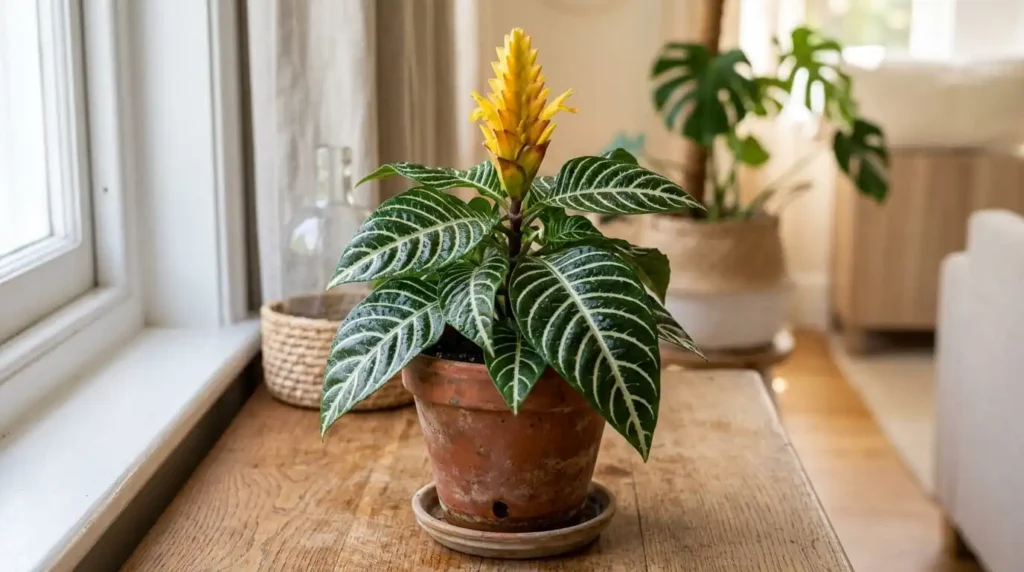
One of such houseplants is the zebra plant, which literally makes people stop in their tracks. The first time I could see Aphelandra squarrosa was in a small nursery corner and its bold, dark-green leaves were marked with large white veins. It was nearly too melodramatic to be true. The zebra stripes that scampered over the foliage made it look like a lush, tropical foliage unlike any other in my collection of indoor foliage.
What makes this plant truly special is its personality. It also compensates prudent cultivators with golden-yellow flower spikes that soar high in late summer or early autumn. Over six weeks may be the maximum period of those blooms provided the right conditions. The plant, native to the tropical forests of Brazil has warm and humid conditions in its DNA. It will be growing it indoors and that will mean to learn about its natural habitat first.
A Plant With History Worth Knowing
The zebra plant gained access into households during the Victorian era; the trendy and in demand tropical plants at the time. After 1845, a Belgian nurseryman named Louis Van Houtte, (1810-1876), would pursue South American orchids across continents. His plant collector returned numerous promising tropical which built up in greenhouses throughout Europe. The Van Houtte firm, of a previous cultivar named Leopoldi, chose the strain Louisae towards the turn of the 20th century.
Other plants that are commonly referred to as zebra plant include references to the Haworthia genus dating back to the 1600s. The genus was initially placed in the genus Aloe of the family Liliaceae before it was transferred to Asphodelaceae. In 1809, it was renamed Haworthia to honour English botanist Adrian Hardy Haworth. In 2013, a rift emerged in the research of genetics, and Haworthiopsis became the product of this research.
Haworthiopsis was named after the Greek word opsis, which means likeness. The Haworthiopsis attenuata and the Haworthiopsis fasciata are both known as zebra plant.
The little zebra plant label sometimes gets attached specifically to Haworthiopsis fasciata. Their white striping appears as warty projections called tubercles across the thick green leaves.
What the Zebra Plant Actually Looks Like
The oval version of the Aphelandra squarrosa has oval-shaped leaves with a sharp tip. They are growing in pairs on a thick purple tinged stem. The leaf- blade is a waxy green, the midrib and the veins being marked in a beautiful creamy-white, which sharply contrasts with the dark background. It is precisely this contrast that makes it look like a zebra with the stripes that people are quick to notice.
The Haworthiopsis grow as rosettes of pointed leaves and a height of 4 to 12 inches. The diameter of the rosette is between 6 and 24 inches depending on conditions. Haworthiopsis fasciata and attenuata differ in their smooth upper surfaces and rough surfaces, respectively, on both sides. They both are slow to grow and do not often require vigorous repotting.
The flowers in Aphelandra appear at the terminal end of the stem. A four-sided yellow spike forms there, with bracts overlapping one another like shingles on a roof. The actual flowers are two lipped and only persist for a few days. The showy bract, however, stays attractive for six to eight weeks easily.
Light Needs: Getting This Right Changes Everything
Light has been the biggest mistake most growers make with this plant. Aphelandra squarrosa thrives in low to medium indoor light but not utter darkness. The plant adapted in tropical forests of Brazil that grow under a heavy canopy. Complete shade does not allow any blooming and that seems like a severe loss.
In the case of the Haworthiopsis species, indirect light coming through an east or a west window works best. A south-facing window can also be used but might require to be filtered using sheer curtains. The problem with direct sunlight is the possibility of burning the fragile leaves and burning the ends of the leaves. These succulents naturally remain shaded between the larger succulents, rocks and other objects that are natural.
Aphelandras bloom in the fall is a natural phenomenon but can be stimulated to bloom at any time of the year. It will take approximately 12 weeks before flowers can be formed due to the plant accumulating about 650 footcandles of light. Such plants are termed as photo-accumulators and zebra plant is an example provided in a textbook. Even night temperatures more than 65 degrees should be maintained during the night.
Watering: The Skill That Separates Good Growers
The proper watering of this plant will make the difference between experienced growers and beginners, in my sincerity. In the case of Aphelandra, the soil must continuously remain moist and not wet. I will always suggest putting your finger in the ground not less than an inch. And, when it remains damp, walk away and revisit in a day or two.
Do not allow the potting medium to dry up with Aphelandra. Even those who once had their zebra plants wilt even once are aware of the painful outcome. The lower leaves drop off and the plant turns into a sort of miniature palm tree. The shape is extremely difficult to undo once it occurs.
In the case of Haworthiopsis, the strategy is a little different. Let the first inch of the soil dry out between waterings. Water and drain out completely every time, and care should be taken to ensure that waterlogged conditions do not develop. The reason is that when water is collected in the rosette leaves, it will rot easily and very hard to get out of once established.
Lukewarm water is the best to Aphelandra as it mimics Brazilian tropical rains. Excess liquid should always flow freely from drainage holes after each watering session. Never mist the foliage of Aphelandra directly because misting leaves causes fungal issues and disease. Ferns and carnivorous plants tolerate misting, but the zebra plant absolutely does not.
Humidity and Temperature: Mimicking the Tropics Indoors
The zebra plant is a great lover of high humidity at all times. To increase the amount of moisture in the air, I maintain a tray of pebbles underneath the saucer of my Aphelandra. The fact that there is a humidifier in the area also helps to keep the humidity level at moderate to high levels that this plant prefers. The average indoor temperatures are quite suitable as far as extremes are to be avoided at all costs.
In the case of Haworthiopsis, the most suitable temperatures are between 70 and 95°F, which is similar to the conditions in their native habitat (southern Africa). At temperatures that are below 50F, the structure of leaves will start to inflict visible damage. In fact, there is no additional humidity needed by these succulent species at all.
Aphelandra squarrosa is thermophilic and grows well in the normal room temperatures of 68 to 77F. In Celsius that temperature range would be 20-25C to those who want to use metric measurements. Always maintain temperatures of at least 55oF or 12o C very low to prevent cold stress. Do not place the pot in areas where there are numerous drafts as movement of cold air is fatal.
The plant is native to the hot and moist Brazilian tropics and it truly does not like cool and dry winter weather. Lots of homes lose the temperature and humidity both in winter and additional care is necessary. The suitability of the hardiness zone is between 11 and 12b to be used in warm climates when growing outdoors.
Soil and Repotting: Foundation for Long-Term Health
Getting the soil mixture right is honestly one of the most important decisions you make early. To give its best in an indoor environment, Aphelandra will require highly organic and extremely well drained soil. Most growers starting out can use an all-purpose potting mixture that has good drainage. The point is that the potting medium must never be left wet or thick.
In the case of Haworthiopsis, a commercial cactus or succulent potting mix that is well-drained would be the most suitable. You can also make a substrate by combining garden ground, sand, humus and peat together in equal proportions. By adding sand or perlite to a general potting mix, the drainage of these species is greatly enhanced. The most appropriate container to use with Haworthiopsis is a shallow terra-cotta pot since it has the ability to breathe freely.
In the case of Aphelandra, the drainage holes in tall pots are more appropriate since this plant will have its roots well within it. As both varieties are slow-growing, they can be kept in the same pot over years without any discomfort. Even without changing the size, repotting into fresh media should still occur after every 2 to 3 years. Replacement of the potting mix prevents depletion of nutrients and accumulation of salt which kills roots in the long run.
Fertilizing: Feeding for Flowers and Foliage
The constant difference in fertilizing is always a real difference in the appearance of this plant as it matures. I use an all-purpose houseplant food to fertilize my Aphelandra every time between March and October. The plant should be the primary beneficiary of weekly feeding during the growing season, but should always mix fertilizer 50:50. Frequency directions should be followed so as to avoid over-fertilizing just as much as neglect is harmful.
Haworthiopsis Cactus fertilizer will suit better than general formulas in the spring and summer growing season. There is no need to feed them during the non-growing season and it may even be detrimental to these succulents. Even the leaves should be dusted occasionally and the pot should be turned by a quarter turn every month to ensure even growth of the plant. Pruning must not occur on a regular schedule but only when necessary.
Once the Aphelandra bloom is over, it is important to handle the used spike and flower at the earliest opportunity. Prune away all the foliage except two layers, and cut away the others when the bracts are fully dried. This will make your zebra plant not grow up leggy and uncontrollable as it would have grown. Following the pruning process, transfer the plant to a warm and sunny area where the plant can revive.
During summer Aphelandra may be transferred to a shaded patio where it may be exposed to indirect outdoor light to its benefit. It is expected to bloom again come fall with the promise of blooming again when properly taken care of throughout the year.
Propagation: Growing More the Right Way
Zebra plant propagation may require some patience on your part, but you will find that your efforts have been worthwhile in the end. The process of stem cuttings is effective in propagating Aphelandra during the spring season, when the plant is vigorous and full of life. Put the cutting in the soil and place it in a warm area with uniform temperature. Wrapping the pot with plastic helps the cutting get humid air that will hasten root development. Roots will form after a month from the start of the cutting process.
Haworthiopsis will yield offsets that are known as pups.These pups can be gently removed from the parent plant and rooted separately in fresh media. Leaf cuttings also work for propagation but due to slow growth, this method demands real patience. Both methods are effective, and I have had success with pups far more consistently than leaf cuttings personally.
Pests, Diseases, and Common Problems
Haworthiopsis plants are usually pest-free and disease-resistant when grown under standard conditions. The most prevalent threat comes from mealybugs, which attack plants in the form of a whitish cottony mass on their foliage. If the mealybug population is small, it can be easily removed using a cotton swab soaked in isopropyl alcohol. Isopropyl alcohol in concentrations below 70% works well, causing minimum damage to the plants.
Before treating the entire plant, a small portion should always be tested using the alcohol solution. It will take a day or two after testing to confirm that the solution will not lead to leaf scorch. Root rot is another serious condition for Haworthiopsis plants, which occurs due to excessive moisture retention in the soil and insufficient lighting. Early detection of root rot is important because it becomes almost impossible to save the plant once it has infected the whole root system.
Regarding Aphelandra, if the leaves start falling, this may indicate that the plant is overwatered or under-watered. Also, if the leaves start curling or burning, it would be best to find a new place for it with lower direct sunlight exposure.
Safety and Surprising Uses
The safety of the Aphelandra squarrosa plant in relation to pets and kids is one of its most appealing qualities. The ASPCA says the zebra plant is not poisonous to dogs or cats, thus making it pet-friendly. This quality makes the plant suitable for those who have kids and pets at their homes.
Myplantin.com reveals a striking fact regarding the cultural importance of the plant. Jamaicans apparently use zebra plants in herbal medicine for the treatment of high blood pressure and colds. Mexicans make a beverage known as Matali using the zebra plant’s sweetened leaves. Such culinary and medicinal applications of the plant add significant value to it beyond its indoor ornamental nature.
Currently, 22,561 individuals grow the plant via database tracking, while 3,081 more people have added the plant to their wish lists. It may have been classified as medium difficulty, but with attention to its natural habitat needs, any dedicated grower can succeed.
Conclusion
The zebra plant is no ordinary houseplant silently resting on a shelf somewhere. It contains huge, dramatic foliage, golden-yellow flower spikes, and a rich history that is seldom matched by indoor plants. All growers who are determined to learn its natural habitat come out truly rewarded. The main requirements of it are warm temperatures, higher humidity, bright indirect light, and well drained soil. Get these correct and the zebra plant makes any inside area something really tropical and alive.
Whether you go with Aphelandra squarrosa, with its dramatic blooms or Haworthiopsis with its sculptural blooms, the zebra plant will continue to deliver the beauty. It is pet friendly, culturally important, and surprisingly strong when its fundamental needs are addressed in proper ways. Having cultivated this plant in dry winters and humid summers, I have never ceased to find it interesting to take care of this plant. The zebra plant is more of a payoff than a penalty and she requires patience, attention, and an actual sense of curiosity more than just about any other houseplant that I have ever kept. The zebra plant will never fail you as long as you are willing to provide it with the care it deserves.
Frequently Asked Questions (FAQ’s)
The name zebra plant commonly refers to Aphelandra squarrosa, a tropical Brazilian houseplant known for dark green leaves with bold white veins and yellow flower spikes. The name is also used for Haworthiopsis species such as H. fasciata and H. attenuata, which have striped succulent foliage.
Aphelandra prefers consistently moist soil, warm temperatures, and higher humidity, while Haworthiopsis behaves more like a typical succulent and should dry slightly between waterings. They also look different: Aphelandra has broad veined leaves and yellow blooms, whereas Haworthiopsis forms compact rosettes of pointed striped leaves.
For Aphelandra, keep the soil consistently moist but never waterlogged, checking the top inch before watering again. Haworthiopsis should be allowed to dry at the surface between waterings, and excess water should always drain away to reduce the risk of root or rosette rot.
Choose a location with indirect light rather than harsh direct sun, which can scorch the foliage. Aphelandra also benefits from warm, humid conditions, while Haworthiopsis prefers bright indirect light and does not require extra humidity.
Haworthiopsis is the more suitable option based on the care conditions described in the article because it does not need the elevated humidity that Aphelandra prefers. Aphelandra is better suited to a warm location where moderate-to-high humidity can be maintained consistently.

3 thoughts on “Growing the Zebra Plant Indoors: A Practical and Detailed Care Guide”