


In London, there’s rarely ever such a thing as easy when it comes to housing. There’s constant pressure, long waiting lists, and a gap between demand and supply that widens year after year. This is what happened within the London Borough of Brent. With one of the largest housing experiments in the modern era of local government. The Brent Housing Partnership, better known as the BHP.
Learning about the BHP, how it worked. And what followed it helps you understand a lot about how council housing really functions. And what tenant rights still exist in Brent through the services and communities still working to this day. Despite the closure of the BHP many years ago.
What Was the Brent Housing Partnership
BHP was founded in 2002 as an arms-length management organisation, also known as an ALMO. The reason was simple to remove direct council control of the management of the housing stock owned by the council. And put it under another body which could work with more commercial freedom. But at the same time serve public interests.
BHP successfully provided the management of council homes within the borough of London Borough of Brent for 15 years – a diverse, densely-populated area of north-west London, dealing with housing issues, growing population, and the largest average family size in the presence of poverty and unemployment. The maximum number of council properties managed by BHP reached 12,500, while their own property portfolio included about 300 properties.
The management agreement between BHP and Brent Council was structured to run until April 2023. With long-term financing provided through loan agreements. The council delegated authority to BHP to operate as its subsidiary. And best partner the organisation tasked with delivering Brent’s vision of housing for the future.
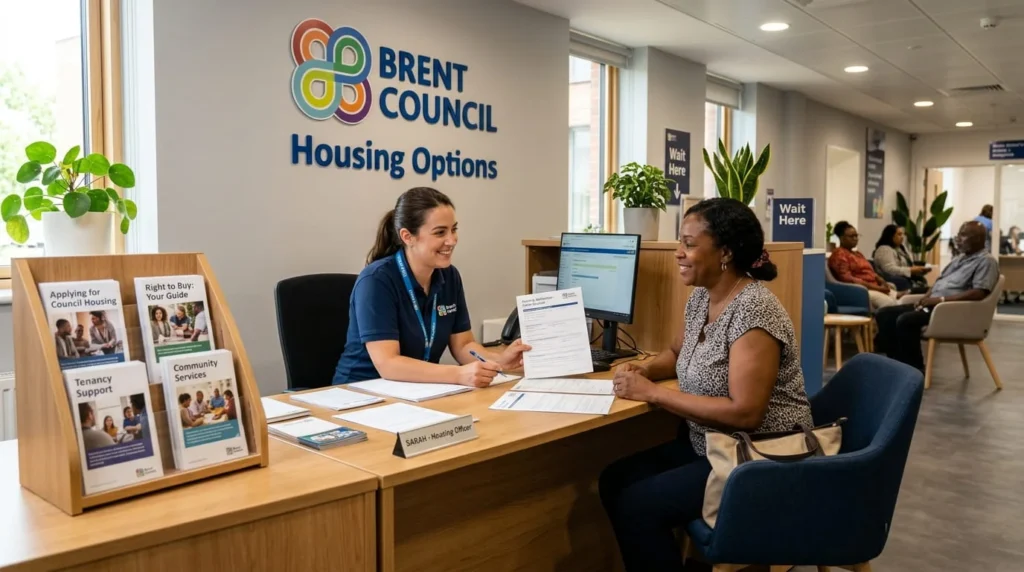
However, by 2017, this situation had been reversed. The bad reputation of BHP due to their poor performance resulted in houses. That were not well taken care of in the borough. With the backlogs in repairs causing loss of faith in the ALMO approach. It was at this point that the decision was made by the Brent Council. To revert management of their properties back to themselves. After fifteen years of contracting out this responsibility. This was according to Nathalie Raffray in her article for the Kilburn Times published in October 2017.
The Vision BHP Set for Itself and Why It Matters
Despite the difficult ending, BHP’s strategic ambition during its operational years was genuinely comprehensive. The Vision and Values strategy published for 2014 to 2018 under the leadership of Chair Joanne Drew. And Managing Director Tom Bremner set out a clear framework for what BHP intended to become.
Vision Was To Build Vibrant, Diverse, And Resilient Communities
The vision was to build vibrant, diverse, and resilient communities summarised in the phrase great places, great people, great homes. The strategy positioned BHP not just as a service provider. But as an enabler and supporter of community leadership, deeply embedded in the lives of Brent’s residents.
Organisation
The organisation was governed by a supervisory Board of 13 Board Members six of them residents, four independents including the Chair, and three representatives from Brent Council. This structure was deliberately designed to keep tenants and leaseholders at the centre of governance. Six residents sat on the Board directly, with separate structures for customer engagement, scrutiny, and independent oversight.
Board Committees
Four Board committees managed the key functions. The Customer Committee owned the overall approach to serving residents. The Development and New Business Committee oversaw growth initiatives. The Audit Committee managed risk management and financial controls. The Governance and Remuneration Committee kept BHP to high standards of integrity, transparency, and accountability.
Executive Leadership Team
The Executive Leadership Team comprised the Managing Director supported by a Director of Finance, a Director of Operations, and a Director of Development and Growth. Each director had clear accountability financial and risk management, resident services quality, and growth opportunity respectively.
Six Key Strategic Objectives
The Six Key Strategic Objectives known internally as KSO1 through KSO6 covered Great Communities, Good Value, Customer Service and Neighbourhoods, Building New Homes and Regenerating Estates, Safe and Well Run, and A Great Place to Work with Strong Partnerships. Taken together they represented an ambitious, resident-first housing management philosophy that went well beyond maintaining properties.
The Housing Context BHP Was Operating In
The scale of Brent’s housing challenge during BHP’s operational years was substantial. The borough was dealing with a waiting list of 19,000 households. A private rented sector expanding but struggling with quality and affordability, rising homelessness, and the cascading impact of welfare reform hitting a low income borough harder than most.
The HRA Housing Revenue Account self-financing model introduced. During this period liberated BHP to plan over the long term and use resources more effectively. But it also meant that financial discipline was non-negotiable. Every decision around income maximisation, procurement, and value for money had direct consequences for the borough’s housing future.
BHP’s development ambitions were tied to an infill development programme building new homes on existing estate land. And a growing role in the private rented sector. The strategy spoke explicitly about contributing to housing products across a range of tenures. And for a range of income groups, tackling illegal subletting and sub-standard conditions in both tenanted and leasehold properties. And investing in energy efficiency and high environmental standards to address fuel poverty.
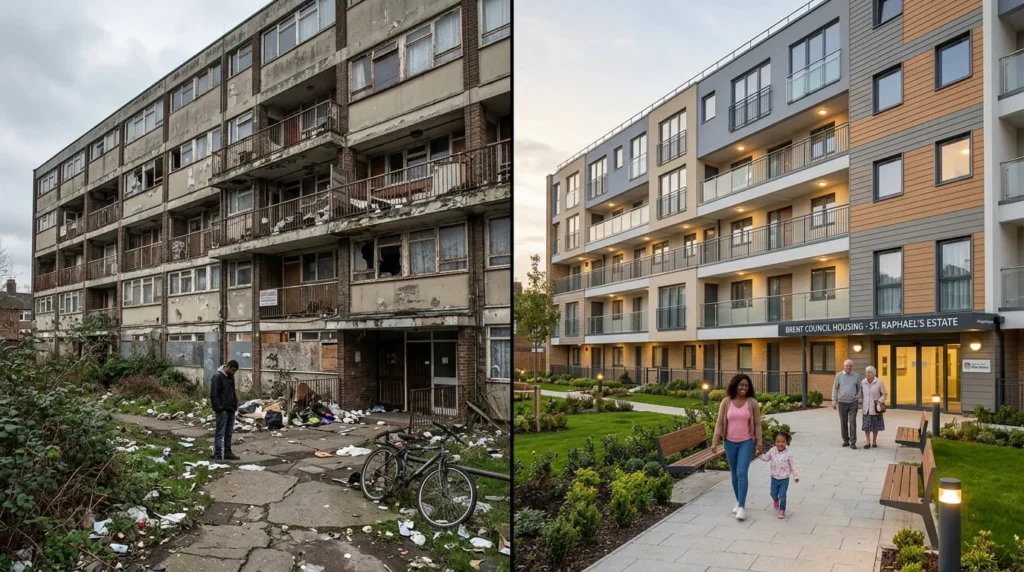
The Decent Homes investment programme completed early under BHP’s watch represented a significant legacy. An excellent service inspection judgment in 2003 gave the organisation early credibility. But the gap between early achievement and later delivery became the defining story.
Brent Housing Authority Alabama Context
Separate from BHP in London, the Brent Housing Authority in Brent, Alabama operates at 10 White Street, Brent, AL 35034 and can be reached at 205-926-7781. This organisation serves the residents of Bibb County, providing stable, quality affordable housing for low and moderate income families. Through the management of public housing apartments and Section 8 Housing Choice Vouchers.
The Alabama authority participates in the Section 8 Centralized Waiting List a partnership of housing authorities. Across the state that streamlines the application process. Applicants submit one common application to the centralized waiting list, which is then made available to all participating housing agencies. Each agency selects participants according to their local policies.
Eligibility for the Section 8 program is based on household income. Not exceeding 50 percent of the median income for the relevant area. Section 8 tenants are generally expected to spend no more than 40 percent of their income on rent and utilities. The Housing Assistance Payment HAP is calculated based on family income, family size, local payment standards, utility costs, and the requested rent.
Rent Reasonableness comparing a listed rental against similar properties using thousands of data points. And all HUD criteria determines whether a landlord’s rent request is acceptable within the program. Landlords who participate receive steady income through guaranteed payments, access to a larger pool of tenants, and reduced vacancy rates. The Fair Housing Act, established in 1968, prohibits discrimination in housing based on race, color, national origin, religion, familial status, gender. And disability principles that govern the Brent Housing Authority just as they do every federally supported housing program across the United States.
Right to Buy Brent Housing Partnership’s Role
One of the most tangible duties that the BHP had to perform during its years of operation was dealing with enquiries relating to Right to Buy of properties situated in the London Borough of Brent. The Right to Buy policy entitles council tenants the right to buy their house at a reduced price.
The criteria for eligibility included having a secure public sector tenancy of at least 2 years for individuals. Who had become council tenants prior to the 18th of January, 2005, and 5 years for those becoming council tenants after this date. The discount system varied between 32 percent for a house and 44 percent for a flat at 2 years of tenancy to a maximum of 60 percent for a house at 30 years of tenancy and 70 percent for a flat at 15 years of tenancy. The maximum discount was limited to £16,000.
For any Right to Buy correspondence regarding property in Brent. The letters were addressed to the Brent Housing Partnership at the Brent Civic Centre, Engineers Way, Wembley, HA9 0FJ. The contact number is 020 8937 2600, fax number is 020 8937 2455, and the e-mail address is rtb@bhphousing.co.uk. General correspondence should be sent to info@bhphousing.co.uk. People residing in South Kilburn may go to the South Kilburn Housing Office at the Community Resource Centre, William Dunbar House, Albert Road, Kilburn, NW6 5DE.

What Replaced BHP Community Services Still Active in Brent
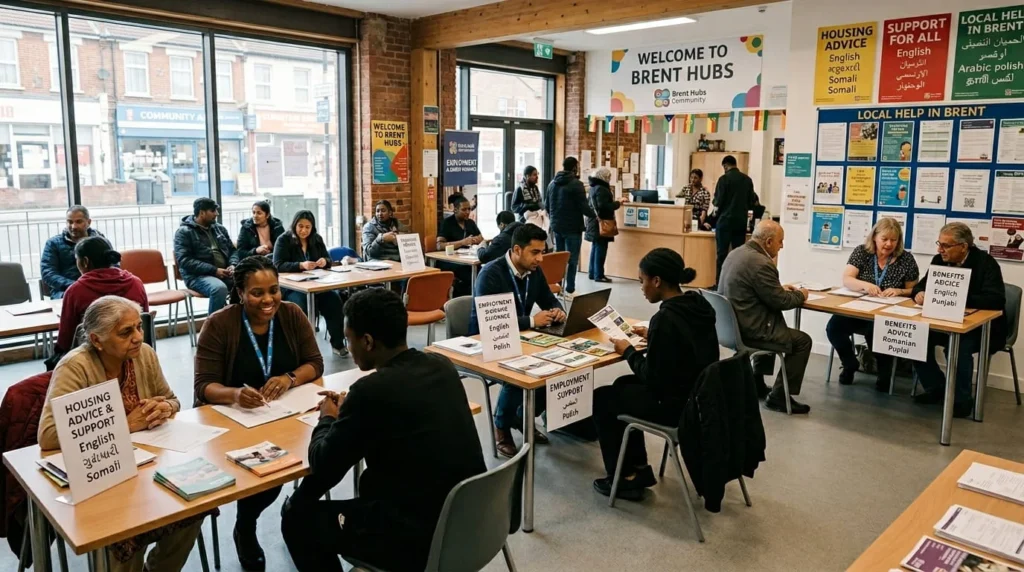
When housing management returned to Brent Council in 2017, the community ecosystem that had grown around BHP did not disappear. Brent Hubs a network of community service points across the borough continues to provide local residents with free support and advice across benefits, employment, money management, debt advice, and housing.
The network comprises sites in Harlesden, Kingsbury, Kilburn, Willesden, and Wembley Ealing Road, as well as the Living Room hub. All the hubs help the local residents connect with a wide variety of partners offering special assistance.
Brent Housing Needs
Brent Housing Needs from Brent Civic Centre, Engineers Way, Wembley, HA9 0FJ, contactable on 020 8937 2000 offer advice on homelessness, housing solutions, housing applications, bidding process online, and local housing allowance. It forms the core of the new system that has largely taken the place of what BHP used to offer.
Citizens Advice Brent is available for financial advice on Mondays at Brent Hubs Civic Centre. Tuesdays at Willesden and Civic Centre on alternate weeks. Wednesdays at Harlesden. Thursdays at Kilburn, and Fridays at Civic Centre, at 270-272 Willesden High Road, London, NW10 2EY, phone 02084381249.
Money And Debt Advice Service
The Money and Debt Advice service consists of customized debt advice, maximizing income, budgeting help, and access to Government Debt Respite Schemes such as Breathing Space, Debt Relief Orders, and Insolvency Solutions.
Shelter offers independent housing advice regarding issues such as homelessness, private renting, tenancy deposits, repossession, eviction, repairs, and council housing. This can be done via the helpline service available from 8am to 8pm during the weekdays. And 9am to 5pm during the weekends and also via the web chat facility offered from 9am to 5pm during the weekdays.
Crisis Skylight Brent based at Unit 2, Ajax Building, 16a St Thomas’s Road, London, NW10 4AJ, telephone 0208 965 2561 offers its services only to those individuals who are either homeless or likely to become homeless by providing progression support, housing support, art and learn opportunities, and employment support along with strategic partnership for creating positive changes for homeless individuals in the borough.
The Synergy Brent provides services that enable vulnerable residents to live independently by developing their abilities to cope with their tenancies and accommodation, find employment, and remain healthy and secure. The agency operates from various hubs within Brent offering a drop-in advice centre in terms of benefits, housing, and other information purposes.
Based at the Brent Civic Centre, Engineers Way, Wembley Park, HA9 0FJ, telephone 020 8937 6295, Brent Works connects the residents to their opportunities in employment, apprenticeships, and learning providers through one-to-one guidance and advice services. It acts as an employment partner for housing support networks that recognize the interdependence between housing and earnings.
Support Network Concerning Housing in Brent
The extent of the support network surrounding housing in Brent illustrates the interdependence of housing vulnerability with health, employment, immigration, and community wellbeing.
Sufra Foodbank, located at 160 Pitfield Way, Stonebridge, London, NW10 0PW, phone number 020 441 1335, offers a food bank, fresh meal service, NHS initiative, community kitchen, counseling services, and refugees support to provide emergency food and continuous assistance to people in urgent need.
Trussell Trust’s Brent Foodbank
Additionally, there is the Trussell Trust’s Brent Foodbank, which can be found at Vestry Hall, Neasden Lane, NW10 2TS, offering three-day emergency food packs on Tuesdays and Thursdays between 1 pm and 3 pm, with an alternative site being Lindsay Park Baptist Church, Kenton, HA3 9TG, on Wednesdays from 12:30 pm to 3 pm.
In terms of help for mental health issues, Brent Mind at Design Works, Park Parade, Harlesden, NW10 4HT, phone number 020 7604 5177, offers individualised assistance for individuals suffering from mental health conditions using the themes of wellness, resilience, and independence.
For people dealing with depression, anxiety, insomnia, and panic attacks, the Brent CNWL Talking Therapies IAPT at Fairfield House, Fairfield’s Crescent, Roe Green, Kingsbury, NW9 0PS, phone number 020 8206 3924, is available for free confidential NHS treatment to anyone over the age of 18.
Green Doctors energy advisors operated through Groundworks London at 18-21 Morley Street, London, SE1 7QZ, telephone 0300 365 5005 provide advice on energy saving, energy bills, and heating systems, directly addressing the fuel poverty challenge that BHP’s strategy had identified as a priority years earlier. The Seasonal Health Intervention Network SHINE adds support around fuel debt, heating grants, and insulation grants for residents struggling with energy costs.
The North West London Law Centre provides comprehensive immigration services such as EU settlement scheme applications, asylum applications, human rights cases, domestic violence cases, trafficking cases, and Immigration Tribunal appeals on Monday from 9 am to 1 pm and Wednesday from 10 am to 1 pm in the Brent Hubs.

Brent Gateway Partnership
Brent Gateway Partnership provides preventive social care and statutory advocacy under Care Act Advocacy, Independent Mental Capacity Act Advocacy, and Independent Mental Health Act Advocacy along with assistance to young carers, older carers, and socially isolated individuals. Providing services from Wembley Library, Willesden Library, and Kilburn Library throughout the week through a phone number, which is 020 3948 0600.
However, the tale of Brent Housing Partnership continues even after its closure in 2017, as its legacy continues to live through the council services, community services, tenant rights framework, and networks that make up housing activities in one of the busiest, most diverse, and most challenging boroughs in London.
The gap left by BHP was not to be filled but has rather been answered by various other organizations that have taken the responsibility to serve the needs of the ever-changing community.
Conclusion
In conclusion, Brent Housing Partnership has certainly left behind an ambivalent legacy. It began with lofty aspirations 12,500 council homes under one roof, communities that are alive, dynamic, and sustainable, and a system where six people lived on the Board itself. It concluded in 2017 with dilapidated homes and a housing department back at the Borough Council of Brent.
But the infrastructure it constructed to enable tenant rights legislation, Right to Buy schemes, and community services delivered via the network of Brent Hubs in Harlesden, Kilburn, Willesden, Kingsbury, and Wembley remains at the service of residents on a daily basis. Brent Housing Needs, Citizens Advice Brent, Shelter, Crisis Skylight Brent, Sufra Foodbank, Brent Works, and countless other partner organisations have collectively taken over the provision of what no one housing organisation could do alone.
The legacy left by BHP is clear. Large-scale council housing demands more than a management contract and a business plan. It demands effective implementation, true accountability to tenants, and a community system capable of dealing with the inevitable mistakes. Brent has built that system. Now comes the challenge of ensuring that all the residents who need it will find it
Frequently Asked Questions (FAQ’s)
Brent Housing Partnership, or BHP, was an arms-length management organisation created in 2002 to manage council-owned homes for the London Borough of Brent. At its peak, it managed about 12,500 council properties and operated separately from the council while remaining accountable to it.
BHP managed Brent’s council housing on behalf of Brent Council, while the council remained the public authority responsible for the housing stock. In 2017, housing management was brought back under direct council control following concerns about performance and repair backlogs.
Brent Council took housing management back in-house, while services such as Brent Housing Needs and Brent Hubs continued supporting residents. These services now help with housing applications, homelessness, benefits, debt advice, employment, and other housing-related needs.
Yes. The article identifies Brent Housing Needs, Brent Hubs, Citizens Advice Brent, Shelter, Crisis Skylight Brent, and other local organisations as sources of housing and related support. The right service depends on whether the issue involves homelessness, tenancy problems, benefits, debt, employment, or another form of assistance.
Yes, BHP previously dealt with Right to Buy enquiries for eligible Brent council tenants while it was responsible for housing management. The article explains the historical eligibility and discount arrangements that applied during BHP’s operating period, but residents seeking current terms should use the council’s present housing services.
