

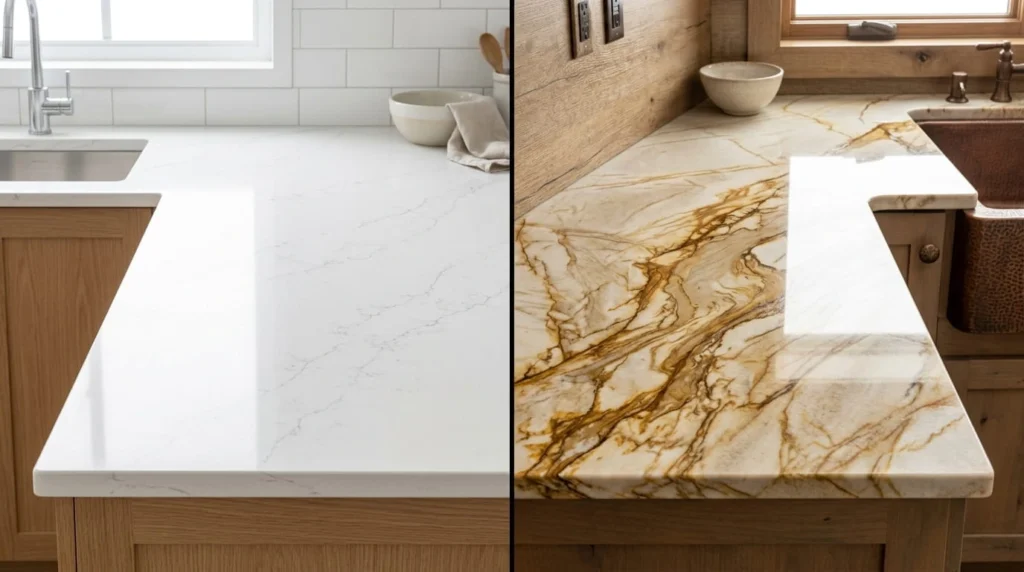
Picking a countertop isn’t just about what looks good in a showroom photo. When you stand in a real kitchen, running your hand across a cold slab, the decision becomes much more personal. I’ve spent years helping homeowners navigate this exact choice and the quartz vs quartzite conversation comes up every single time.
Most people walk in thinking these two are basically the same thing. They share the same mineral, the names rhyme, and half the time the sales associate at a big-box store can’t tell them apart either. But after working closely with fabricators, visiting quarries, and watching how both materials perform over years in real homes, I can tell you with confidence these two surfaces live very different lives on your countertops.
Starting With What the Stone Actually Is
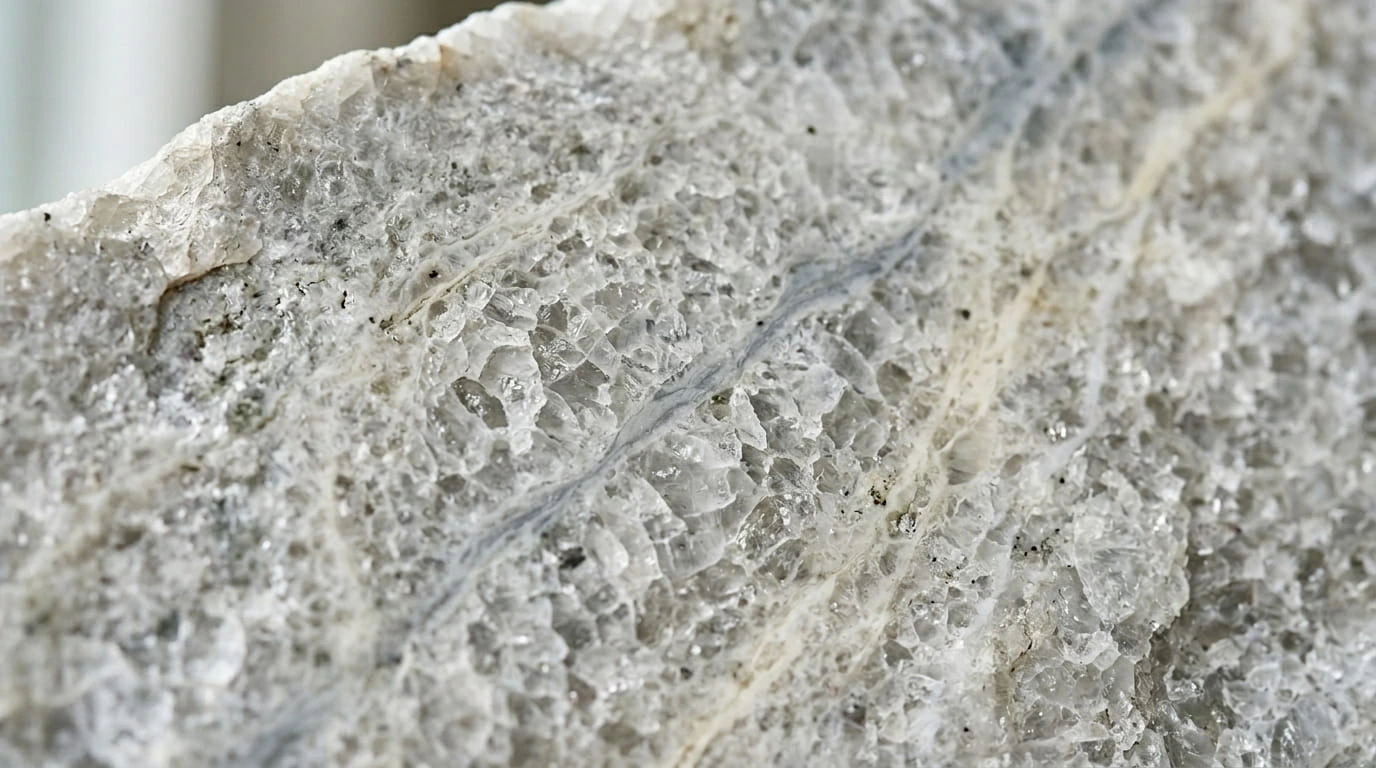
Let’s begin with the quartzite stone since knowing about it will allow us to understand all other types much more easily. This type of stone is a metamorphic one. In other words, this kind of stone wasn’t created in any factory; rather, it emerged due to long-lasting geological processes during which quartz-rich sandstone underwent tremendous heat and pressure that led to forming crystals of quartz mineral.
The resulting product is a dense, hard stone with crystalline texture whose hardness even surpasses that of granite according to the Mohs scale. Thus, by looking at a piece of quartzite, one can observe how nature worked very hard on creating it. Moreover, each slab is unique due to its natural veining and coloring. For instance, one cannot create this kind of unique surface artificially. That is why many designers prefer this type of material to make eye-catching islands and countertops.
On the contrary, quartz is an engineered stone. In this case, companies grind quartz crystals, the very crystals that exist within quartzite rocks, along with resins, color pigments, and polymer resins in the manufacturing plant environment. Quartz slabs are formed through compression into dense and non-porous blocks and subsequently polished to perfection.
Since quartz is an engineered stone, it allows manufacturers to design quartz that looks like marble, granite, or quartzite itself. In addition, it allows for the development of a consistent and predictable look across the entire block of quartz since the process is highly controlled by manufacturers. You can almost literally copy and paste the exact same quartz design into several homes something you simply cannot do with natural stones like quartzite.
How Hardness and Daily Wear Actually Play Out
This is where it gets exciting, and this is also where I have noticed that many homeowners have made costly mistakes. Both of them are rated highly on the Mohs hardness scale; quartzite ranges from 7 to 8, whereas quartz falls somewhere near 7. But hardness doesn’t tell the whole story.
The quartzite is highly durable more durable than quartz and even granite in some cases, second only to diamonds among countertop materials. The durability is derived from the natural formation process, which involves high pressure and temperature over many years.
It does not scratch easily, withstands heavy wear, and has been proven to be highly durable over many years when maintained properly. However, the material may chip if hit strongly at the edges and, surprisingly, etch after prolonged contact with acidic substances. Spilling lemon juice, vinegar, wine, tomato sauces, and other similar substances without cleaning can ruin the elegant veins you love.
Quartz is slightly less durable but makes up for it with the presence of resins.
That slight flexibility from the resin actually helps it resist chips at the edges better than quartzite. It repels all but the most severe of scratches that would be experienced in an active kitchen environment, and its smooth surface remains consistently unchanged year in and year out, with less susceptibility to the process of etching. This level of consistency is vital for a large house hold or frequent kitchen usage.
The Heat and Stain Conversation
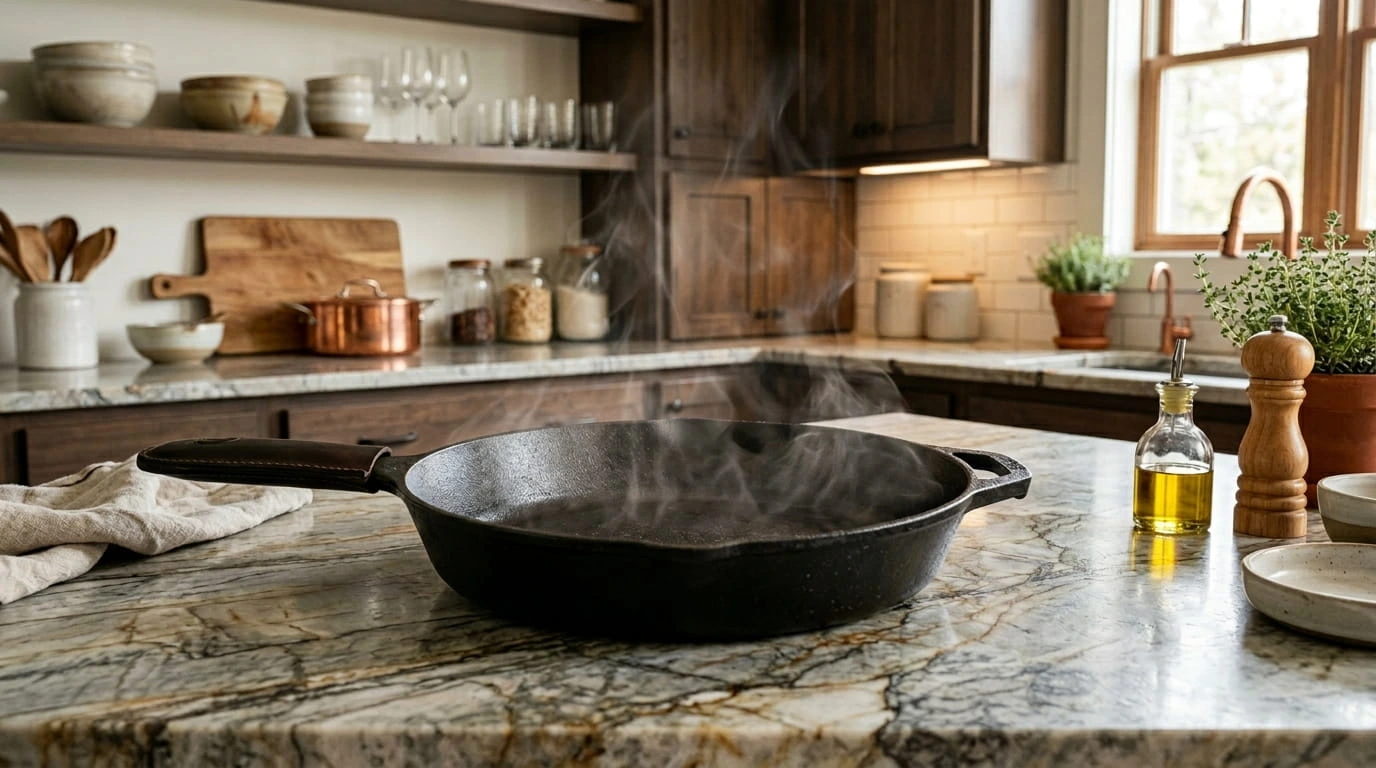
Resistance to heat is one of the biggest advantages that quartzite boasts. Since it was created due to heat in nature, it can withstand extreme heat without being affected. This means that you can place a very hot pot on the quartzite countertop without causing any harm. Quartz does not offer such resistance.
The natural quartz crystals themselves won’t burn, but the resin binders used in engineered quartz can start melting around 300°F. Place a red-hot pot or baking sheet directly on the surface and you risk a permanent burn mark. In daily use this usually isn’t a problem but you’ll want trivets or hot pads nearby. For anyone near fireplaces or high-heat areas, natural quartzite is absolutely the better choice.
On stain and moisture resistance, the tables turn. Quartz has a clear advantage because of its non-porous surface it simply won’t absorb liquids, making it naturally stain resistant and genuinely easy to clean. You don’t need to think about sealing it. Wine, oil, coffee wipe them away and move on. Quartzite is a porous material. Without sealant, it would soak up liquids with ease, and even sealant that has simply worn thin won’t resist liquids like wine or tomato sauce if you leave spills uncleaned for too long. Sealing quartzite is not complicated you pour the sealer on, let it soak, and wipe it off but it needs doing, typically 1-2 times a year. Some dense varieties like Taj Mahal and Cristallo are much more forgiving and may rarely need sealing at all, but you should test: if water darkens the surface or changes color when it sits, it’s time to reseal. A simple stone-safe cleaner and a pH-neutral cleaner are all you need day to day just avoid abrasive cleaners or anything acidic that could compromise the finish.
Appearance, Color, and the Look You Actually Want
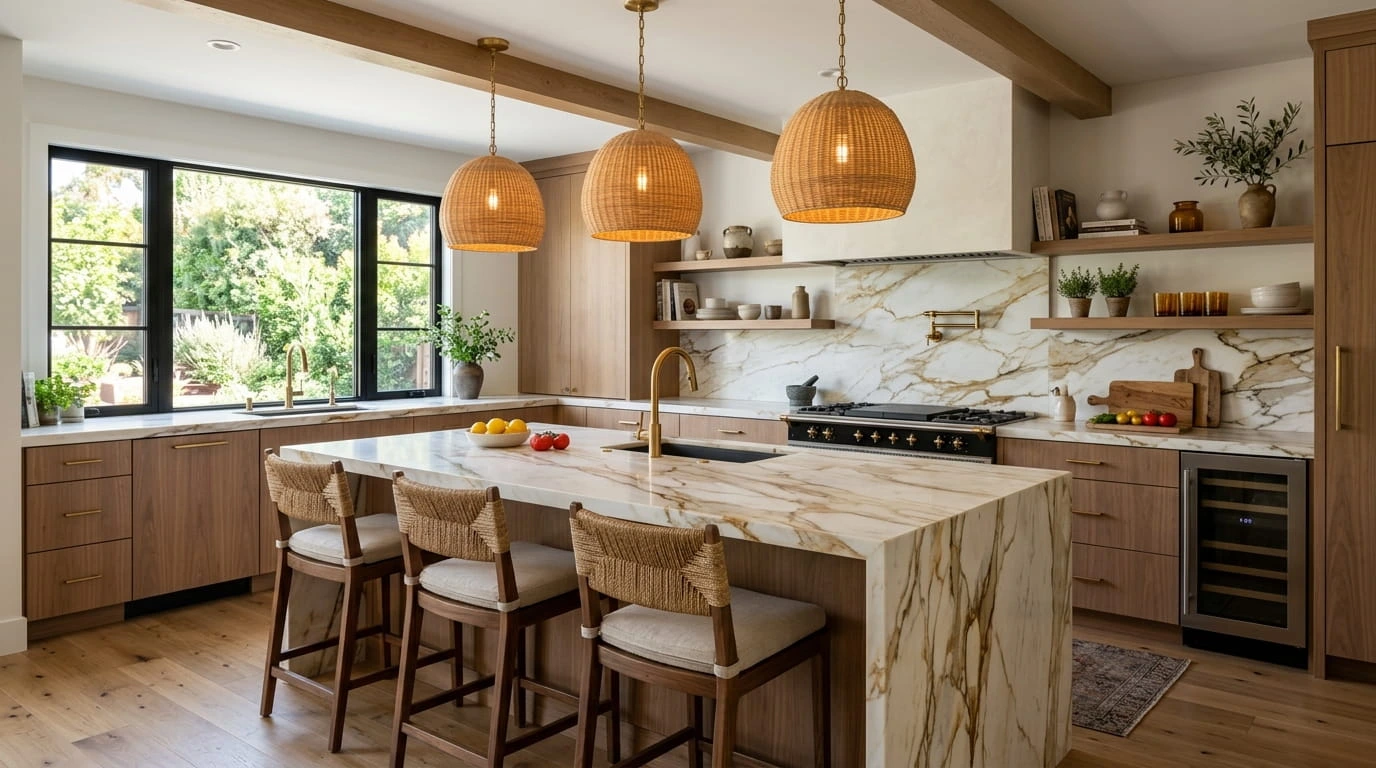
This is where personal preference should kick in, and rightly so. For one, quartzite countertops have a certain unique beauty that is difficult to emulate in any other stone countertop material. First off, homeowners are fond of how quartzite looks as if it is made of marble while being just as durable as granite. It comes with veins, color variations, as well as lightness, making it appear airy inside the kitchen space.
Colors may vary depending on the mineral composition of the stone slab, but they may come in either white, gray, or even beige, gold, blue, or pinkish hues. All in all, the material tends to have a more marbly finish than a granitic one because of its more vibrant appearance with some shine resembling that of marble stones. However, unlike marble, true quartzite will never etch because of acidic materials like lemons and vinegar.
I should mention one important exception from experience. Fantasy Brown one of the most beautiful and popular stones I’ve worked with over the years is frequently mislabeled as quartzite in showrooms. Dolomitic marble is what it is called. It is stronger than regular Carrara marble from Italy and less likely to scratch, but it does not have the super-strong composition of quartzite. It has calcium carbonate in it, so it will etch if you put a lemon slice or vinegar on it for too long. If you love Fantasy Brown, go for it the value-per-square-foot is extraordinary but know what you’re getting and treat it accordingly.
Quartz, in terms of appearance, offers something entirely different: endless design possibilities. In production, pigments may be added for almost any color – pure white, pure black, dark blue, brown, or even red. They are much more consistent in terms of coloration, pattern, and veining.
Multiple slabs can be installed with clean seams in larger kitchens and bathrooms – which can be difficult with natural stone because each piece of stone has its own unique characteristics. Some quartz countertop brands have been designed to look similar to other natural stone varieties such as marble or granite. Some lower-priced brands may develop a yellowish hue over time and become easier to damage.
Cost, Fabrication, and What You’re Really Paying For
Both of these have quite variable pricing, and the simple truth is that it depends upon the particular slab, the manufacturer, the color, and the difficulty of the job itself. The cost of quartz typically begins at about $50 per square foot installed, but the price may go as high as $150 per square foot, depending upon the brand and the type of quartz being used. The pricing for quartzite countertops begins where regular quartz leaves off, usually between $80 and $150 or more per square foot installed, especially with blues and reds.
Taj Mahal and Cristallo are among the most sought-after and priced accordingly.
What many people overlook is fabrication. Quartzite requires skilled cutting and finishing the wrong approach leads to waste or breakage, which drives up the cost per square foot dramatically. It takes the right tools, including CNC machines and water jet cutting, along with genuine experience to handle the details properly.
Quartz, because it’s man-made and more uniform, can be molded to suit virtually any application or design imaginable including complex shapes like waterfall countertops which reduces costs significantly and makes it a more flexible material for keeping up with countertop trends. For budget planning, always calculate your estimated square foot needs before you commit to either material.
Finish Options and Where Each Material Shines
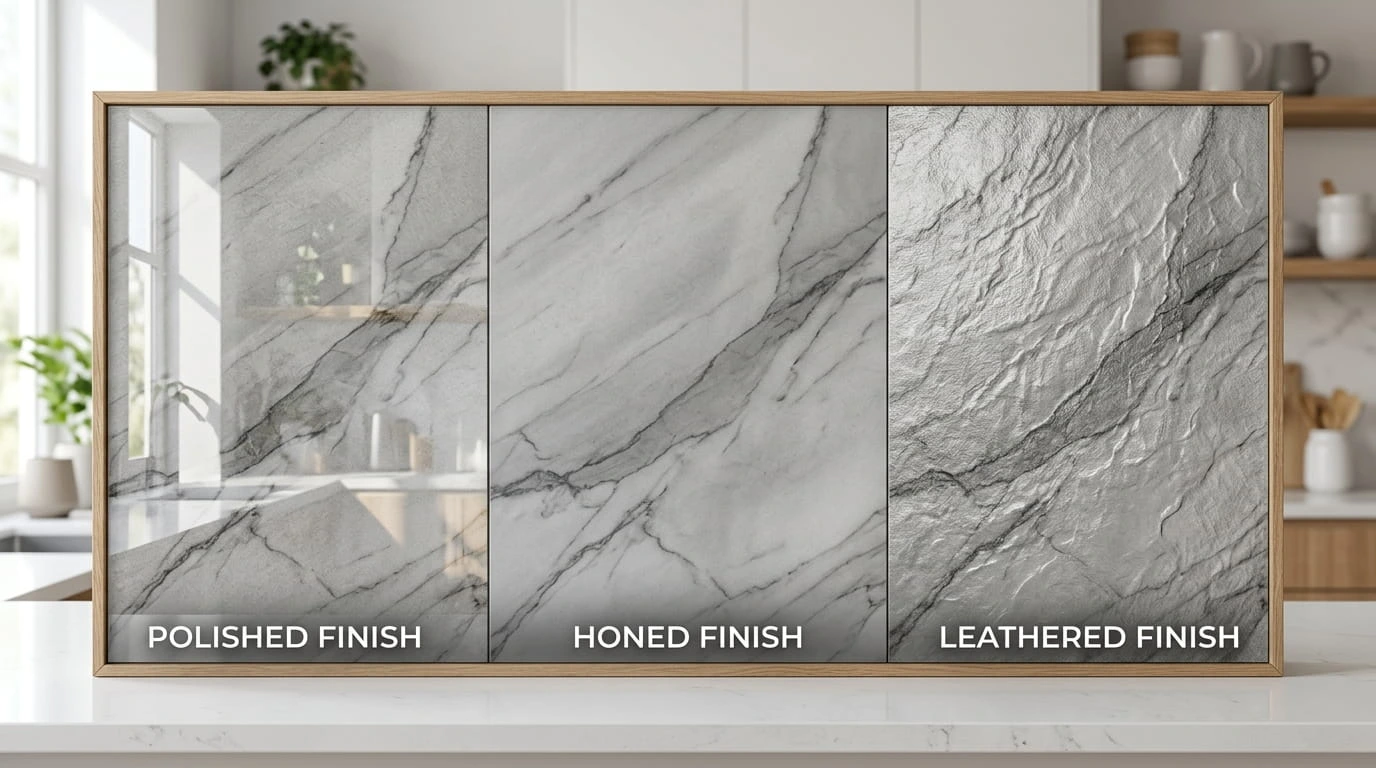
Quartz and quartzite also have many other finishes besides the polished surface. The honed finish comes out with a smooth and flat surface which does not reflect and has a very natural look. It is a good choice for those clients seeking for a more sophisticated style of finish. Leather finish makes the stone resistant to fingerprints and smudges. Leather finish adds an interesting texture for the kitchen countertop. If we consider natural stones, like quartzite, it should be noted that the honing and leathering process can be done in house. However, it will never be possible to polish back the stone since special equipment will be needed, and it cannot be obtained in close proximity.
When it comes to considering the application of these stones in different areas, quartzite is suitable for kitchen islands which serve as eye-catchers, countertops, waterfall edges, and outdoor kitchen countertops. It should be mentioned that the place where quartzite will feel at ease is the fireplace surround, due to its ability to withstand high temperatures and create visual interest. Speaking about quartz, it is ideal for those locations which experience heavy traffic, like kitchens and bathrooms. Such surfaces require low maintenance, non-porous and highly stain-resistant finish. Quartz cannot be used outdoors.
The Real Decision
It’s not a question of one material being better than the other. It’s a matter of which material is going to suit your lifestyle, your home, and your needs. If all you’re after is an easy-to-clean, uniform product that doesn’t mind a little heat, then quartz is a reasonable and dependable option. But if you are looking for something truly unique – something dramatic, luxurious, strong, and durable that doesn’t break a sweat when it comes to heat – then quartzite is worth every penny. Speak with a counter professional, get up close and personal with some samples, and let the stone do its thing. Pictures never tell the whole story.
Conclusion
The decision on quartz vs quartzite ultimately rests on a single, straightforward inquiry – what do you actually do in your kitchen? Both are beautiful stones, both are hard and resistant, and both will make your space something special that less expensive material cannot match. However, they are not the same, and the difference lies in the way they work and the people who enjoy them. For those who prioritize easy cleaning, uniformity, and reliable performance, quartz is an unbeatable material. For those who prefer authentic craftsmanship and uniqueness, a product made from a genuine stone with veins impossible to achieve in factories, along with natural heat resistance and a price tag to match, quartzite is the perfect choice. Neither option is wrong. The correct answer depends solely on your preferences and needs.
Frequently Asked Questions (FAQ’s)
Quartzite is a natural metamorphic stone formed from quartz-rich sandstone under intense heat and pressure. Quartz is an engineered surface made from quartz crystals combined with resins and pigments, which gives it a more uniform and predictable appearance.
Both materials are durable, but quartzite is generally harder and better suited to heavy wear and high-heat areas. Quartz has some flexibility from its resin content, which can help it resist edge chipping during normal kitchen use.
Quartz is easier to maintain because its non-porous surface does not require sealing and resists everyday stains well. Quartzite is porous and typically needs periodic sealing to protect it from liquids and staining.
Yes. Quartzite handles high temperatures better because it is natural stone formed under intense geological heat, while the resin in engineered quartz can be damaged by very hot cookware. Trivets or hot pads are therefore advisable on quartz countertops.
Quartz is usually the more budget-friendly choice, starting around $50 per square foot installed in the article, while quartzite commonly starts around $80 per square foot and can rise considerably for premium slabs. Quartz is better suited to buyers prioritizing easy maintenance and consistency, while quartzite can justify its higher price for those who value natural variation, heat resistance, and a distinctive stone appearance.

8 thoughts on “Quartz vs Quartzite: Which Countertop Is Actually Worth Your Money?”